

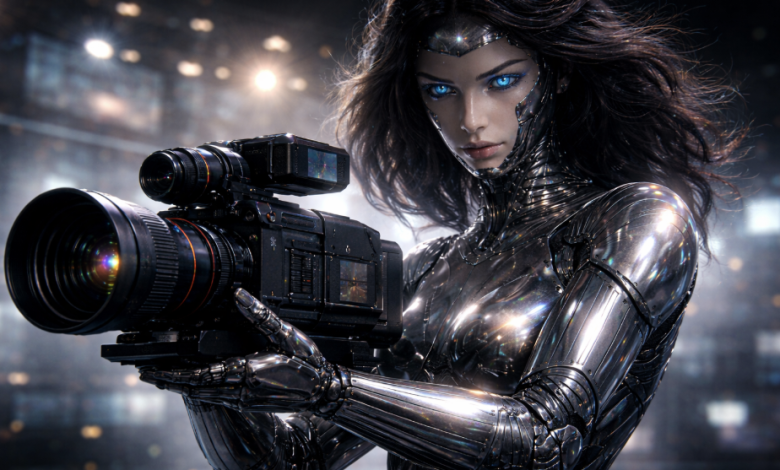
The shift no one in cinema can ignore
For decades, filmmaking has been defined by access.
Access to equipment, to budgets, to teams, to distribution. The barrier to entry was high, and that barrier shaped who could create, and what stories were told.
That structure is now being quietly dismantled.
Generative AI is lowering the technical threshold required to produce visual content at a pace and scale that was previously unthinkable. Tools that once required entire crews can now be operated by individuals. Scenes can be generated, edited, and iterated in minutes rather than days.
As these tools become more accessible, a new question emerges:
If execution becomes easier, what actually differentiates creators?
When technique fades, ideas take center stage
In a world where anyone can generate images, animate sequences, or simulate cinematic effects, technical skill becomes less of a gatekeeper.
What remains is the idea.
Creativity, direction, narrative instinct, and taste begin to matter more than the ability to operate complex equipment. The role of the filmmaker shifts from executing every step of production to orchestrating it.
This does not eliminate craft. It transforms it.
Filmmaking becomes less about controlling every frame manually, and more about guiding systems, curating outputs, and making creative decisions within a new kind of workflow.
For some, this represents a loss of authenticity. For others, it is a redistribution of creative power.
Threat or opportunity: a familiar debate
The conversation around AI in cinema tends to polarize quickly.
On one side, there is concern that automation will dilute artistic value, replace human labor, and flood the industry with low-quality content. The fear is not just technological, but cultural. If anyone can create anything, does creation itself lose meaning?
On the other side, there is a sense of expansion.
Independent filmmakers, who have historically faced financial and logistical constraints, now have access to tools that allow them to produce ambitious work without traditional infrastructure. Entire visual worlds can be explored without the need for physical sets or large crews.
From this perspective, AI does not replace cinema. It broadens it.
What seems increasingly clear is that AI will not leave the industry unchanged. The only uncertainty is the shape that change will take.
From tool to collaborator
One of the most significant shifts is conceptual.
Artificial intelligence is no longer just assisting filmmakers. It is beginning to participate in the creative process.
Systems can now generate visual styles, suggest narrative structures, and produce sequences that would traditionally require multiple specialists. In some cases, the output is not simply executed, but interpreted and refined by the creator.
This introduces a new dynamic.
Creation becomes a dialogue between human intent and machine generation. The filmmaker sets direction, constraints, and vision, while the system explores variations and possibilities within that framework.
This raises deeper questions about authorship.
If a system contributes to the aesthetic or narrative of a piece, where does authorship begin and end? And does that distinction still matter in the same way?
A real-world signal: the AI Film Festival in Monaco
These questions are not theoretical.
They are beginning to take shape in dedicated spaces where experimentation is encouraged and observed in real time. One example is the AI Film Festival in Monaco, taking place on June 9–10, 2026 at One Monte-Carlo .
Positioned immediately after the Monaco Grand Prix, the event brings together filmmakers, AI creators, researchers, and industry professionals to explore how artificial intelligence is influencing storytelling and production .
Rather than focusing purely on technology, the festival places emphasis on the intersection between cinema and AI. Screenings, discussions, and artistic showcases aim to examine how these tools are being integrated into creative workflows, and how they reshape the role of the creator.
This framing is important.
It suggests that AI in film is not just a technical development, but a cultural shift.
The rise of AI-native creation
One of the emerging phenomena is the appearance of what could be described as “AI-native” creators.
These are filmmakers who are not adapting existing workflows to include AI, but are building their entire creative process around it. Their approach is not constrained by traditional production logic.
Instead of writing scripts designed for physical execution, they may design prompts, systems, and iterative processes that generate narrative and visual output dynamically.
This does not mean traditional filmmaking disappears.
It means a parallel approach begins to develop, one that operates under different constraints, timelines, and creative possibilities.
Festivals and events dedicated to this space act as early indicators of how these practices evolve.
Experimentation under pressure: the 24-hour creation cycle
One of the formats that illustrates this shift particularly well is the 24-hour AI Film Hackathon, part of the Monaco event .
Participants, including filmmakers, developers, and creative technologists, collaborate to produce a film within a single day using AI tools.
This compressed timeline changes the nature of production.
Instead of long planning cycles and extended shoots, the process becomes rapid, iterative, and exploratory. Ideas are tested quickly, refined in real time, and brought to completion under tight constraints.
This format reflects a broader trend in AI-driven creation: speed becomes a creative parameter.
Recognition in a new creative landscape
The festival concludes with an awards ceremony that recognizes achievements in AI-driven filmmaking, including storytelling, technical innovation, and the integration of AI within cinematic language .
What is being evaluated here is not simply the use of technology, but how effectively it is used to serve a creative vision.
This distinction matters.
As AI tools become more widespread, the novelty of using them will diminish. What will remain relevant is how they are used, and whether they contribute meaningfully to the narrative or aesthetic of a work.
Recognition frameworks like these help define emerging standards in a rapidly evolving field.
Cinema as a shared language
At its core, the rise of AI in filmmaking challenges a long-standing assumption: that artistic creation is an exclusively human domain.
As systems become capable of generating images, narratives, and emotional cues, creation begins to take on a more collaborative dimension. The boundaries between human imagination and machine output become less distinct.
Some see this as a loss.
Others see it as an evolution.
The idea that cinema could become a shared language between humans and intelligent systems is no longer abstract. It is being explored in practice, through projects, tools, and events that bring these questions into the open.
What comes next
It is unlikely that AI will replace traditional filmmaking.
More realistically, it will coexist with it, influence it, and gradually reshape parts of it.
Certain roles may evolve. New ones will emerge. Production timelines may compress, while creative possibilities expand.
The industry has undergone transformations before, from the transition to sound, to digital production, to streaming platforms.
Each time, the medium adapted.
AI may represent a similar inflection point.
A shift already underway
The most important takeaway is not whether AI will transform cinema.
It already is.
The tools are improving. Access is expanding. Creators are experimenting. New formats are emerging.
Events like the AI Film Festival in Monaco do not create this shift, but they make it visible. They bring together the different actors involved, and offer a glimpse into how the industry might evolve.
The question is no longer if change is coming.
It is how creators choose to engage with it.
https://aifilmfest-monaco.com/
Mini bio :
Victor Tamer is a French author and PR professional working at the intersection of technology, media, and culture. He has contributed to international publications and led global campaigns across the tech industry. His work explores how emerging technologies are reshaping industries, from finance to the creative sector. He is also the founder of Omicron Artvertising, a U.S.-based marketing and communications agency.