Enterprise software may be entering one of its biggest shifts in decades.
For more than twenty years the dominant model was simple. If a company needed a new capability it bought software. Finance teams used accounting systems, sales teams adopted CRM platforms and HR departments relied on workforce tools. Most of these solutions arrived as SaaS or other off the shelf enterprise software. The promise was convenient. Instead of building internal systems organizations could subscribe to packaged tools and start operating quickly.
That model worked extremely well. It reduced infrastructure complexity and helped companies digitize faster than ever before. Yet as businesses became more digital many leaders began noticing a different challenge. The real work inside organizations rarely fits perfectly inside packaged applications. Processes move across systems, people and data sources. Increasingly the question is not which application should run the process, but how the process should run across many systems. AI agents are starting to change how companies answer that question.
When Applications Do Not Fit the Workflow
Traditional SaaS software is built to serve thousands of organizations at once. That scale is powerful, but it also creates limitations. Every business operates slightly differently. A manufacturing company may tie production planning to machine telemetry and supplier schedules. A healthcare organization may align systems with regulatory workflows. A logistics firm might combine routing data, fuel prices and real time weather conditions when making daily decisions.
Because packaged software cannot anticipate every scenario, teams often create workarounds. Data moves into spreadsheets, approvals happen in messaging tools and reports are assembled manually from several systems. Work flows between applications even though those applications were meant to centralize it. AI agents offer another path. Instead of forcing the workflow to adapt to the software, agents allow the software to adapt to the workflow by coordinating tasks across systems.
From Application Driven to Workflow Driven Design
For years enterprise technology decisions focused on selecting the right platform. Teams compared vendors, evaluated features and tried to standardize on systems that handled entire processes. This approach assumes that the application itself defines how the workflow operates.
AI agents introduce a different model. Instead of relying on a single application to manage an entire process, organizations can define the goal and allow agents to coordinate the steps. The agent gathers information from systems, checks policies, routes approvals and updates records. A procurement request is a simple example. An employee submits a request, a manager reviews it, finance verifies the budget and an order is created. In a traditional environment this might require a dedicated procurement application. With agents the same workflow can move across collaboration tools, financial systems and supplier APIs while the coordination happens through an intelligent layer that understands the process.
The Rise of Multi Agent Systems
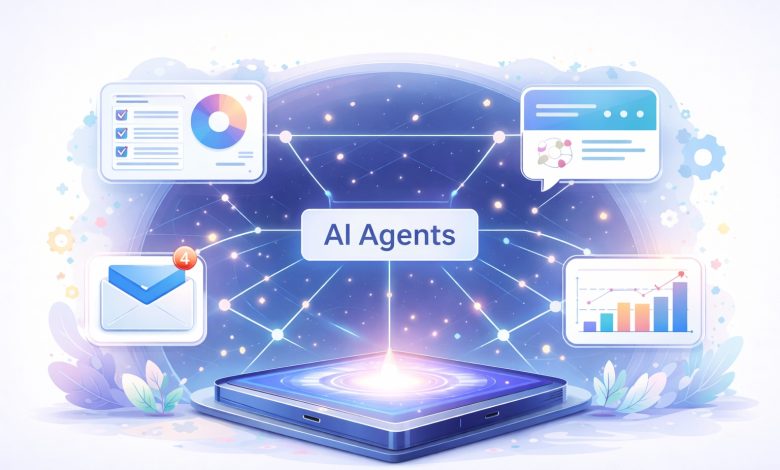
As organizations experiment with these systems, another pattern is emerging. Instead of relying on a single agent, many teams are building groups of specialized agents that collaborate with each other. One agent might collect operational data, another may analyze the information and another may trigger actions inside connected systems.
This approach mirrors how real teams operate. Different people contribute different expertise while coordination ensures the work progresses toward a shared outcome. Orchestration layers manage that coordination for agents. They track progress, control execution order and handle failures or retries. When agents and orchestration work together the result is automation that is more adaptable than traditional workflow tools.
MCP and Structured Tool Access
A major reason this model is becoming practical is the emergence of structured tool access frameworks such as MCP servers. Agents need reliable ways to interact with databases, APIs and enterprise systems. MCP provides a standardized method to expose these tools so agents can use them safely.
Instead of building a custom integration for every application, organizations can expose capabilities through a consistent interface. An agent might retrieve data from a database, search internal documentation and trigger actions through APIs using the same tool layer. The agent focuses on reasoning about the task while the MCP layer manages connectivity and access behind the scenes. This reduces development complexity and allows companies to expand automation gradually as new tools are added.
Toward Agent Native Enterprise Architecture
These developments point toward a broader idea that some architects describe as agent native enterprise architecture. In traditional enterprise design applications sit at the center. Employees log into systems and complete tasks inside those environments, moving from one interface to another as work progresses.
In an agent native model the center shifts. Users describe what they want to accomplish and agents coordinate the work across APIs, databases and enterprise tools. The applications still exist, but they increasingly function as capability providers. They store data, expose services and perform specialized operations while the workflow logic lives in the agent layer. Enterprise architecture begins to focus less on which application controls a process and more on how agents orchestrate systems together.
The Evolving Role of SaaS and Packaged Software
None of this means SaaS software disappears. Communication platforms, identity systems, analytics tools and financial services remain essential building blocks of modern technology stacks. What changes is how these systems participate in workflows.
Instead of being the place where every task happens, many applications become services that agents call when needed. The interface remains valuable, but it is no longer the only way work gets done. APIs become central, orchestration layers coordinate tasks and the agent layer becomes the place where workflows are assembled. In that environment the real value shifts toward how processes are designed rather than which individual tool is purchased.
What This Means for Technology Leaders
For CIOs, CAIOs and enterprise architects the shift is not about replacing software. It is about rethinking where coordination happens inside the technology stack. For many years digital transformation meant adopting more applications. The next phase may focus on orchestrating the systems organizations already operate.
Companies that combine AI agents, orchestration layers and existing enterprise tools may find they can adapt workflows faster and respond to change more easily. Enterprise software is not disappearing. It is being reorganized around a new coordination layer. As that shift continues the agent layer may become one of the most important components of enterprise architecture.