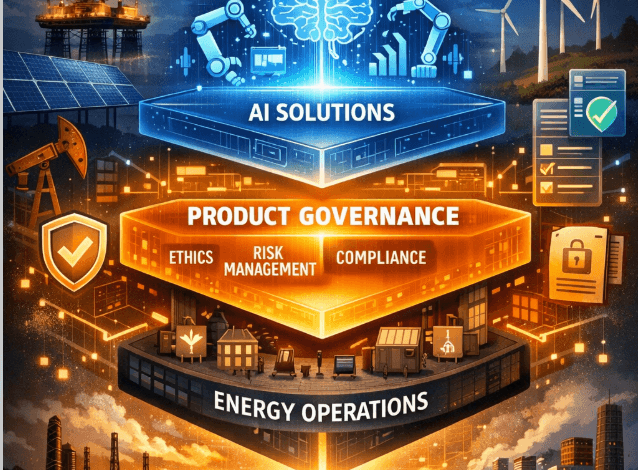
Artificial intelligence is increasingly embedded in energy systems, supporting functions such as load forecasting, asset monitoring, outage prediction, and customer engagement. As these systems move from pilots to enterprise platforms, energy organizations face a new challenge: scaling AI responsibly while maintaining reliability, trust, and regulatory alignment.
Many AI initiatives demonstrate technical success but struggle to deliver sustained operational impact. Models perform well in isolation, yet adoption remains uneven and outcomes inconsistent. The missing layer is not additional data or more complex algorithms—it is product governance.
The Unique Risk Profile of Energy AI
Energy systems operate under strict safety, reliability, and regulatory constraints. Unlike consumer technology, failures in energy AI can have cascading operational and societal consequences. As AI systems scale, they intersect with grid operations, field services, compliance reporting, and customer communications.
This interconnectedness amplifies risk when ownership and accountability are unclear. Responsible scaling therefore requires governance that extends beyond technical validation into product decision-making.
Why Technical Governance Is Not Enough
Most energy organizations rely on technical governance mechanisms such as model validation, cybersecurity controls, and data quality checks. While necessary, these mechanisms focus on whether systems function correctly, not whether they deliver the right outcomes.
Product governance addresses this gap by defining who owns each AI-enabled capability, how success is measured, and when systems should evolve or be retired. Without this layer, AI solutions proliferate without strategic alignment.
As Kiran Kalyanaraman observes, “Energy AI often fails at scale not because models are inaccurate, but because no one owns how predictions translate into decisions.”
Governing AI Around Decisions, Not Models
A critical governance shift is reframing AI initiatives around decisions rather than predictions. Predicting asset failure has limited value unless it changes maintenance planning, capital allocation, or operational response.
Product governance clarifies how AI insights integrate into workflows and who is accountable for acting on them. This decision-centered approach improves adoption and reduces resistance from operators who must rely on AI outputs in safety-critical environments.
Trust and Explainability as Product Requirements
Trust is a prerequisite for AI adoption in energy operations. Operators must understand when to rely on AI recommendations and when to override them. Product governance ensures explainability and usability are treated as core requirements, not optional features.
Explainability does not require exposing algorithmic complexity. It requires contextual information that supports operational judgment, consistent with emerging guidance on trustworthy AI from institutions such as the U.S. National Institute of Standards and Technology (https://www.nist.gov/ai).
According to Kalyanaraman, “In energy systems, trust and explainability matter more than raw accuracy because decisions carry operational and regulatory consequences.”
Managing Cost and Complexity at Scale
Scaling AI introduces new cost dynamics. Energy platforms ingest high-volume data from meters, sensors, and field systems, often in near real time. Without governance, storage, processing, and maintenance costs can grow faster than operational benefits.
Product governance introduces prioritization by clarifying which use cases justify real-time analytics, which can rely on batch processing, and which should be retired. This discipline helps prevent AI platforms from becoming sources of technical debt.
Regulatory Alignment Through Product Strategy
Regulatory compliance is often treated as a downstream constraint, but in energy AI it must be embedded into product strategy from the outset. Product governance ensures that AI systems align with auditability, reporting requirements, and evolving regulatory expectations.
This alignment reduces deployment friction and improves an organization’s ability to explain automated decisions to regulators and stakeholders.
Platform Thinking Over Point Solutions
Responsible AI scaling favors integrated platforms over isolated solutions. Platforms that unify data ingestion, analytics, governance, and user experience reduce fragmentation and improve consistency across operations.
Product governance provides the structure required to manage these platforms effectively, ensuring enhancements benefit the enterprise rather than individual teams. This approach aligns with broader enterprise AI research highlighted by institutions such as MIT Sloan (https://sloanreview.mit.edu).
Measuring Responsible AI Outcomes
The success of AI governance should be measured by outcomes, not activity. Responsible scaling leads to higher adoption, controlled costs, clearer accountability, and fewer conflicting insights.
Product governance enables energy organizations to align AI initiatives with operational metrics such as reliability, maintenance efficiency, and customer satisfaction. Over time, this alignment builds confidence in AI as a core operational capability.
Conclusion
As energy systems become more data-driven and decentralized, AI will play an increasingly central role. The organizations that succeed will not be those deploying the most models, but those governing them with clarity and discipline.
Product governance is the missing layer that enables AI to scale responsibly in energy. By focusing on decisions, trust, cost, and accountability, energy providers can ensure AI strengthens infrastructure rather than complicating it.