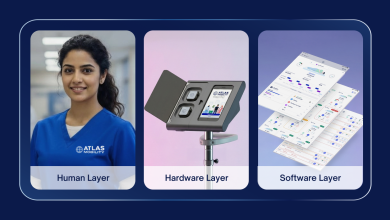
Leadership teams in UK universities, from Vice Chancellors through to frontline student admissions staff, are facing rising student expectations and operational strain. The majority of students entering higher education are digital natives and expect fast, consistent and personalised support across digital channels, putting professional services teams under huge pressure to meet this demand with limited capacity – particularly during peak times of the academic calendar, such as admissions and enrolment.
AI-powered student support systems are often presented as the answer to ease some of the pressure during these peak times. In practice, however, many higher education institutions are being held back by fragmented, rule-based chatbots and small proof-of-concept deployments that struggle to move beyond individual departments or basic FAQs. Rather than transforming the student experience, these tools introduce new complexities and additional handoffs for already over-stretched professional service teams.
The real opportunity for UK universities to ease this pressure lies in the implementation of specialised AI agents.
Highly customisable AI agents can orchestrate workflows across existing campus systems, empowering universities to deliver end-to-end student journeys that are consistent, policy-accurate and available 24/7. When such agents are designed with governance and integration in mind, they have the ability to reduce administrative burden across the institution while improving the quality and reliability of student support.
Human expertise delivers the greatest value
Traditional, rule-based chatbots are designed to answer simple questions within narrow boundaries. They rely on predefined flows and static content and struggle when a conversation requires context, a judgement or action to be taken across multiple systems.
This limitation is especially visible in higher education, where even a seemingly simple query about enrolment, financial aid or course registration often requires an understanding that spans multiple departments, policies and financial systems.
AI agents change this dynamic. Rather than respond with isolated answers, conversational AI agents orchestrate workflows across admissions platforms, student information systems, finance tools and service desks. They can maintain context across channels, apply approved academic and institutional rules and complete multi-step processes rather than handing students off at the first point of complexity.
For students, this means fewer dead ends and less repetition. For staff, it means fewer interruptions and far less manual triage, which reduces handoffs, shortens resolution times and improves service consistency across the institution.
Importantly, this change of dynamic is not about replacing academic judgement or human support. It is about handling high-volume, repetitive interactions so that institutional capacity is protected and valuable staff time can be redirected towards more complex, sensitive or high-impact cases where their human expertise will deliver the greatest value and support a stronger student experience.
Always-on support that works at campus scale
Student demand does not align neatly with office hours, particularly during admissions cycles or around key deadlines, and this is where using AI agents offers one of the most immediate benefits.
Call centres and service desks are often understaffed and under strain, with peaks that are difficult and expensive to cover simply by increasing the headcount. “Always-on” AI agents provide a way to absorb this demand without increasing the pressure on existing teams.
By resolving common enquiries autonomously and escalating to a member of the student support team only when necessary, university student support teams can stabilise service levels – even during peak times.
By using AI agents, universities can maintain consistent, policy-accurate support at scale and protect existing teams from burning out. Crucially, this student experience of dealing with the university is improved, giving prospective and current students timely, consistent guidance when they need it, rather than days later once the queues clear.
Over time, this responsiveness can be linked to having a measurable impact on enquiry-to-enrol conversion, which helps to reduce student drop-off between acceptance and enrolment, and improve first-year retention.
Proving the concept of using AI agents in higher education
When looking to deploy an AI platform, IT leaders can often find themselves drawn into a crowded and competitive landscape of no-code, low-code and enterprise platforms. While these tools promise flexibility, they typically require significant configuration, integration and governance effort before any meaningful value is delivered and realised.
Instead of decreasing complexity, this actually increases it. It can slow down progress and significantly increase the risk that digital transformation projects stall before they even begin to deliver any tangible outcomes.
A more effective approach is to start with a clearly defined, high-impact student journey and solve it by implementing ready-made, specialised AI Agents. Admissions, enrolment guidance, financial aid and core student services are natural entry points because they combine high demand with high visibility across the institution. Using AI agents to deliver consistent outcomes in these student journeys quickly builds confidence in the technology, demonstrates value to stakeholders and creates the momentum needed to extend AI-powered support more widely.
The same underlying platform, integrations and governance can be extended across departments without the need to introduce new tools or disrupt any existing systems already in place. In practice, by starting small and proving the concept, specialised AI agents begin to deliver value to the university very early on in the deployment phase, drawing on data points already embedded in the existing technology stack.
This ‘land and expand’ model helps to address one of the most overlooked challenges in the adoption of AI technology in higher education – doing nothing.
A large proportion of AI-powered digital transformation projects stall not because a better alternative exists, but because the perceived risk outweighs immediate benefit. By focusing on fast time-to-value and measurable outcomes from the very beginning, AI agents reduce the barriers to wider adoption that can hold university leaders back from deciding to act.
Reducing complexity through consolidation
Many universities today operate multiple overlapping tools to support student engagement, with live chat platforms, campaign managers, knowledge bases and departmental bots procured independently over time. While each tool may solve a local problem, the cumulative effect is higher technological debt, fragmented student experiences and longer implementation timelines as new solutions are added.
Consolidating these capabilities into a single, governed conversational AI platform offers clear advantages. From a pricing perspective, it reduces the number of overlapping suppliers, contracts and licences. From a structural perspective, it simplifies integration, support and security. From a student journey perspective, it shortens the time required to launch new journeys because teams are not repeatedly onboarding and stitching together new technologies.
Universities that consolidate multiple student-facing tools into a single AI agent-driven approach see faster rollouts, more consistent governance and a clearer ownership model across IT, admissions and student services. This consolidation is not about replacing core systems, but rather about using AI-agents to orchestrate them more effectively through a single conversational layer.
Governance and trust as foundations
But none of this works without trust. Universities operate in a highly regulated environment where policy accuracy, data protection and accountability are essentia. Therefore, AI agents must be grounded in approved knowledge sources, authenticated access and tightly governed workflows.
When designed correctly, these conversational AI agents strengthen rather than weaken institutional control. Their responses are consistent because they are based on validated content, and their actions are auditable because workflows are clearly defined and constantly monitored. If any updates to policy or process need to be applied, they can be applied centrally and reflected immediately across all connected channels.
This level of governance is particularly important as universities scale AI-powered agents beyond initial test projects. The trust earned in AI agents handling admissions or student services will become the foundation for the wider expansion into operational and employee experience workflows.
A practical path forward
For UK universities coping with staffing constraints and rising student expectations, conversational AI agents offer a practical path forward. The question is not whether to adopt AI, but how to adopt AI in a way that delivers value quickly without increasing risk or complexity.
Universities that succeed will focus on high-impact student journeys, deploy AI agents that integrate with existing campus systems and expand only once trust and results are established.
Always-on, policy-accurate AI agents are becoming a core capability for universities that are being judged not only on their academic reputation, but on how easy it is to engage, enrol and succeed whilst at university.
In this model, the student experience becomes the entry point, governance becomes the foundation, and scale becomes a consequence rather than an objective.