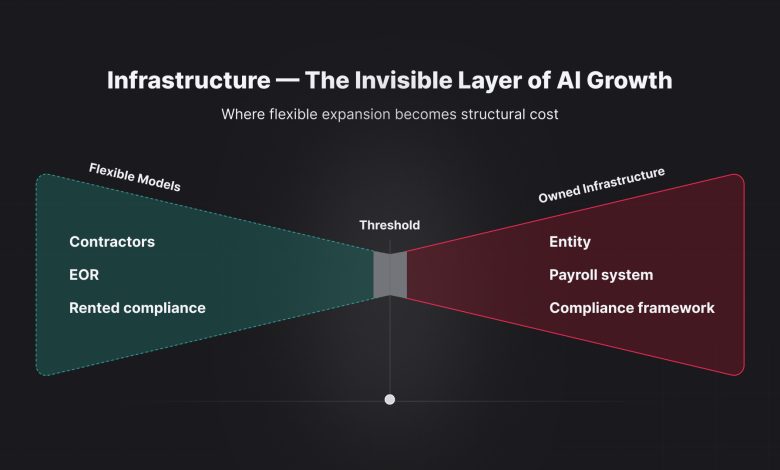
AI startups often grow at high speed. Model development, product launches, and early go-to-market pushes take priority. In scenarios when hiring across borders feels urgent, operational infrastructure, including payroll, compliance, and entity setups, often lags behind.
In simple words, founders scale their technology and headcount quickly, but the operational background isn’t ready to support it. This is a system mismatch problem. Without a durable infrastructure, recurring costs can easily accumulate, friction increases, and market expansion becomes riskier.
Native Teams’ Global Expansion Report highlights this pattern across 3,000+ globally active companies in 19 markets. Early-stage startups routinely treat expansion as tactical by using contractors, flexible payroll, and rented compliance, rather than an infrastructure investment.
For AI founders and operators, speed is a huge differentiator. But infrastructure determines whether that speed is sustainable or not. Understanding global expansion as a systems challenge, rather than a hiring challenge, is the first step towards scaling compliantly and cost-effectively.
What the data shows – hidden infrastructure costs in global growth
The Global Expansion Report provides a clear view of the financial and operational realities behind scaling across borders. Across 19 jurisdictions, the average cost to set up a local entity is roughly €7,300, covering incorporation, legal filings, and bank setups. Annual maintenance adds another €7,700, bringing the total cost of owning an entity around €15,000 per market per year.
The operational complexity is different, depending on the region. Some countries require additional administrative steps that extend timelines and increase cost, while others allow mostly online incorporation, which shifts the economics of infrastructure ownership.
The report also identifies a clear threshold where intermediated models, such as contractors of Employer of Record (EOR) services, start to compete with infrastructure ownership costs. Once a team in a market reaches three to seven employees, recurring costs for these models meet or exceed the annual cost of entity ownership.
These numbers reveal that early expansion decisions are already infrastructure investments. For AI startups that scale quickly, ignoring these thresholds can create friction long before the team recognises the investment.
Systems debt and hidden complexity
Scaling globally without solid infrastructure in place is a lot like accruing technical debt in software – the shortcuts you take early compound over time. In global expansion, things like fragmented payroll, compliance, and entity management create what we call system debt – the hidden cost that accumulates as headcount grows or markets multiply.
The Global Expansion Report highlights the regional differences in this debt. In high-friction countries, such as Germany, Belgium, and Spain (score 4 out of 5), mandatory notarisation, capital deposits, and local bank requirements extend setup timelines and increase ongoing administrative load. AI startups that rely on temporary solutions in these markets often encounter unexpected operational friction.
On the other hand, digital-first economies such as the UK, Ireland, and Estonia (score 1 out of 5) streamline entity setup, enabling teams to consolidate systems and avoid unnecessary overhead.
Contractors, EOR, and rented compliance models can give the illusion of speed and low risk. But without intentional design, this flexibility often masks systemic fragility. Operational shortcuts may seem temporary, yet recurring payroll, tax, and compliance obligations behave structurally and create debt that disrupts operations later.
The two-stage infrastructure maturity model
The Global Expansion Report proposes viewing global growth through a two-stage infrastructure maturity model.
Early-stage expansion relies on flexible market entry through contractors, EOR services, and rented compliance systems. These solutions allow AI startups to test markets, validate demand, and hire quickly without committing to fixed infrastructure. They are fast to deploy and low risk, but they carry recurring costs that accumulate over time.
Stage two begins once scale and market justify investment in owned infrastructure. At this stage, founders should establish their own entities, adopt dedicated payroll systems, and integrate compliance workflows internally. The shift converts recurring operational spend into durable infrastructure that supports multiple markets. According to the report, the shift becomes economically rational once a local team reaches three to seven employees or operations span multiple countries.
This framework mirrors engineering principles in AI development – early shortcuts may accelerate deployment, but without deliberate design, they create systemic friction later. Just as scaling an AI model requires solid data pipelines and modular architecture, scaling a global team requires a structural operational system.
Infrastructure as a competitive advantage
Global expansion exceeds HR and operational spans, and should be treated as a strategic capital allocation decision. Choices about entity ownership, payroll systems, and compliance processes will determine companies’ ability to grow across multiple markets without unexpected surprises along the way.
AI organisations should learn their lesson – just as a robust ML infrastructure ensures models run reliably at scale, a strong operational infrastructure ensures global teams operate efficiently, with costs under control and risks mitigated.
Companies that treat global expansion as core infrastructure rather than a temporary or tactical fix gain a durable competitive advantage. They can either enter new markets without issues, scale way faster without compliance surprises, and maintain solid operations as they expand across countries.
AI founders should build systems that scale first, with talent, compliance, and legal following. Viewed this way, infrastructure becomes a competitive advantage instead of a persistent cost centre.