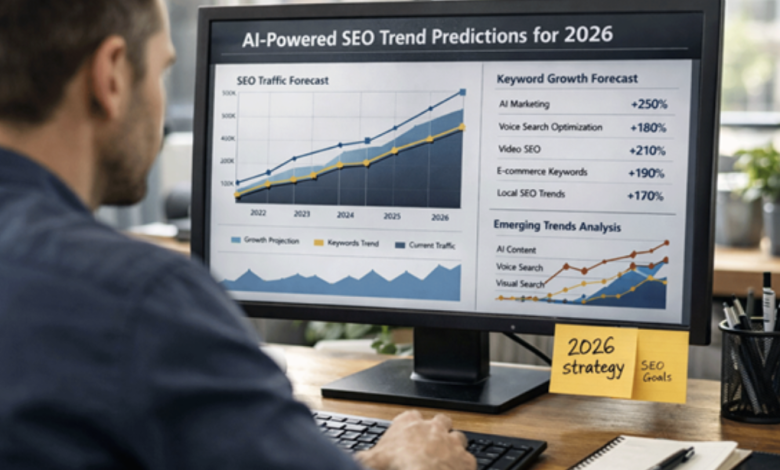
Search is changing and not in a subtle way.
For years, SEO has mostly been reactive. You publish content, build links, track rankings, and adjust when something drops. If traffic dips, you investigate. If a competitor outranks you, you respond.
That cycle has defined SEO for a long time.
AI is shifting that dynamic. Instead of just influencing how results are ranked, it’s now shaping how answers are delivered. People aren’t only clicking links anymore — they’re asking AI tools to summarize, compare, and recommend.
That changes what “visibility” even means.
In 2026, success won’t come from chasing rankings alone. It will come from anticipating where search behavior is going and making sure your brand is positioned before the shift happens.
SEO Is Moving From Reactive to Predictive
Most SEO teams still operate by looking backward. We analyze what happened last month, last quarter, or after an algorithm update. By the time we act, the change has already impacted performance.
AI introduces something different: pattern recognition at scale.
Modern tools can scan search behavior, content trends, engagement signals, and brand mentions across the web. They can spot early signs of new topic clusters forming or specific intent becoming more defined. That gives teams a chance to act before everyone else piles in.
And in competitive markets, timing matters. Being early in a growing niche is far easier than trying to compete once it’s saturated.
Search Intent Is Getting More Specific
Search queries aren’t as broad as they used to be. AI systems are better at understanding context, which means users are getting more precise with what they ask.
A simple query like “best HR software” doesn’t stay simple for long. It turns into “best HR software for remote teams” or “best HR software for startups managing global payroll.” These smaller intent pockets usually show up quietly at first in forums, refined searches, or long-tail variations.
If you’re paying attention, you can see them forming.
In 2026, this kind of micro-intent targeting will matter more than broad keyword coverage. The brands that win won’t be the ones trying to rank for everything. They’ll be the ones clearly speaking to a specific audience with a specific need.
Content Will Keep Growing — But Authority Will Matter More
There’s no denying that AI is accelerating content production. Publishing is faster and cheaper than ever. But more content doesn’t mean more visibility.
If anything, it makes clarity and focus more important.
AI systems don’t just look at whether you’ve written about a topic. They look at how consistently you’re associated with it. Do other sources mention you in that context? Do you show depth, or just surface-level coverage?
By 2026, publishing broadly without a clear niche will be less effective. Focused authority repeatedly demonstrating expertise in a defined area will carry more weight than sheer volume.
Rankings Will Feel Less Stable
Ranking shifts are already happening faster, and that trend will likely continue.
Search engines and AI systems consider more than backlinks and on-page keywords. They look at how your brand connects to topics, how often you’re cited, and how consistent your messaging is across platforms.
That means visibility can change even if you haven’t touched a page.
The difference going forward is that teams can’t afford to wait for traffic drops to signal a problem. Monitoring early indicators, declining mentions, and competitors gaining traction in adjacent topics will be essential. The goal is to reinforce authority before the dip shows up in analytics.
AI Discovery Changes the Definition of “Ranking”
One of the biggest shifts heading into 2026 is how people discover brands.
More users are asking AI assistants to recommend tools, summarize options, or explain differences. In those cases, traditional rankings don’t always determine who gets mentioned.
You could rank well in search and still not appear in an AI-generated answer.
AI systems pull from multiple sources. They evaluate how clearly your brand is defined, how structured your information is, and how consistently you appear across the broader ecosystem.
Understanding how these systems evaluate and select sources becomes critical, especially when examining how LLMs choose content for AI-generated answers. If your messaging is fragmented or unclear, your chances of being recommended decrease.
This is why AI visibility is becoming its own metric, and why brands are starting to measure their presence in AI-generated content alongside traditional rankings. Learning how to track your visibility in AI responses is becoming an important part of modern SEO strategy.
Competitive Analysis Is Expanding
Competitive SEO used to mean comparing backlinks and keyword overlap. That’s still relevant, but it’s no longer enough.
AI tools can now analyze broader patterns like when a competitor starts being mentioned more often in industry discussions, or when they’re gaining authority around a new topic cluster.
This allows brands to reposition early instead of reacting after losing ground.
For founders and marketing leaders, this means SEO strategy has to extend beyond optimizing individual pages. It requires watching how the entire ecosystem evolves — and where your brand sits within it.
What 2026 Will Likely Look Like
A few themes are becoming clear:
- Brands will be treated more like entities than websites. Clear positioning and structured information will matter.
- Micro-intent targeting will outperform broad keyword strategies.
- AI recommendation visibility will become a standard KPI.
- Authority will depend on ecosystem consistency, not just backlinks.
- Technical SEO will remain foundational, especially structured data and crawlability.
None of this replaces traditional SEO. It adds another layer to it.
Preparing Now
The brands that adapt early will have an advantage.
That means getting specific about who you serve and what problems you solve. It requires cleaning up structured data and reviewing how your brand is described across your website, social channels, and third-party listings. It also means monitoring AI visibility alongside rankings and traffic.
Most importantly, it means shifting your mindset.
SEO is no longer just about reacting to performance changes. It’s about anticipating them.
Final Thought
In 2026, success in SEO won’t depend only on where you rank. It will depend on whether AI systems understand your brand, trust it, and feel confident recommending it. The companies that treat AI as part of their visibility strategy, not just a background algorithm, will be the ones leading the next phase of search.
That means thinking beyond keywords and traffic reports. It means building a brand that’s clear, consistent, and credible wherever it shows up online. The earlier you adapt to that mindset, the easier it will be to stay visible as search continues to evolve.
FAQs
- How is AI helping predict SEO trends?
AI analyzes large volumes of search behavior, content performance, and ecosystem signals to identify emerging patterns. This allows marketers to spot rising topics, intent shifts, and competitive movements earlier than traditional reporting methods.
- Will traditional keyword research still matter in 2026?
Yes, but it will evolve. Broad keyword targeting will become less effective than identifying specific, high-intent queries. Understanding micro-intent and contextual search behavior will be more important than chasing high-volume terms.
- Why is AI visibility becoming a key SEO metric?
As more users rely on AI-generated summaries and recommendations, being mentioned in those responses directly impacts brand discovery. Rankings alone won’t reflect your full visibility if AI tools aren’t surfacing your brand.
- How can brands prepare for predictive, AI-driven SEO?
Brands should focus on clear positioning, structured content, consistent messaging across platforms, and proactive monitoring of emerging topic clusters. Tracking how AI systems reference your brand is also becoming essential.
- What role does ecosystem consistency play in future SEO success?
AI systems evaluate how consistently your brand is described across websites, media mentions, reviews, and social platforms. Strong alignment across these sources increases trust and improves the likelihood of being recommended.