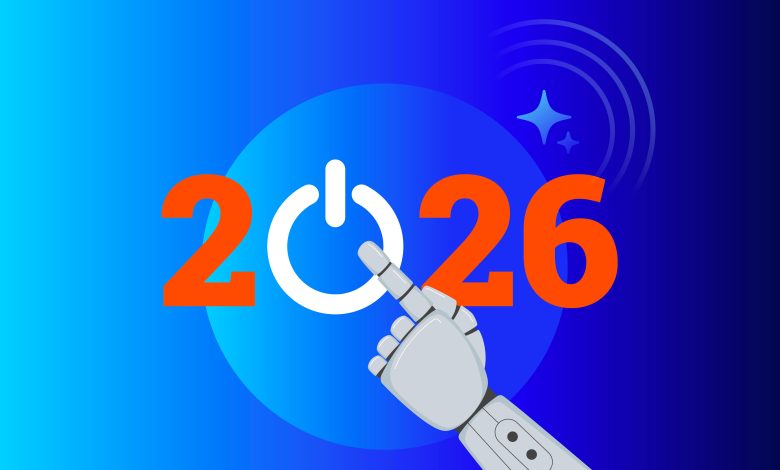
For the past several years, AI has captured the world’s imagination, producing real progress alongside an inevitable dose of hype. 2026, however, is shaping up to be the year when the hype cycle finally collides with operational reality.
The next era of AI will be shaped by a more sober, more strategic understanding of what today’s systems can – and cannot – do. In short, this is the year AI grows up – and the result is a recalibration that touches everything from agentic AI to data architecture to the very interfaces we use to interact with software.
Autonomy meets its limits
Few areas illustrate this shift more clearly than agentic AI. In 2025, the term became a catchall for anything that looked vaguely automated. But as enterprises began deploying these tools at scale, a more nuanced picture emerged.
Many socalled agents turned out to be little more than workflow macros with a marketing budget. They followed predefined paths, executed rigid sequences, and struggled the moment a task required improvisation. Their behavior resembled early selfdriving cars: capable of staying in a lane, but helpless if an unexpected obstacle appeared.
True autonomy, the kind that can plan, adapt, and solve complex problems without human intervention, remains aspirational for now. And that’s not a failure; it’s a clarification. The market is beginning to distinguish between genuine autonomous systems and clever wrappers around deterministic logic. That distinction will shape investment, product design, and enterprise expectations throughout 2026.
From hallucination panic to hallucination management
Another area undergoing a reality check is AI hallucination. After several years of high profile AI errors making embarrassing headlines, organisations are accepting an uncomfortable truth: hallucinations aren’t going away anytime soon.
Foundational model builders have made meaningful progress through training refinements and inference-time techniques, but most acknowledge that truly eliminating hallucinations may ultimately require a fundamentally new architecture – a breakthrough that could be years out. In the meantime, enterprises are taking matters into their own hands to manage potential risk in this area.
Instead of waiting for vendors to “fix” hallucinations, organisations are building their own guardrails. They’re layering human oversight into highstakes workflows, implementing multistep verification for AIgenerated outputs, and even exploring insurance products designed to offset the financial risk of model error.
Liability debates – whether responsibility lies with the toolmaker or the user – will continue. But the practical reality is clear: enterprises are taking ownership of their AI risk posture rather than waiting for a “perfect”, hallucination-free technology to appear.
The data architecture pivot: moving beyond the ‘what’
As organisations mature in their AI adoption, they’re also confronting a deeper architectural challenge: today’s systems are excellent at retrieving information but far less capable of explaining it.
RetrievalAugmented Generation (RAG) has become the industry’s go to method for grounding AI in enterprise data. It excels at answering “what” questions – locating documents, extracting facts, surfacing relevant passages. But when users ask “why” or “how,” typical RAG implementations show their limits. The way most systems chunk and embed documents lacks the connective tissue needed to represent relationships, dependencies, and causal logic.
In 2026, the next evolution of data architecture will begin to take shape. Instead of humans manually structuring information into taxonomies and hierarchies, AI systems will increasingly take the lead. Autonomous structuring tools will map relationships across millions of data points, revealing patterns and context that would be impossible for humans to assemble at scale.
This shift – from humandesigned structure to machinegenerated knowledge graphs – will redefine how enterprises think about data readiness. The goal is no longer just retrieval – it’s understanding business-critical interconnections across multiple data points.
AI-powered interfaces get dynamic
Perhaps the most visible shift in 2026 will be the transformation of the user interface. The era of static, onesizefitsall software is giving way to something far more fluid: interfaces that assemble themselves on demand.
Instead of navigating dense menus in a spreadsheet application, for instance, users will simply state their intent – “Compare Q1 sales for region X against last year’s Q1 sales and chart the trend” – and the system will generate a temporary, taskspecific interface designed solely for that purpose. These “microapps” will exist for minutes, not months.
This shift reduces cognitive load, accelerates workflows, and redefines what software even is. The interface becomes ephemeral, personalised, and disposable. And because these microapps depend on deep integration with enterprise data, the companies best positioned to deliver them will be those that control both the data layer and the AI that interprets it.
A more grounded, more capable AI era
The story of AI in 2026 isn’t one of disillusionment. It’s one of maturation. The industry is moving past inflated expectations and toward a more grounded understanding of what AI can deliver today – and where it’s headed tomorrow.
The result is an ecosystem that is more realistic, more accountable, and ultimately more powerful. AI isn’t becoming less exciting – it’s becoming more useful. That’s the natural evolution of a technology that’s growing up.