eCommerce organizations require a centralized product data infrastructure to maintain consistency across channels, accelerate time-to-market, and deliver personalized customer experiences that drive conversion. While businesses possess extensive product information—supplier specifications, imagery, pricing data, inventory records—most struggle to systematically manage and distribute this information across expanding digital touchpoints.
The Solution: Product Information Management (PIM).
The PIM market is expected to grow upto USD 23.8 billion by 2027. PIM platforms establish centralized governance, automate distribution workflows, integrate AI for enrichment and validation, enable omnichannel consistency, and provide analytics for optimization. This blog explores five critical product information management capabilities in detail.
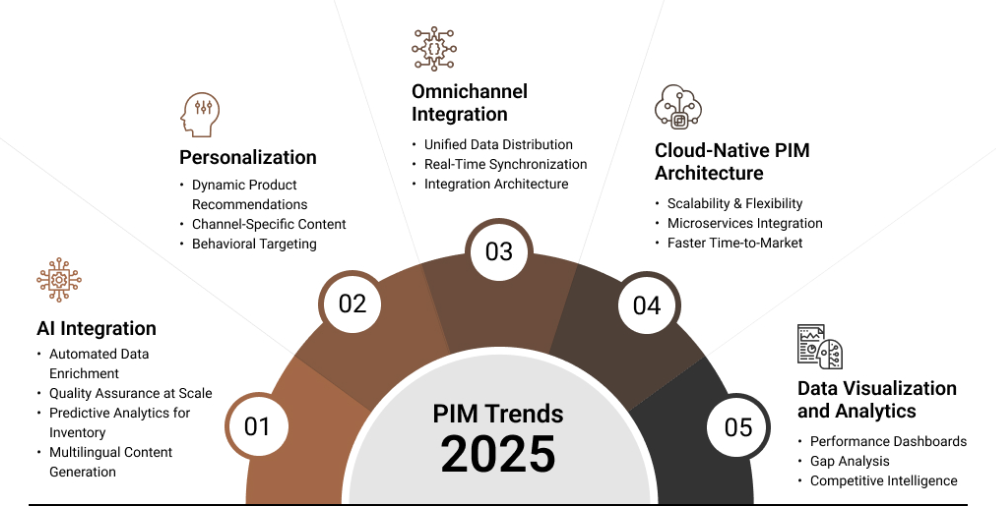
#1 AI Integration in Product Information Management
The role of AI in product information management has moved from experimental feature to operational necessity in product information management. eCommerce businesses now deploy AI across the entire product data lifecycle to solve practical problems that directly impact revenue.
-
Automated Data Enrichment
AI extracts product attributes directly from images—materials, colors, dimensions, style details. The system generates channel-specific descriptions. For eCommerce operations managing thousands of SKUs, this transforms product launches from weeks to days.
-
Quality Assurance at Scale
Machine learning validates data against predefined rules, identifies incomplete specifications before publication, and flags inconsistencies across product families. This prevents the data errors that drive customer returns—incorrect sizes, missing specifications, inaccurate materials.
-
Predictive Analytics for Inventory
AI analyzes historical sales data and attributes correlations to forecast demand at granular levels. Rather than predicting that winter jackets will sell well, the system identifies which specific color, size, and material combinations will outperform in which markets. This intelligence transforms inventory planning and reduces overstock.
-
Multilingual Content Generation
Natural language processing creates localized product content that adapts for regional markets—adjusting terminology for cultural context, converting measurements to local standards, and optimizing descriptions for regional search behavior.
#2 Personalization
eCommerce personalization requires a sophisticated product data infrastructure. Modern PIM systems enable businesses to deliver personalized experiences by powering channel-specific content, dynamic recommendations, and individualized product presentations.
-
Dynamic Product Recommendations
PIM systems analyze customer interaction data—browsing history, purchase patterns, demographic information—to power personalized product suggestions. The platform connects product attributes with customer preferences to identify relevant cross-sell and upsell opportunities.
-
Channel-Specific Content
B2B buyers need technical specifications and bulk pricing. B2C consumers want lifestyle imagery and usage scenarios. PIM can tailor product content to include lifestyle imagery, usage scenarios, and other consumer-centric details that drive emotional appeal and purchasing behavior without data duplication.
-
Behavioral Targeting
Analytics-enabled PIM platforms track how customers interact with product content across channels. This insight refines product descriptions, enhances search optimization, and identifies the attributes that drive conversion for specific customer segments.
#3 Omnichannel Integration in Product Information Management
A customer searching for a product on Instagram, comparing prices on Amazon, and completing the purchase in-store should encounter identical specifications, pricing, and availability—not conflicting information that undermines trust and drives cart abandonment. This consistency across websites, marketplaces, mobile apps, social channels, and physical retail is foundational to eCommerce success.
-
Unified Data Distribution
PIM platforms operate as a “centralized hub” maintaining a single product record that feeds all channels. The system automatically formats data to meet platform-specific requirements—Amazon’s attribute structure, Google Shopping’s feed specifications, Instagram’s visual requirements, and in-store point-of-sale systems.
The Catch: Although, PIM tools do provide a powerful framework, the 100% accuracy in data standardization can be achieved by a combination of automation, human oversight and defined processes.
-
Real-Time Synchronization
Inventory changes or pricing updates get synchronized across all channels within seconds rather than hours. This eliminates overselling on marketplaces, prevents pricing discrepancies, and keeps product availability accurate across touchpoints.
-
Integration Architecture
PIM connects with ERP for inventory and pricing, CRM for customer data, eCommerce platforms for storefront management, and marketplace APIs for third-party channel distribution. These integrations automate product updates and ensure uniform information.
#4 Cloud-Native PIM Architecture
Cloud-based PIM platforms provide the infrastructure beyond cost efficiency, enabling the flexibility and integration capabilities that digital commerce demands.
Scalability & Flexibility
- Cloud PIM supports dynamic scaling for catalog expansion, eliminating the need for additional infrastructure investment.
- Supports new product lines, new market entries, and seasonal volume spikes, ensuring product data is always up-to-date and consistent across channels.
Microservices Integration
- API-first architecture enables seamless integration with eCommerce technologies like storefront platforms, payment processors, shipping systems, and analytics tools.
- Ensures a centralized source of truth for product data, enhancing data consistency across systems and improving customer experiences.
Faster Time-to-Market
- Cloud-native PIM accelerates deployment by eliminating lengthy implementation cycles.
- Quick system configuration, data onboarding, and channel launches empower businesses to go live faster and stay agile in response to market needs.
#5 Data Visualization and Analytics in PIM
-
Performance Dashboards
PIM analytics track key performance metrics, including sales conversion rates, inventory turnover, and customer engagement, across various channels. This allows teams to identify top-performing products, spot underperforming SKUs, and anticipate seasonal trends in product demand.
-
Gap Analysis
These PIM platforms automatically identify content gaps, such as missing product attributes, incomplete descriptions, or low-quality imagery, prioritizing content enrichment efforts to ensure accurate and appealing product information.
-
Competitive Intelligence
PIM systems integrate with competitive benchmarking tools, comparing product performance against industry benchmarks. This data empowers businesses to optimize pricing strategies, refine marketing approaches, and ensure product presentations align with market expectations.
The Competitive Reality
From AI-driven automation and omnichannel consistency to cloud-native architecture and predictive analytics, eCommerce product data management continues evolving in scope and strategic importance. The businesses that master these top 5 PIM trends for 2025 don’t just manage information more efficiently—they create the operational capacity to compete effectively in increasingly complex digital markets.