The manufacturing industry has had a tumultuous 2025. Supply networks have been reshaped faster than they could stabilise, tariffs and trade shifts have redrawn production footprints, labour shortages continued to squeeze margins and expose critical skill gaps, and sustainability mandates piled on complexity to planning, sourcing, and operations. Amid all this turbulence, AI moved from the edges of experimentation to the centre of industrial strategy.
But modernising core systems and adopting AI are distinct efforts with different timelines, investment structures, and organisational implications. They mature at different paces, which directly threatens the efficacy of AI initiatives, particularly as many manufacturers are still working through legacy upgrades, fragmented data architectures, and competing transformation priorities.
AI progress has been uneven. Connected factories and intelligent supply chains exist in pockets, while the technical, organisational, and cultural foundations needed for AI to operate end-to-end are still being built.
In 2026, manufacturing leaders expect to double down on the practical adoption of AI. A global survey of more than 100 COOs at manufacturers (revenues ≥ $1B) revealed that 93% plan to increase investments in AI and digital technologies over the next five years. But they need to identify where to begin, how to scale, and how to deploy the technology in ways that deliver measurable outcomes across production, supply chain, the workforce, field operations, and customer experience.
But fasten your digital seatbelts. AI is primed to transform the shop floor, particularly in four key areas but manufacturers must be ready to put the work in. The year ahead will bring changes to traditional organisational structures, workflows, and business priorities:
Prediction 1: Organisations will break rigid structures to make AI work
Most manufacturing organisations were built for sequential work, fixed hierarchies, and departmental optimisation. Through previous waves of digital transformation, systems have modernised and workflows have been digitised, but the structure around the work stayed the same.
That structure is now the bottleneck. AI can connect planning, production, supply chain, service, and workforce activity in real time, but when an organisation is still designed for linear, sequential work, the value stalls at departmental boundaries. Intelligence gets trapped in functions. Progress defaults to the pace of approvals and hierarchy, not the speed of what technology makes possible.
Removing the ceiling that holds back human ingenuity
This year, manufacturers will begin reassessing their design, not to reduce roles, but to remove the structural barriers that limit what people can achieve with AI. This is not about replacing humans, it’s about removing the friction that holds them back. Governance will always matter, but governance is not the constraint here. The constraint is the scaffolding around the work itself.
When structure aligns with how work actually flows, AI’s impact expands, and the ceiling on what’s possible rises. To realise returns on AI investments, organisations will need to move beyond hierarchies built for a different era and build designs that enable work to move fluidly across functions. The shift is less about adopting a new org chart template and more about designing around how work, decisions, and outcomes actually move through a business in order to unlock new levels of speed, clarity, and performance.
Prediction 2: Humanoid robots are primed to be the next factory powerhouse
Productivity challenges have been a familiar story in manufacturing for years, and they’re only accelerating. Recent OECD data shows annual productivity gains have fallen from 2-3% in the early 2000s to less than 1% today. After years of digital transformation investment, many manufacturers are asking, why hasn’t output kept pace?
Legacy systems and fragmented processes play a role, but the deeper constraint is capacity. The global labour shortage has reached a breaking point. Skilled technicians are retiring faster than replacements enter the workforce, and open roles remain unfilled for months. In factories already running lean, every vacancy compounds downtime and lost throughput.
But side-by-side collaboration will require new working models
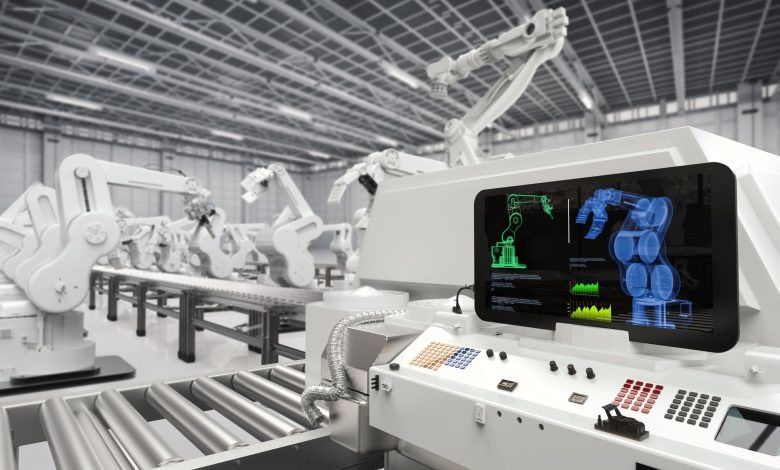
The next leap in industrial productivity will come from a fundamentally new workforce model, one where robots and AI-enabled systems operate side by side. Humanoid and mobile robots are no longer science projects. They’re proving their value on production floors, designed not to replace people but to extend their reach, consistency, judgment, and problem-solving.
For most, that won’t mean overnight automation. It will mean rethinking how people and robots collaborate day to day, clarifying which tasks are best handled by each, updating safety protocols, and redesigning workflows so teams work confidently alongside intelligent machines. Success depends as much on change management and trust as it does technology. Those who hesitate, risk being constrained by a workforce model that can no longer scale with demand.
Prediction 3: Stress tests will be a must-have for ongoing supply-chain readiness
If 2025 proved anything, it is that predicting disruption is impossible, but preparing for it is not. Manufacturers now have the ability to model complex what-if scenarios, simulate disruptions, and plan responses before issues reach production.
For most organisations, supply chain data remains distributed across systems and formats. That reality has not changed. What has changed is how manufacturers can work with it. Most are already familiar with AI’s ability to extract and structure data, making it more coherent and useable—even when it has been created or managed in siloed ways. What has changed is that AI-enabled supply chain modelling and simulation tools can now use that data, even where gaps remain, to build and test scenarios across the supply chain.
Yet success hinges on supply chain intelligence moving in-house
The constraint is no longer the availability of data or modelling technology. What matters now is how effectively manufacturers bring the two together to test assumptions at different stages and levels of their supply chain. Doing so makes it possible to see where gaps remain, which parts of the supply chain are more or less resilient, and how different scenarios are likely to play out.
Over 2026, supply chain intelligence will increasingly become a core internal capability. Rather than relying on third-party or consultant-led, periodic analysis, manufacturers will use AI-enabled supply chain intelligence tools internally on a regular basis to explore scenarios, test assumptions, and better respond to change. Over time, this embeds optimisation, resilience, and value creation directly into how supply chains are managed, not as a one-off exercise, but as part of day-to-day operations.
Prediction 4: Efficiency will leave no room for unsustainable operations
As global regulations fluctuate and investor expectations rise, manufacturers must now measure environmental performance with the same rigor applied to cost and quality. Expanding mandates around emission disclosure and energy transparency will drive demand for continuous, verifiable data across operations. Sustainability will become AI-enabled and embedded into how factories, supply chains, workforces, and assets are managed day to day, integrated directly into planning, execution, and optimisation cycles.
AI systems unify fragmented data, monitor resource use at the source, and generate real-time insight into energy consumption, emissions, and waste. What once required lengthy reporting cycles or audits will evolve into a continuous feedback system, one that learns, flags anomalies, and guides adjustments before targets are missed.
2026 will favour manufacturers who act with discipline and not wait for direction
If 2025 was defined by disruption, then 2026 will be defined by disciplined action. The manufacturers who gain momentum in the year ahead will not be those waiting for perfect conditions, flawless data, or complete organisational readiness. They will be those who build readiness as they move—prioritising the highest-value use cases, modernising selectively, addressing the foundations that matter most, and reducing the drag of legacy systems so progress can compound over time.
Disciplined action will become the backbone of success—ensuring manufacturers are open to change, prepared to challenge legacy ways of working, and ready to move at the pace the world demands.