The conversation about enterprise AI video generation in 2026 has been dominated by leaderboard scores — which model has the highest Elo, which produces the most realistic faces, which generates the longest clip. That conversation has missed the more consequential shift. The actual story is that the input side of these models is converging on multimodal, and ByteDance’s Seedance 2.0, launched in February 2026 and rolled out broadly through CapCut on March 26, is the clearest production example of what that looks like.
For enterprises building content operations around AI video, the multimodal pivot matters more than the next 50 Elo points on a benchmark. It changes which vendor decisions are reversible and which ones are not.
What Seedance 2.0 actually accepts
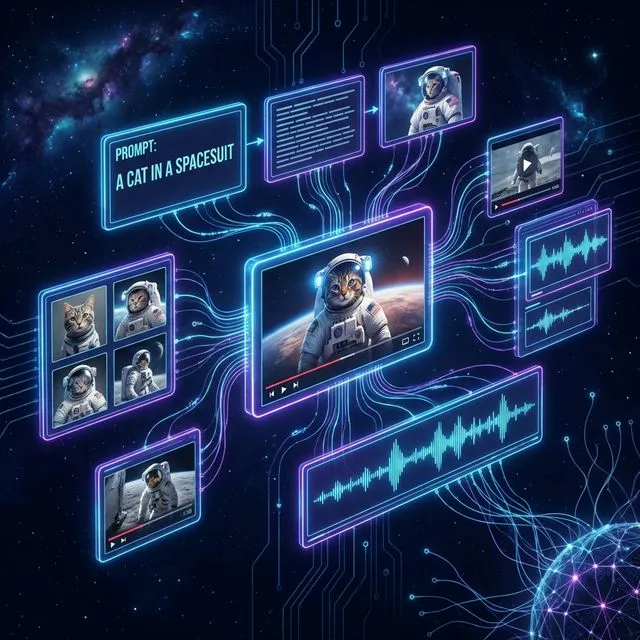
Seedance 2.0 uses a unified multimodal audio-video joint generation architecture. A single generation call can take text, images, audio, and reference videos as input — up to 9 images, 3 videos, and 3 audio files per project in Dreamina, ByteDance’s interface for the model — and outputs 2K video with synchronized native audio in a single pass. Durations run from 4 to 15 seconds across all standard aspect ratios from vertical 9:16 to horizontal 21:9.
The technically interesting detail is the audio-video synchronization. Seedance 2.0 generates dialogue, sound effects, ambient noise, and music in the same forward pass as the video itself, with millisecond-precision alignment between visual events and the sonic layers. The previous generation of video models — including Seedance 1.x — handled audio as a separate post-generation step. The architectural shift to joint audio-video generation lets the model reason about cause and effect across both modalities. The cup hits the table and the sound lands on the right frame, because both came out of the same prediction.
For enterprise content teams, the multimodal input side is the more important change. A marketing team producing a product video used to chain three or four discrete tools — image generation for the starting frame, image-to-video for the motion, audio generation for the voiceover, and a video editor to stitch it together. With Seedance 2.0, a brief that includes the product reference image, a brand voiceover sample, and a 30-second text prompt produces the finished clip in one call. This evolution is also reflected in newer video creation solutions such as the Seedance 2.0 Mini Text-to-Video Tool, which prioritize faster iteration and streamlined production workflows while maintaining many of the capabilities that enterprise teams increasingly expect from modern AI video platforms.
This isn’t an isolated release
Seedance 2.0 currently ranks second on the Artificial Analysis Video Arena (text-to-video with audio, Elo 1212), behind HappyHorse-1.0 at Elo 1213. Rankings move month to month. The more telling pattern is what sits below the leaderboard: three of the top five video models released in the last six months — Seedance 2.0, Kling 3.0 Omni, and Google’s Gemini Omni (unveiled May 19, 2026 at I/O) — share the multimodal-input architecture. The text-only input paradigm that defined AI video through 2024 and 2025 is being deprecated by the model labs themselves.
For enterprises that built workflows around the text-to-video paradigm — including most of the dedicated AI video tooling currently on the market — this is a structural change. The competitive question for any AI video vendor in mid-2026 is no longer how good the text-to-video output is, but what range of inputs the system can accept and reason across. Platforms that don’t make this shift will look outdated by Q4.
Worth flagging for any enterprise team running a multimodal-video pilot this quarter: LoraAI is currently offering HappyHorse at 20% off for pilot evaluation, which is the practical way to put the actual Video Arena #1 in front of an incumbent vendor without committing to list pricing during the comparison.
The strategic implications for enterprise content operations
Two implications follow from the multimodal pivot.
The first is that the boundary between AI video generation and AI editing is dissolving. A model that accepts video as input, applies a prompt or reference, and outputs edited video is not really a generator — it’s an editor that happens to also generate. Enterprise content operations that maintained separate procurement tracks for generation and post-production are increasingly running into the same vendor on both sides, which has implications for budget allocation and team ownership that few content leaders have worked through.
The second is that single-model standardization is becoming less defensible. When the top four to five video models all accept similar inputs, all produce comparable durations and resolutions, and all sit within 120 Elo of each other on blind tests, vendor lock-in is the larger risk than picking the “wrong” model. Enterprises that committed deeply to a single AI video vendor in 2025 are spending Q2 2026 untangling those decisions. The right posture in 2026 is to treat the frontier model layer as a commodity that gets swapped between, not as a strategic standardization decision.
The layer below the model that actually compounds
What hasn’t changed — and what no model launch in 2026 will change — is that these frontier video and image models do not know what an enterprise’s specific products, talent, or visual identity look like. They draw plausible versions of similar things. For one-off generations that’s fine. For producing thousands of brand-consistent assets across campaigns, it’s the gap that keeps content programs trapped in re-touching cycles.
That gap is closed by LoRA training. The technique comes from Edward Hu and colleagues’ 2021 paper (arXiv:2106.09685), which demonstrated that low-rank adaptation can reduce trainable parameters by 10,000x compared to full fine-tuning, with no quality loss. Applied to diffusion-based image and video models, a content team can take a curated reference set — 15-30 images for a character, 30-50 for a style, 20-40 for an object — and produce a small adapter file in a few hours that anchors all subsequent generation to a specific identity.
The mistakes that derail enterprise LoRA programs are operational, not technical. Dataset curation matters more than dataset size; 20 well-selected references outperform 200 mediocre ones every time. Base-model lock-in surprises teams later, since a Flux LoRA does not work on Wan and a 2024-era Flux LoRA needs retraining for Flux 2. Version management — refresh cycles tied to brand changes, packaging redesigns, talent rotation — needs explicit owners. The organizations that handle these well treat their LoRA portfolio as a design-system asset, with the same governance discipline applied to fonts, color tokens, and component libraries.
Done well, the LoRA layer compounds in value regardless of which frontier model is at the top of the leaderboard this quarter. The model gets superseded. The LoRA library does not, as long as the base-model decisions were made with portability in mind.
What this stack looks like in practice
McKinsey’s Q1 2026 State of AI data shows 65% of organizations now use generative AI in at least one business function — double the figure from 10 months earlier. Gartner’s May 2026 survey of marketing leaders shows expected AI-driven automation of marketing work rising from 16% in 2026 to 36% by 2028. The volume curve is moving in one direction across every industry producing visual content at scale.
The platforms that make sense in this picture are the ones treating image generation, video generation, and LoRA training as one workflow under one credit balance, rather than three separate procurement decisions. LoraAI is one of those. It runs Seedance 2.0 alongside Gemini Omni, Veo 3.1, Kling V3, Wan, HappyHorse, and PixVerse on the video side, plus GPT Image 2, Nano Banana Pro, Seedream 5.0, Flux 2, and Qwen Image on the image side. LoRA training on Flux, Kontext, Wan, and Nano Banana base models lives in the same interface, with trained LoRAs appearing directly in the generation UI without an export step.
On the image side of the same pilot window: GPT Image 2 is currently uncapped on LoraAI, which makes it cost-effective to evaluate the closed-source image leader against the incumbent image vendor on the same brief volume.
You can evaluate LoraAI with 50 free credits at signup, no card required.