Training an AI model needs huge volumes of data. But controlled companies are under strict regulations. They should gather information in society without violating laws or internal policies. A high-speed data center proxy provides the speed these companies need. It makes the connection remain stable. It also enables teams to effectively collect information from different sources. What you require is a reliable method for handling high-volume requests within the law. It is a decision that impacts your bottom line.
The Role of High-Volume Data Collection
AI firms rely on publicly available information to nourish their algorithms. This is done by retrieving millions of data points per day. The main factor here is speed. This amount of information would not be possible to collect with a regular office connection. A data center proxy uses high-bandwidth servers in remote facilities. This arrangement enables quick requests. Speed is not the only factor. Controlled companies should make sure that their practices are consistent with industry professional knowledge on data ethics.
The AI sector grows fast. And the global datacenter proxy market already reaches 2 billion dollars. It is a trend that is not going to slow down. But why do businesses choose one type instead of another? It boils down to cost and performance. A data center proxy is often cheaper than a residential one. It offers higher uptime. This is vital for 24/7 operations.
Knowledge of Technical Requirements
What constitutes a good technical setup? The majority of developers consider protocols. You might choose between SOCKS5 vs HTTP proxy for AI. Web-based tasks are typical of HTTP. But SOCKS5 supports additional types of traffic. It is more flexible. It supports any protocol or port. This flexibility is great for complex AI applications. It aids in the heavy lifting involved in training neural networks.
The other consideration is the kind of tool you are using. Do you have custom scripts? Then a proxy for AI automation tools is necessary. These tools process the request’s logic. The proxy provides the path. It is a team effort. You can use SOCKS5 proxies to maintain a steady flow of data between your server and the target. This makes sure that the pipeline does not run dry.
Requirements for a Bulk Data Center Proxy Pool
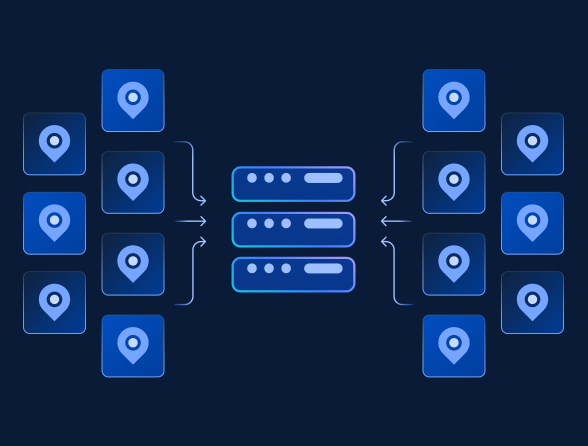
AI companies often use a bulk pool. This enables them to distribute requests to thousands of IPs. This ensures that no single point is a bottleneck. It also makes data gathering smoother. This scale is required in large organizations. They cannot count on some speeches. They need a massive network.
Consider the needs of a proxy for AI model training. It takes petabytes of text or images to train a model. Fetching this data requires a proxy for large scale AI scraping that does not fail under pressure. It is about volume. It is about reliability. A comparison of common options is given in the table below.
| Feature | Datacenter | Residential |
| Speed | Extremely High | Moderate |
| Cost | Low ($0.50 – $1.50 per IP) | High ($10+ per GB) |
| Uptime | 99.9% | Variable |
| Usage | Automated AI tasks | General browsing |
Compliance and Ethical Standards
Modern tech companies are regulated. GDPR and CCPA define the rules. Although these proxies are working with data that is available to the public, you still have to be careful. You are not to scrape personal information. You need to look for providers who follow ethical sourcing regulations.
It is better to be safe now. A data center proxy helps you maintain a professional footprint. It shows that you are working with dedicated resources. This is a common practice in top tech companies.
Important Measures of Performance
What should you measure? Latency is the first thing. Latency is slowing down your training loops. This costs money. It is a waste of resources. Low latency ensures bots complete their tasks in time. Success rates should also be checked. The gold standard is 95%+ success rate. When your rate is coming down, you are wasting time.
- Use fast connections to minimize ping.
- Switch IPs to avoid server load on target.
- Keep track of your usage to catch mistakes early.
- For non-web protocols, use SOCKS5.
And then there is the cost. Most providers offer tiered pricing. You can pay by IP or by gigabyte. In the case of data centers, the per-IP model is more suitable. It supports unlimited traffic. It makes the budget predictable. In a regulated firm, financial planning is very predictable.
Scaling Your Infrastructure
Scale is a choice. You can start small and grow. But your data center proxy must grow with you. Most companies start out with several hundred IPs. They soon move to thousands. This expansion requires a robust management system. You should keep track of the active IPs. You need to rotate them.
How can this be best managed? Automation is the answer. Use a proxy for automated AI tasks to handle the rotation for you. This saves time for your developers. They can focus on the AI model. They are not supposed to spend the whole day dealing with IPs. It is a matter of efficiency. Firms succeed because they can concentrate on core tech.
Concluding Remarks
Selecting a data center proxy is a technical necessity. It is a portion of your stack that affects how you gather information and the rate of model training. It is all about finding the right balance between price and speed. This balance is needed in regulated firms to stay competitive. They have to obey regulations and move fast.
Need better performance? Look at your current setup. Check your latency. Compare your costs. It is a simple step. But it makes a huge difference to your results. Use reliable tools and stay on public info. This is the way to ethical scaling.