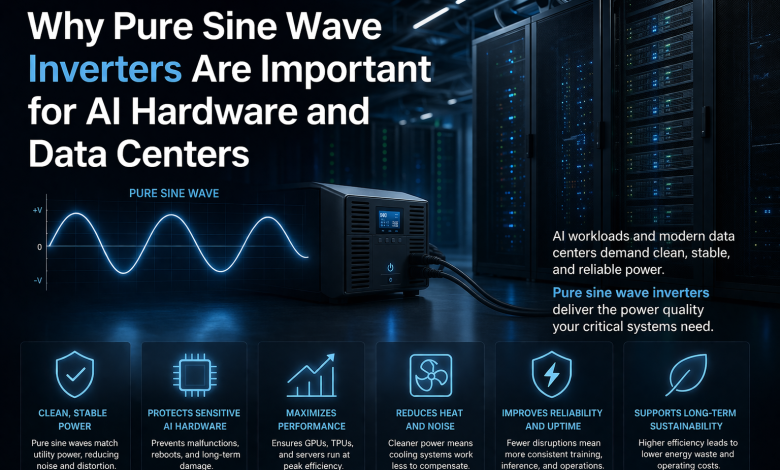
Anyone who’s spent time running AI workloads on remote edge devices or backup systems has probably noticed this: the GPU server runs warmer than it should, the storage array throws errors, the edge inference unit starts behaving erratically. Swap in a pure sine wave inverter and the symptoms vanish. The hardware wasn’t broken, it was just getting the wrong kind of power.
Batteries and wiring get blamed for a lot of problems that actually trace back to waveform quality.
Every inverter takes DC from a battery and outputs AC your equipment can use. Where they diverge is how faithfully they reproduce the smooth sine wave that utility power delivers. That difference, invisible to the eye — shows up in heat, noise, and hardware lifespan.
Here’s why waveform quality matters for AI infrastructure and how to choose the right inverter.
What Is a Sine Wave Inverter?
Utility power delivers a smooth, curving sine wave, rising and falling sixty times per second. A pure sine wave inverter reproduces that exact waveform from battery DC. GPUs, power supplies, and sensitive electronics were designed for this shape, so they run at proper temperatures and draw correct current.
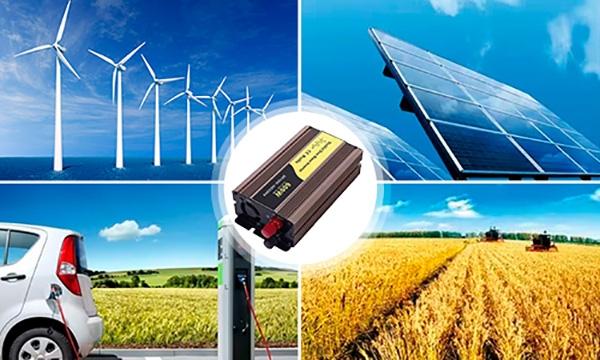
Common DC power sources for AI deployments:
- 12V, 24V, or 48V battery banks in edge cabinets
- Solar arrays with charge controllers (remote AI sensors)
- Vehicle electrical systems (autonomous mobile robots)
- Portable power stations (field AI deployments)
Output powers standard AI hardware:
- GPU servers, AI training clusters
- Edge inference devices, industrial PCs
- Networking gear, storage arrays
- Monitoring sensors, vision systems
A pure sine wave inverter keeps harmonic distortion under 3% and holds voltage steady — the two things that prevent the heat buildup, erratic behavior, and premature failure you get with cheaper alternatives.
How Does a Sine Wave Inverter Work?
Breaking down what actually happens inside helps explain why waveform quality matters for AI hardware.
- Step 1: DC input. The inverter draws from whatever battery voltage your system runs at, typically 12V for mobile edge units, 24V or 48V for larger AI racks where efficiency matters.
- Step 2: DC to AC conversion. MOSFETs arranged in an H-bridge switch the polarity of the DC input thousands of times per second. That rapid reversal creates alternating current.
- Step 3: Waveform shaping. A microcontroller varies the duty cycle of those switching pulses moment by moment, staying on longer near the crest of the intended wave, barely on at the zero crossing. The resulting envelope approximates a sine curve before filtering.
- Step 4: Filtering. Inductors and capacitors round off the stepped pulses left by the switching stage, producing a smooth continuous wave that measuring equipment can barely distinguish from utility power.
- Step 5: Voltage regulation. As batteries deplete or load change, feedback circuits adjust switching parameters fast enough to hold output voltage stable.
- All five stages happen continuously. From your perspective, you just plug in AI hardware and it works.
Types of Pure Sine Wave Inverters for AI Deployments
The right inverter depends on your application and battery system.
12V Pure Sine Wave Inverters
12V dominates the small-system market for one simple reason: practically every vehicle, edge cabinet, and mobile robot already has a 12V bank onboard. Common uses include:
- Mobile AI inference units in vehicles
- Edge computing nodes at remote sites
- Portable AI testing rigs
- Small solar-powered sensors with AI processing
12V pure sine wave inverter units generally run 150W to 700W at 90–92% efficiency. Expect USB ports, an LED readout for voltage and load, and the usual protection circuits baked in.
24V Pure Sine Wave Inverters
Step up to 24V and you immediately cut the current draw in half — which translates into thinner wiring, less heat, and slightly better efficiency (92–93%). This matters on longer wire runs in data center racks or distributed AI sensor networks.
Applications:
- AI edge clusters in industrial settings
- Medium-sized off-grid AI monitoring stations
- Backup power for networking and compute nodes
Our 24V line runs 150W to 600W.
48V Pure Sine Wave Inverters
At 48V, current drops to a quarter of what a 12V system would pull. That cuts resistive losses dramatically and pushes efficiency to around 95%. Benefits for larger AI deployments:
- Minimal wiring losses in AI server racks
- Works well with large solar arrays for remote AI sites
- Ideal for off-grid AI training facilities
- Handles higher power loads for GPU clusters
Whole-home AI labs, large off-grid edge data centers, and commercial AI systems are where 48V earns its keep. Our 48V models go up to 600W.
Pure Sine Wave UPS Inverters
A UPS inverter is a different animal. Instead of just converting battery power, it combines three things:
- An inverter for clean AC
- A battery charger
- An automatic transfer switch
Under normal conditions the unit passes grid power straight through while keeping the battery topped up. When grid power drops, the transfer switch activates in milliseconds — fast enough that AI servers never notice the gap.
Our 300W and 500W UPS models are sized for AI inference nodes, networking gear, and edge devices where even a half-second power blip causes processing errors.
Benefits of Pure Sine Wave Inverters for AI Hardware
- Universal compatibility. Everything from a GPU server to an edge inference unit runs without complaint on pure sine wave output. Modified sine wave often cause power supplies to run hot or fail.
- No interference. The harmonic distortion that causes data errors, display shimmer, and erratic sensor readings simply isn’t present when the waveform is clean.
- Efficient operation. AI hardware draws only what it needs and stays at rated temperature. On a modified sine wave, power supplies work harder and run hotter to produce the same output.
- Longer hardware life. Harmonic distortion creates heat inside power supplies every hour they run. Over months, that thermal stress shortens component life noticeably. For expensive GPU clusters, this matters.
- No data errors. Digital devices are vulnerable to voltage instability. A clean waveform eliminates the random crashes, corrupted data, and unexplained reboots that poor power quality can cause.
- Quiet operation. The electrical noise that sometimes interferes with sensitive sensors disappears. AI vision systems get cleaner signals.
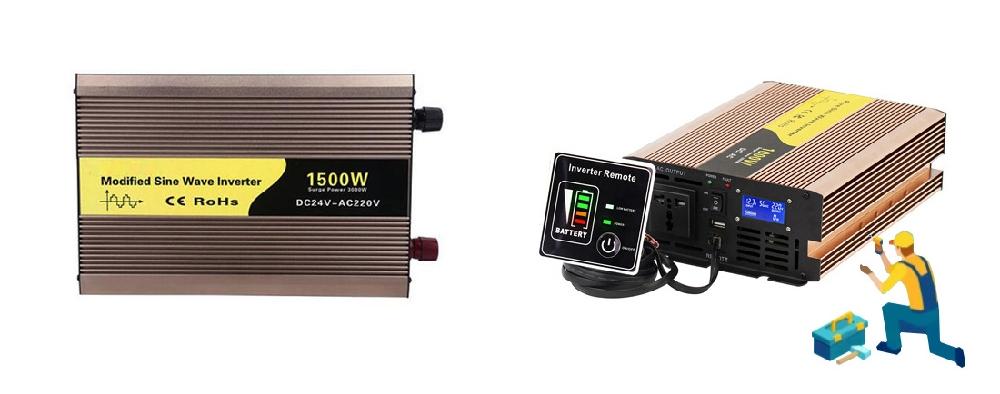
Pure Sine Wave vs Modified Sine Wave: Comparison
Modified sine wave units cost less because the waveform they produce — a blocky, stepped approximation — is cheaper to generate. The table shows what that trade‑off actually looks like for AI hardware:
| Feature | Pure Sine Wave | Modified Sine Wave |
| Waveform shape | Smooth curve | Stepped, blocky |
| Power quality | Same as grid | Lower quality |
| Harmonic distortion | <3% | 20-40% |
| Cost | Higher | Lower |
| Hardware compatibility | All AI gear | Some only |
| Power supply efficiency | 100% rated | 70-80% rated |
| Operating temp | Normal | 10-20% hotter |
| Data errors | None | Possible corruption |
| Radio interference | None | Possible static |
Applications for Sine Wave Inverters in AI
Pure sine wave inverters show up anywhere AI hardware runs on batteries or backup power.
- Edge AI deployments. A 150W–600W unit handles an edge inference node, a few cameras, and networking gear without protest. More importantly, data stays clean and systems stay stable.
- Data center backup. An outage hits and critical AI servers, storage arrays, and networking gear keep running without a gap. No generator warm‑up time, no voltage sag during transfer.
- Off-grid AI labs. Panels charge the bank during the day; the inverter draws on stored energy after dark. The setup scales from a small R&D test bed to a full off‑grid AI training facility.
- Mobile AI platforms. Autonomous vehicles, mobile robots, and field AI units rely on clean power for onboard processing. Dirty power means erratic behavior.
- Remote monitoring stations. AI-powered environmental sensors, security cameras, and industrial monitoring gear run on solar with battery backup. Inverters must deliver clean power to keep data accurate.
- Medical AI devices. AI‑assisted diagnostics, patient monitoring, and portable imaging systems aren’t rated for modified sine waves. Pure sine wave is the only appropriate choice.
How to Select and Use a Sine Wave Inverter for AI
Undersizing is the most common mistake, and it usually shows up the first time you try to spin up a GPU cluster.
Step 1: Calculate Your Power Needs
Think through a typical use scenario rather than listing devices in isolation. The AI server runs continuously; storage arrays and networking gear draw power in parallel; cooling fans spike when heat loads rise. That combination — not each item on its own — is what the sine wave inverter has to handle.
Pull the wattage off the nameplate or spec sticker on each device. If the label only shows amps, multiply by the operating voltage to get there. Add everything up.
Add 20% on top of that running total. GPUs and CPUs don’t start gently — they pull their full current instantly, and an undersized inverter will trip right when you need it most.
Step 2: Choose Continuous vs Surge Rating
Inverters have two power ratings:
- Continuous power. What it can run indefinitely
- Surge power. What it can handle for a few seconds during startup
Your continuous load must stay under the inverter’s continuous rating. Startup loads must stay under the surge rating.
Step 3: Select Battery Voltage
Match the inverter to your battery bank.
- 12V for small edge nodes, vehicles, portable AI rigs
- 24V for medium systems, larger edge deployments, robotics
- 48V for large off-grid AI labs, highest efficiency
Higher voltage systems are more efficient but require more batteries in series.
Step 4: Check Features
Look for:
- Overload protection. Shuts down if you draw too much power
- Over temperature protection. Prevents damage from overheating
- Short circuit protection. Shuts down if wires touch
- Low voltage alarm and shutdown. Warns you when batteries are low, then shuts off to protect them
- Over voltage protection. Handles charging system problems
- Cool fan. Keeps electronics cool under load
- USB ports. For charging small devices
All our inverters include these protections.
Step 5: Install Properly
- Mount in a clean, dry location with airflow
- Use proper gauge wire (too thin causes voltage drop and fire risk)
- Keep wire runs as short as practical
- Install appropriate fuses or breakers
- Connect to battery terminals securely
Step 6: Test Before Relying on It
Run your intended loads and check:
- Does everything boot and run normally?
- Any unusual noise from fans or power supplies?
- Does the inverter get too hot?
- How long does the battery last under realistic AI workload?
Summary
The job of any inverter is to turn battery DC into AC your equipment can use. The job of a pure sine wave inverter is to do that without your AI hardware ever noticing it’s not on grid power.
Modified sine wave units are cheaper, but that savings gets eaten up quickly — power supplies running hotter than rated, GPUs throwing errors, data corruption from voltage instability. You pay less upfront and spend it later in shortened hardware life and lost work.
Pure sine wave costs more upfront and works with everything without complaint — no buzzing, no unexplained heat, no corrupted inference runs.
The decision usually comes down to what you’re running:
- Simple lights and heaters? Modified might work.
- AI servers, GPUs, edge devices, medical equipment, or anything with a switching power supply — pure sine wave, no exceptions.
For most AI deployments, the price difference between pure and modified sine wave is smaller than the cost of one failed GPU or a corrupted training run. The upgrade pays for itself.