The release cycle of foundational AI models has become brutally fast. A model that dominates the coding benchmarks in January is frequently obsolete by April. If you hardcode your development workflow to a single ecosystem—relying exclusively on OpenAI, Anthropic, or Google—you are placing a massive bet on a single horse in a race that never truly ends. The real competitive advantage for modern engineering teams no longer lies in having access to the “best” model, because the definition of “best” changes weekly. The true moat is agility. To build software efficiently today, you must decouple your productivity from the underlying intelligence layer. The future of software engineering isn’t about rigid loyalty to a specific LLM; it is about embracing model-agnostic AI workflows.
The Hidden Tax of Vendor Lock-In
When ChatGPT first launched, many developers built their entire internal toolchains, prompt libraries, and deployment pipelines around OpenAI’s specific API structures and idiosyncrasies. Then Claude 3.5 Sonnet arrived, proving significantly better at complex React refactoring and nuanced system architecture. Developers who were locked into the OpenAI ecosystem watched in frustration as competitors who could pivot instantly started shipping faster.
This is the new technical debt. Vendor lock-in in the AI era doesn’t just cost you money; it costs you capability. Every model has a unique “personality,” a specific way it handles context, and a distinct failure mode. If your workflow requires you to painstakingly rewrite your prompts and reconfigure your environments every time a new state-of-the-art model drops, your workflow is broken.
Routing Tasks to the Right Specialist
The core philosophy of a model-agnostic workflow is treating large language models not as a monolithic brain, but as a specialized team of contractors. You do not hire a world-class graphic designer to fix your plumbing, and you shouldn’t use a heavy reasoning model to perform simple regex extractions.
To maximize efficiency, you need to route specific tasks to the models that excel at them:
- The Architect (e.g., Claude Opus / Sonnet): Often the undisputed champion of multi-file code generation, complex refactoring, and maintaining strict adherence to complex coding constraints. You assign this model to write your core business logic.
- The Librarian (e.g., Gemini Pro): Unmatched when dealing with massive context windows. When you need to dump a 1-million-token API documentation PDF, an entire legacy codebase, or massive production error logs into the context window to find a needle in a haystack, you route the task here.
- The Generalist (e.g., GPT series): Excellent for general reasoning, rapid prototyping, and integrating with vast arrays of existing third-party tools due to its wide adoption in the developer community.
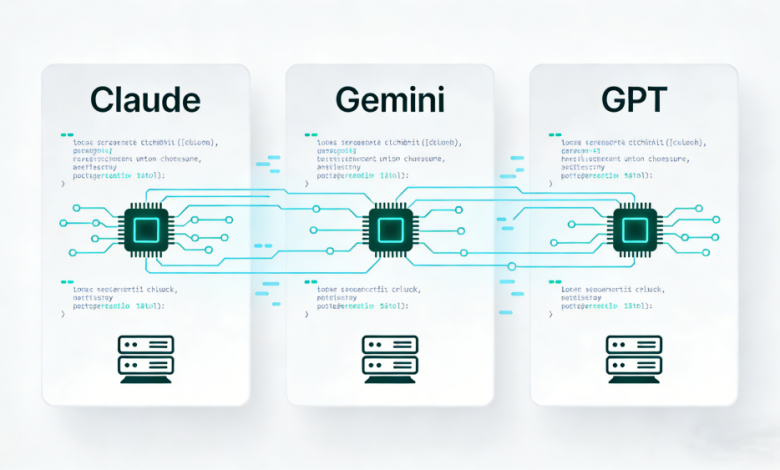
How do you actually orchestrate this without managing a dozen API keys, juggling multiple paid subscriptions, and constantly context-switching between different web tabs? You abstract the model layer using a unified workspace. By orchestrating your development through verdent, you bypass the friction of ecosystem lock-in entirely. Because its infrastructure is built specifically around providing Leading Models Access, you can instantly toggle between the latest versions of Claude, Gemini, and GPT directly inside your editor. You can literally assign a Claude-powered agent to write a new frontend component, while simultaneously dispatching a Gemini-powered agent in a parallel Git worktree to digest massive server logs and hunt down a memory leak. You utilize the absolute best engine for each specific task without ever leaving your IDE.
Resilience and Cost Optimization
Beyond pure coding performance, model-agnostic workflows solve two critical operational headaches: uptime and unit economics.
Cloud providers go down. APIs experience degraded performance. If your entire engineering team relies on a single AI provider, an outage at that company means your team’s productivity plummets to zero. In a model-agnostic environment, an outage is a minor inconvenience. You simply hit a dropdown menu, switch your agent’s routing to a different provider, and continue working. This redundancy is non-negotiable for enterprise teams.
Furthermore, dynamic model routing allows for aggressive cost optimization. Heavy-duty reasoning models consume expensive tokens. A smart workflow dictates that you use highly capable, cheaper, and faster models (like Gemini Flash or Claude Haiku) for repetitive tasks—like generating boilerplate unit tests, writing docstrings, or formatting JSON. You reserve the expensive, heavy models strictly for architectural design and complex problem-solving. This routing strategy can cut your AI infrastructure costs by a massive margin while actually speeding up execution times.
How to Build for Model Agnosticism
To ensure your team can adopt this fluid workflow, you need to change how you communicate with the AI. You cannot rely on the undocumented quirks of a single model. Here are three actionable rules for building a future-proof, model-agnostic system:
- Standardize Your Prompt Architecture Stop writing conversational prompts. Different models interpret conversational nuances differently. Instead, use universal, structured formats. Embrace XML tags or strict Markdown to separate instructions from context. For example, wrap your code snippets in <source_code> tags and your rules in <constraints> tags. Claude, Gemini, and GPT all parse well-structured XML incredibly effectively, ensuring your prompts port over seamlessly when you switch models.
- Focus on “Plan-First” Directives Models have different coding styles. If you just ask a model to “build a feature,” GPT might use one design pattern while Claude uses another. To maintain consistency across models, enforce a “Plan-First” workflow. Ask the model to generate a strict, step-by-step architectural plan first. Once you (the human) approve the plan, you can feed that exact plan to any model to execute the code. The plan becomes the universal source of truth, independent of the LLM’s default biases.
- Maintain an Internal Benchmark Don’t trust Twitter hype when a new model is announced. Maintain a small, internal suite of test prompts based on your company’s actual codebase (e.g., “Refactor this specific legacy controller,” or “Find the security flaw in this auth script”). When a new model drops, run your benchmark. If it outperforms your current default, you simply flip the switch in your agnostic workspace and upgrade your entire team’s capability instantly.
The Agility Imperative
The AI wars are just beginning. The landscape of foundational models will become more fragmented, more competitive, and more specialized. Tying your professional productivity to the roadmap of a single tech giant is a massive liability.
The most productive developers of the next five years will not be the ones who master the intricacies of a single AI model. They will be the conductors who seamlessly orchestrate a rotating cast of the world’s most powerful models, swapping them in and out as the technology evolves. Embrace the agnostic workflow today, and ensure you are always building with the best tools the industry has to offer.