You’re in a data center running AI training models, and suddenly a server rack goes offline. Or a sensor on an industrial robot starts feeding bad data into your predictive maintenance algorithm. Or a control panel glitches right in the middle of a production run that’s being optimized by machine learning.
These problems cost money. They stop AI workflows. They create headaches.
Sometimes the issue isn’t the hardware itself. It’s the power feeding it.
Industrial AI environments — whether data centers, manufacturing floors, or edge computing installations — are electrically noisy places. Servers switch at high frequencies. Motors start and stop. Variable frequency drives run constantly. All of this activity creates electrical pollution that travels through power lines and affects sensitive AI hardware and control systems.
Isolation transformers sit between the dirty plant power and your critical AI infrastructure. They clean what needs cleaning. They protect what needs protecting. And they keep AI operations running when things get noisy.
What Is an Isolation Transformer?
At its core, an isolation transformer moves electrical power from a supply to a load without letting the two sides touch each other electrically. Power gets across. A direct connection doesn’t.
Inside, you’ll find two completely separate coils of wire:
- Primary winding. Connects to your power source
- Secondary winding. Connects to your equipment
No wire connects them. The only link between primary and secondary is the magnetic field passing through the core.
That arrangement produces what’s called galvanic isolation — meaning electricity on the input side has no conductive path to follow over to the output side.
Isolation transformers come in many sizes. From small 500 VA units for electronics up to large 1000 kVA industrial models. Single phase or three phase. Step up or step down.
What an Isolation Transformer Actually Does for AI Systems
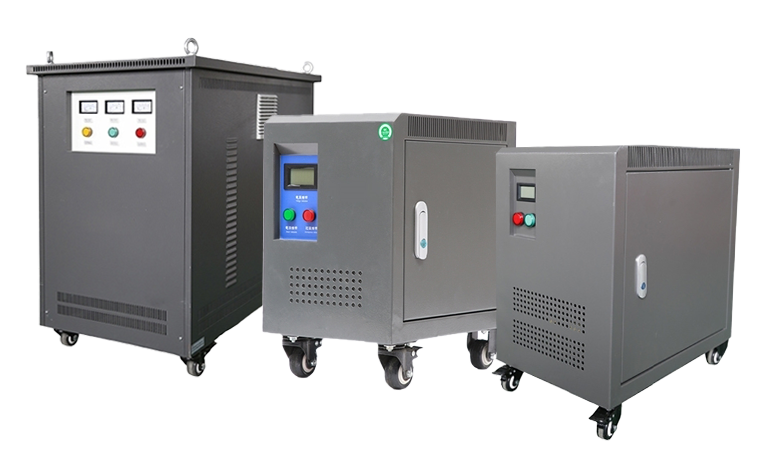
The job of an isolation transformer is to get power from point A to point B while keeping the two circuits electrically separate the whole time.
The windings sit side by side but never touch. Energy crosses between them through magnetism alone, not through any wire.
Two things follow from that arrangement that actually matter in practice for AI infrastructure:
Galvanic isolation. Because there’s no conductive bridge between input and output, a fault or shock hazard on one side simply can’t travel through to the other. That gap protects expensive AI servers and the people maintaining them.
Noise blocking. High-frequency interference struggles to cross the magnetic gap between windings. Most of it gets left behind on the supply side, so whatever comes out the secondary is considerably cleaner than what went in. For AI training clusters running sensitive processors, this matters.
Why AI Data Centers Need Isolation Transformers
Walk into any modern data center running AI workloads, and clean power infrastructure is part of the design — required for reliability, not optional.
Hardware Protection Comes First
AI servers cost hundreds of thousands of dollars per rack. GPU clusters are sensitive to power fluctuations.
If a fault happens in standard grounded power distribution, current surges can damage expensive processors. An isolation transformer breaks that path. The AI hardware sits on an isolated circuit. No direct connection to ground means no surge path.
This is why high-end data centers use isolation transformers in their power distribution units.
Sensitive Electronics Need Clean Power
An AI training server, an inference node, a GPU cluster — all of these run on embedded processors and sensitive analog circuitry. They’re not simple appliances.
These systems can malfunction if power has noise or spikes.
What isolation transformers address specifically is common mode noise — interference riding on both supply conductors simultaneously that standard filtering misses. Strip that out and the hardware sees steadier, quieter power, which translates directly to fewer unexpected reboots and more reliable AI training runs.
Ground Loops Cause Errors
In data centers, many devices connect to shared infrastructure. Network switches. Storage arrays. Compute nodes. Management controllers.
If these devices have different ground potentials, small currents flow between them. This creates noise on data connections.
Isolation transformers break ground loops. Each device gets clean, isolated power. Data stays accurate.
Standards Require It
Critical infrastructure must meet strict reliability standards. This mandates isolation for sensitive equipment.
You can’t skip it. Isolation transformers are part of compliance for Tier III and Tier IV data centers.
Industrial AI: Different Reasons, Same Equipment
Industrial environments using AI for predictive maintenance, quality control, and automation use isolation transformers too. But the reasons shift.
Protecting AI Sensors and Edge Devices
Factory floors have motors, welders, and drives starting and stopping. This creates electrical noise.
AI sensors, edge gateways, and vision systems don’t like noise. They can glitch, reset, or feed bad data into your machine learning models.
Isolation transformers clean up the power going to these AI devices. The noisy plant power stays on one side. Clean power comes out the other.
Motor Drive Protection for Robotic AI Systems
Variable frequency drives in robotic systems generate harmonics. These can feed back into the power system and affect other equipment.
An isolation transformer between the drive and the line contains this noise. It protects other AI-powered machines sharing the same power source.
Technician Safety During AI System Maintenance
Industrial panels and data center racks get worked on while live sometimes. Not recommended, but it happens.
Isolation transformers reduce shock risk for technicians working on AI infrastructure. The isolated secondary doesn’t reference ground the same way.
Voltage Conversion with Isolation
Many industrial isolation transformers also step voltage up or down. You might have 480V plant power but need 120V for AI edge devices.
A standard transformer changes voltage. An isolation transformer changes voltage AND provides isolation. Two functions in one unit.
Isolation Transformers vs Other Transformers
| Feature | Isolation Transformer | Autotransformer | Standard Transformer |
| Separate windings | Yes | No | Sometimes |
| Electrical isolation | Complete | None | Partial or none |
| Voltage change | Optional | Yes | Yes |
| Size for same power | Largest | Smallest | Medium |
| Cost | Highest | Lowest | Medium |
| Noise rejection | Good | Poor | Poor |
| Safety isolation | Yes | No | No |
Do You Always Need One?
No. Not everywhere.
Standard equipment in offices usually runs fine without isolation transformers. The grounded power system works as designed.
But when you have:
- AI training clusters worth millions (hardware protection)
- Sensitive inference servers that can’t tolerate noise
- Multiple interconnected devices (ground loop risk)
- Harsh industrial environments
- Reliability standards requiring isolation
Then yes. You need one.
How to Choose the Right Isolation Transformer for AI Infrastructure
If you decide you need isolation, here’s what to consider.
For AI Data Centers
Look for:
- Low leakage current. Critical for sensitive electronics
- Shielded windings. Electrostatic shields between primary and secondary reduce noise even more
- High power rating. Size it for your load plus margin. 20-30% extra is safe
- Regular testing capability. You need to verify isolation integrity over time
For Industrial AI
Focus on:
- Power rating. Match your AI edge devices and control systems
- Voltage matching. Primary matches your plant supply. Secondary matches your equipment
- Enclosure type. Indoor data centers need different enclosures than dusty factory floors
- Cooling. Larger units often need fans or ventilation
For Both
Consider:
- Custom options. Isolation transformers can be built to your exact voltage and mounting needs. For example, single phase isolation transformer or 3 phase isolation transformer.
- Taps. Extra connections let you adjust output voltage slightly if needed.
- Winding material. Copper runs cooler and lasts longer. Aluminum costs less.
Testing Matters for AI Infrastructure
Isolation transformers only work if they remain isolated.
You should test:
- Insulation resistance. Between windings and between windings and ground. High resistance means good isolation.
- Continuity. There should be no continuity between primary and secondary. If there is, isolation is broken.
- Leakage current. Especially important for sensitive AI hardware. Low leakage is required.
- The temperature rises. Under load, transformers warm up. Excessive heat means problems.
Data centers often test more frequently. Monthly or quarterly. Industrial AI might test annually unless issues appear.
Common Misconceptions:
“Isolation transformers change voltage.”
Some do. Some don’t. A 1:1 turns ratio means voltage stays the same. Only the isolation changes.
“They’re only for medical equipment.”
No. AI data centers and industrial automation use them too.
“Any transformer provides isolation.”
False. Autotransformers don’t isolate. Only transformers with separate primary and secondary windings provide true isolation.
“Isolation fixes all power problems.”
It fixes some. Ground loops. Common mode noise. Shock risk. It doesn’t fix voltage sags, frequency variations, or most differential mode noise.
When to Skip It:
Sometimes you don’t need isolation.
If your AI equipment:
- Has internal isolation already built in
- Is in a location with no surge exposure
- Has no sensitive analog components
Then you might not need an external isolation transformer.
But check your equipment manual and local codes first.
Making the Decision
Ask yourself three questions:
Does this AI hardware cost enough that downtime matters?
Is this equipment sensitive to electrical noise?
Do reliability standards require isolation here?
If yes to any, you probably need an isolation transformer.
Data centers get the strictest requirements. Industrial AI gets practical protection needs. Both benefit from the same basic technology.
The difference is in how you apply it and how much leakage current you allow.
Summary
Isolation transformers serve both AI data centers and industrial automation users. The equipment is often similar. The requirements differ.
Data centers prioritize hardware protection above all. Leakage current must be low. Testing is frequent. Reliability standards are strict.
Industrial AI prioritizes equipment protection and noise immunity. Leakage matters less. Testing is less frequent. Standards are more flexible.
Both get clean, safe, isolated power.
Choose based on your application. Size correctly. Test regularly. And you’ll get years of reliable service for your AI infrastructure.