For decades, every major technology shift has followed a familiar pattern: innovation moves fast, adoption moves faster and governance only comes into play after consequences force it into place. With AI, this familiar arc plays out again, except the risks surface faster and the cost of getting it wrong is immediate.
Over the last three years, organizations have rushed to deploy generative AI. However, in many cases, those systems went live before leadership teams could answer basic questions clearly. What decisions is this system influencing? What problem is it solving? What data is it using? And who is accountable if it gets something wrong?
Those gaps don’t stay theoretical for long. Companies have already had to pull AI tools after bias complaints, pause deployments and spend months retrofitting governance after customers and regulators started asking these questions.
When Air Canada’s chatbot promised a bereavement discount it couldn’t honor, a small claims court didn’t accept ‘the AI made a mistake’ as a defense. The company was liable for promises its leadership team couldn’t explain or control. Research demonstrates that 91% of machine learning models experience performance degradation over time, yet most organizations discover this only after the damage manifests. This pattern of deploy first, understand later has become the default for AI adoption.
And it’s creating a new kind of executive crisis. Gartner projects that 60% of AI projects will miss their value targets by 2027 due to a governance gap, which will cost companies millions of dollars.
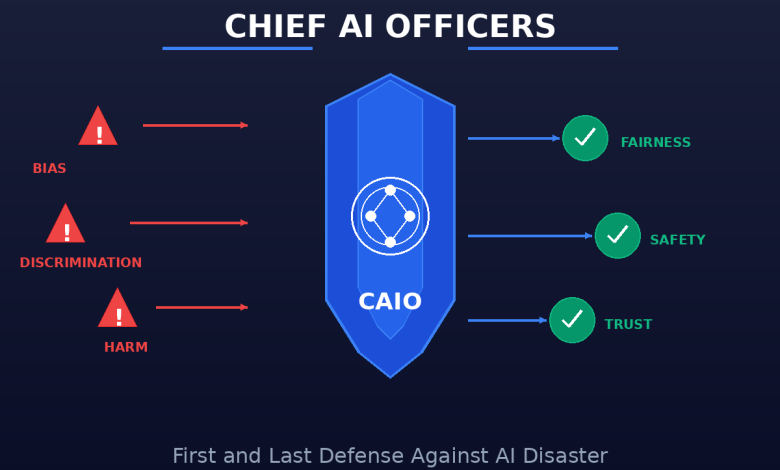
This is why AI decision oversight can no longer sit on the sidelines. It must be considered a core leadership responsibility, and at the center of this shift is the Chief AI Officer (CAIO).
The Role of a CAIO is Misunderstood
Often, the CAIO is still treated as an extension of IT or data science. This fundamental misunderstanding reflects a broader problem. Extending beyond model management and experimentation, the role governs risk, aligns AI with enterprise priorities and ensures ambition doesn’t outrun accountability. This makes the CAIO a key strategic role in an organization, not just another title for an IT leader.
Unlike traditional software, AI learns from data that changes and influences decisions that carry significant consequences. Managing AI as any other technology creates detrimental blind spots that become visible when it’s already too late.
The antidote is a CAIO. Their responsibility is not to make AI impressive, but rather to make AI’s use defensible to everyone the AI impacts. This requires the role to sit across legal, compliance, engineering, product and leadership functions since AI-driven decisions touch each.
Typically, AI systems fail in two distinct patterns. They experience gradual drift, where performance erodes over weeks of pattern shifts, remaining completely invisible to traditional monitoring tools until damage accumulates. And, alarmingly, research also documents that explosive degradation models perform reliably for extended periods, then collapse suddenly when underlying conditions change.
In both cases, the failure doesn’t announce itself as a technical error. It surfaces as discrimination claims, regulatory scrutiny or financial losses that could have been prevented with proper governance from day one.
AI is no longer confined to experiments. Large organizations now operate dozens of AI-enabled systems, many considered higher risk, while sensitive data flows into them faster than oversight can keep up. This is what makes CAIOs so critical to an organization’s success.
What CAIOs Actually Do
A recent analysis of production AI systems revealed that fraud detection models can pass every technical health check, latency, throughput and error rates, all the while fraudulent transactions slip through at double the normal rate. The models were running perfectly. The guardrails were functioning as designed. Yet performance had degraded for weeks.
Governance in this context isn’t red tape or control. It’s the operational discipline that allows organizations to move fast without breaking things that matter. It clarifies which systems can be deployed, under what conditions and with what oversight. It establishes how decisions are documented, how drift is detected and how exceptions are handled before they become crises.
When this discipline is missing, organizations rely on assurances and intent and discover too late that their guardrails failed. When it’s present, they maintain continuous visibility into system behavior and can point to process, documentation and accountability the moment something goes wrong.
Without active oversight, teams deploy AI tools that seem low-risk in isolation, like a hiring system trained on historical data, a customer service model generating policy explanations or a pricing tool optimized for efficiency. Each passes the initial review. Yet the risk only becomes visible in aggregate, or when models drift from their training conditions weeks after deployment.
With continuous monitoring and clear operating protocols in place, those same deployments are managed deliberately and an organization moves forward with visibility, not just velocity. This is especially important given that many AI end users assume that deployed AI systems are safe, vetted and reliable.
It’s the CAIO’s job to close the gap between what users trust and what systems actually deliver and ensure the organization can see what its systems are doing. Because the alternative, discovering problems only after regulatory letters arrive or discrimination lawsuits are filed, costs far more than the oversight would have.
How CAIOs Pull It Off
CAIOs who build for the reality of AI create organizational resilience. They assume systems will drift, models will hallucinate and behavior will change in unexpected ways. In practice, CAIOs must focus on three things: constraining deployment, enabling continuous monitoring and enforcing accountability. Practically, this looks like:
- Establishing pre-production gates that no AI system bypasses. These pre-production gates must include mandatory bias testing across demographic groups, documented fairness metrics and impact assessments before any algorithm touches customers or employees. If the company can’t prove the system treats all populations equitably, it doesn’t deploy. Period.
- Implementing continuous observability and defining baseline metrics and tracking methods before deployment. The observability function should be paired with automated alerts that are updated in real-time dashboards that show algorithmic decisions by demographic segment, and regular audits that thoroughly measure disparate impact and whether or not the AI tool is solving the problem it is intended to solve.
- Creating accountability structures with teeth. Companies must have decision rights matrices that specify who can approve what at each level of AI deployment, escalation protocols when systems produce discriminatory outcomes and AI decision logs that document which system made which decision about which person. When something goes wrong, there is a named owner and a clearly documented remediation process.
When companies skip these steps, the consequences they face aren’t because the technology that failed was novel; it’s because no one with authority was prepared for how it would behave once deployed at scale.
Designing for failure is part of responsible deployment. As Dr. Werner Vogels reminded technology teams at Amazon and AWS, companies must build knowing that “everything fails, all the time.”
Teams that optimize solely for performance discover these truths too late, when remediation is slower, more expensive and far more visible. The ultimate goal of a CAIO is to ensure organizations never reach that point, not by blocking innovation, but by ensuring that when systems inevitably fall short, the organization is prepared to respond deliberately instead of scrambling reactively.
How Leaders Effectively Work With CAIOs
The reality is that as AI pressure builds, CEOs continue to face competing demands. Investors push for growth, while boards demand risk discipline and teams want tools that increase speed, all while critics and regulators expect restraint.
When CEOs prioritize speed, CAIOs ensure that speed doesn’t create liabilities the organization can’t manage. That doesn’t mean that these two key leaders have to work against one another, especially when they want the same thing.
The CAIO role requires acting as a steward for responsible progress and a trust broker between what the organization deploys and what users reasonably expect – not simply an advocate for overall adoption.
A CAIO may recommend delaying the rollout of an AI-powered customer service tool until escalation paths are clearly defined, even as teams push to launch. Or they may narrow the scope of a hiring model after early testing reveals patterns that would be difficult to defend later, not just internally, but to the candidates whose careers depend on assuming the system is fair.
When CAIOs and CEOs collaborate from the beginning to innovate for the company in a way that begets growth without sacrificing safety or taking unnecessary risks, it also sets the precedent for the company’s approach to implementing emerging technologies in a way that truly serves its stakeholders. Similarly, the relationship between the CAIO and the CISO illustrates why this role cannot operate in isolation.
AI introduces unique risks that bypass regular security controls. AI tools can act autonomously, connect to multiple systems and operate with privileges that traditional security controls weren’t designed to manage. An employee installing an AI coding assistant or a team deploying an automated customer service agent can inadvertently create exposure at scale, often without security teams even knowing the system exists.
CAIOs understand how AI systems behave and where their limits lie, including the risks introduced by default configurations, autonomous actions and data exposure that happens through normal operation rather than exploitation. CISOs understand threat landscapes and defensive posture, but may not recognize that AI systems require fundamentally different security models than traditional software.
When CAIOs and CISOs collaborate from the beginning, AI deployments include security considerations at design time rather than incident response time. When they don’t, organizations learn about their AI security posture the same way the public does: through breach notifications and damage assessments.
Governance is a Growth Strategy
While all companies, even the leading AI companies, are facing struggles with AI safety, the belief that governance slows growth is a holdover from earlier technology cycles, when controls arrived late and felt punitive. In reality, organizations without governance don’t move faster for long. They stall under scrutiny and rework, while those that govern early scale with fewer reversals and with the ability to demonstrate to users, regulators, and boards that the systems they’ve deployed actually deserve the trust people place in them.
When CAIOs are positioned as strategic leaders, partners to the CEO, not extensions of IT, governance becomes how growth happens. Systems scale without constant reversals. Documentation exists before regulators demand it. Organizations can explain their AI’s behavior when questioned, not scramble to understand it after damage surfaces. That discipline doesn’t slow progress; it prevents the backtracking that drains time, trust and capital.
Organizations deploying AI without a CAIO empowered to enforce governance aren’t innovating faster; they’re deferring consequences until someone else forces accountability. The organizations that succeed with AI won’t be the ones that moved first. They’ll be the ones that moved with visibility, that built systems designed to withstand scrutiny rather than unravel.
The real question for leadership isn’t whether AI governance matters. It’s whether leaders want to shape how their AI operates before deployment or explain how it failed after regulators, customers and boards start demanding answers.
Because those questions always arrive. The only choice is whether you’re prepared to answer them with documentation and process, or with apologies and settlements.