



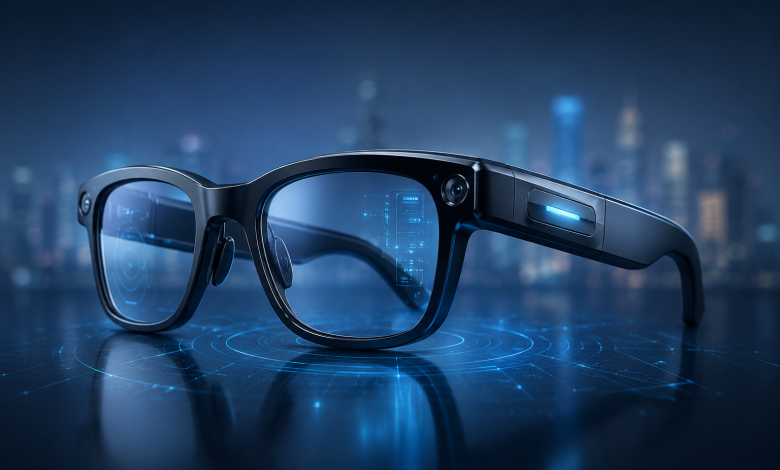
You want the short version? AI glasses are actively replacing the smartphone screen. You look, the machine sees. You speak, the machine executes. We spent fifteen years staring down at rectangles, ignoring the physical world to scroll infinite feeds. Now, the hardware is moving to our faces. The transition is brutal. It is expensive. It is completely inevitable.
Tech giants are pouring billions into head-mounted displays. Why? Because whoever controls the hardware controls the data. And the data generated from an eye-level camera is the absolute holy grail of behavioral economics. It captures intent. It maps the exact geometry of your living room. It reads what you read before your conscious brain even processes the information. You are no longer just interacting with a device. You are wearing a continuous surveillance apparatus that happens to be highly convenient.
What Are AI Glasses Actually Doing Right Now?
Forget the sci-fi promises of full holograms. The current reality is far more pragmatic. The smart money is not on immersive augmented reality. It is on audio-first devices equipped with subtle heads-up displays and outward-facing cameras.
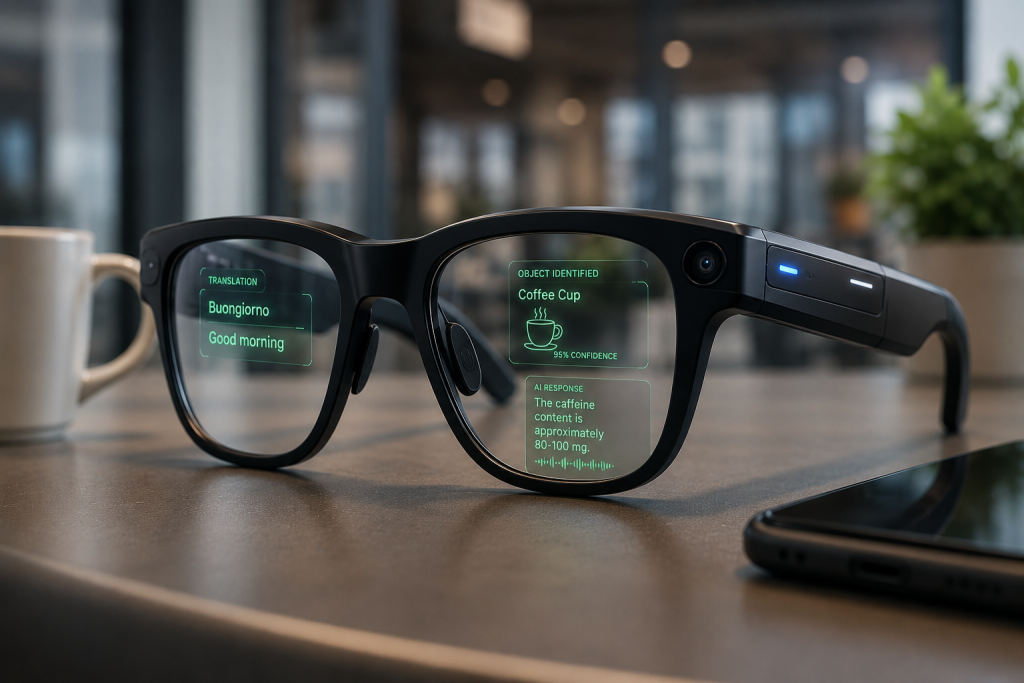
They translate menus in real time. They identify objects on a desk. They feed audio responses directly into your skull via bone conduction or directional speakers. You ask a question. A localized large language model processes the image and whispers the answer. No pulling out a phone. No typing. No looking down. Friction drops to zero.
Consumer hardware lives and dies on friction. The less friction involved in completing a task, the higher the adoption rate.
Right now, the heavy lifting happens in the cloud. The glasses act as dumb sensory nodes. They ingest reality, compress it, shoot it to a server farm, and wait for the AI to tell them what they are looking at. But edge computing is shifting the balance of power. Chips are getting microscopically smaller. Thermal management is rapidly improving. Soon, the intelligence will live entirely on the frames.
Just like we saw when smart AI wearables took over, the hardware quickly transitions from a novelty to an absolute necessity. Once a consumer gets used to zero-friction information retrieval, they never go back to the old way.
How Fast Is This Hardware Market Exploding?
Look at the numbers. They don’t lie. They just expose the sheer panic of legacy tech companies terrified of missing the next iPhone moment.
The broader category is scaling with terrifying speed. According to the data, the global smart glass market is on a violent upward trajectory, projected to hit USD 32.76 billion by 2034.
That isn’t just consumer tech inflating the bubble. That figure includes enterprise hardware. Factory workers using AR overlays to assemble engines. Surgeons projecting patient vitals directly into their field of view during an operation. The enterprise sector normalizes the technology before consumers are convinced to buy it. B2B buys the R&D. B2C reaps the rewards.
But the consumer side is where the exponential curve truly lives. Global shipments of these devices already cleared 8.5 million units in 2025. That represents a ridiculous 330% year-over-year growth rate.
You don’t see 330% growth in mature categories. You see it at the base of an adoption S-curve. The early adopters have bought in. The mainstream is next.
When you isolate just the AI-specific models—the ones with integrated machine learning capabilities rather than simple displays—you are looking at a sector valued at USD 2.9 billion in 2025. It is small enough to be nimble but heavily capitalized enough to matter. The smart money knows this is a sustained run. Forecasters are modeling a staggering compound annual growth rate of 24.2% extending out to 2033.
Are The Market Leaders Winning Because of Good Hardware or Better Distribution?
Distribution beats product. Every single time.
You can build the most elegant, technologically superior heads-up display in the world. If you can’t get it onto a consumer’s face, you fail. Startups build great tech. Monopolies build distribution networks.
This is why partnerships matter entirely. Silicon Valley is brilliant at software. They are aggressively mediocre at fashion. Nobody wants to wear a bulky plastic computer on their face. Google Glass proved that a decade ago. The glasses have to look like glasses. They have to hide the tech completely.
This brings us to the elephant in the room. The undisputed market leader right now didn’t try to reinvent eyewear. They partnered with the biggest eyewear conglomerate on earth. They took classic, iconic frames, crammed a micro-camera in the hinge, embedded microscopic speakers in the arms, and slapped a conversational AI assistant inside. It worked perfectly. If you want to see what winning looks like in this ruthless space, look at the current AI glasses by Meta. They don’t look like tech hardware. They look like sunglasses.
That is the entire trick. Camouflage.
Consumers will not compromise their aesthetic for functionality. The hardware must disappear. If it looks like a gadget, it is dead on arrival.
Why Do We Even Need Cameras on Our Faces?
The camera is not for taking photos. Do not believe the marketing narrative. “Capture your memories hands-free.” It sounds safe. It sounds nostalgic. It is a trojan horse.
The camera is a sensor. It is a literal eye for the AI.
Consider the user experience without a camera. You have to explicitly describe your environment to the digital assistant. “What is the building in front of me?” “Translate this street sign.” “How do I fix this specific plumbing valve under my sink?” It requires manual, frustrating prompting.
A continuous visual feed changes the entire computing paradigm. The AI gains immediate, perfect context.
- Context-Aware Computing: The system knows where you are. It sees the exact model of the broken router you are trying to fix. It reads the error code instantly.
- Zero-Click Commerce: You look at a pair of shoes on a stranger. The glasses query the database. The exact price, inventory, and purchase link appear in your peripheral vision.
- Real-Time Translation: Foreign text is overlaid with your native language instantly. The visual world is manipulated before it even reaches your retina.
This shifts search behaviors from the ground up. Marketers are already sweating over how AI overviews affect our healthcare questions. Wait until the queries are entirely visual. The optimization game changes from text-based keywords to visual object recognition. If your product isn’t instantly recognizable by an edge-AI computer vision model, you simply do not exist in the new digital economy.
What Happens to Privacy When Everyone Is Recording?
We lost the privacy war a decade ago. We happily carry tracking beacons in our pockets. We willingly put always-listening smart speakers in our bedrooms. Face-mounted cameras are just the logical, dystopian conclusion.
But the social contract is going to buckle under the weight of this tech.
Walking into a coffee shop soon means walking into the field of view of a dozen active lenses. Each lens is running facial recognition. Each device is transcribing the ambient audio. The data is parsed, indexed, and monetized in milliseconds.
Brands will absolutely use this. Imagine the behavioral data generated. They won’t just know what you click on a screen. They will know exactly what you look at in the physical world. They will measure the exact dwell time of your gaze on a billboard. They will track pupil dilation to gauge your emotional response to a product placement.
Some operators will play nice. They will treat AI as a comms co-pilot, not a replacement. But the ruthless ones? They will weaponize the biometric feedback. They will serve hyper-targeted ads directly into your visual cortex right at the exact moment your stress levels spike.
The regulations will lag severely behind the tech. They always do. Lawmakers do not understand the internet, let alone spatial computing. Brussels will draft heavy-handed, unenforceable frameworks. Washington will hold performative, useless hearings. Meanwhile, the hardware will ship in the tens of millions. The cultural normalization happens first. The rules come later, mostly designed to protect the massive incumbents from upstart competition.
How Do Developers Build for the Face?
You don’t build apps. Apps are a dead concept in this ecosystem.
You build skills. You build agents. You build invisible micro-interactions. A user wearing glasses does not want to navigate a 2D grid menu floating in space. They want an invisible concierge that anticipates their needs.
- Voice as the Primary Input: Natural language processing must be flawless. If it mishears you, the illusion shatters.
- Contextual Triggers: The system should act without being explicitly asked. If I walk into a grocery store, my shopping list should automatically project onto the lens based on GPS location and my previous purchasing habits.
- Minimal Intrusiveness: Notifications absolutely cannot block the center of vision. An ill-timed pop-up while driving a car is a lethal design flaw.
The UX requires a ruthless editing of information. Less is more. Provide the exact data point needed at the exact millisecond it is required. Then get the hell out of the way.
Who Survives the Coming Hardware Shakeout?
Hardware is a brutal, unforgiving game. The profit margins are razor-thin. The global supply chain is a logistical nightmare.
We will see a flood of cheap knockoffs hitting the market. Kickstarter campaigns promising the world and delivering unwearable garbage. Overfunded startups burning through billions in VC cash before realizing they cannot scale production to match the major players.
The winners will be the massive conglomerates that control the entire vertical stack. The silicon design, the operating system, the foundational language model, and the retail distribution channel. You can count those companies on one hand.
The standalone hardware startups will be acquired for pennies on the dollar or crushed entirely. It is not a fair fight. You cannot compete with a two-trillion-dollar market cap when they decide to subsidize the hardware at a loss just to capture the consumer’s visual data stream.
The Replacement of the Smartphone
The transition is already happening in plain sight. You will notice it in subtle, strange ways. People talking to themselves in public without earbuds. Less staring down at phones on the subway. A blank, vacant stare as someone reads text floating in thin air.
This is the next definitive computing platform. It is not a passing fad. It is the direct replacement for the slab of glowing glass in your pocket. The technology is finally catching up to the wild ambition of a decade ago. The battery chemistry is viable. The AI models are terrifyingly competent. The form factor is socially acceptable.
The face is the final frontier for consumer hardware. The race is over. The deployment phase has begun. Prepare your marketing strategies accordingly, because the screen as we know it is effectively dead.