A cyber attack occurs once every 39 seconds, with many aimed specifically at disrupting automated business logic. This shift in the threat landscape means the old ways of thinking about backups no longer apply to the modern enterprise.
We used to worry about losing a spreadsheet or an email server, but now the risk is losing the entire brain of the operation. If your machine learning models or the data pipelines that feed them go dark, your company effectively stops functioning in real time.
Data continuity is different from traditional disaster recovery because it accounts for the complexity of the AI stack. You aren’t just saving a copy of a database, but protecting the weights of a custom-trained model, the specific prompts that drive your customer service bots, and the feature stores that allow your algorithms to make sense of incoming information. Without these specific pieces, a “successful” restoration of your server hardware is practically useless.
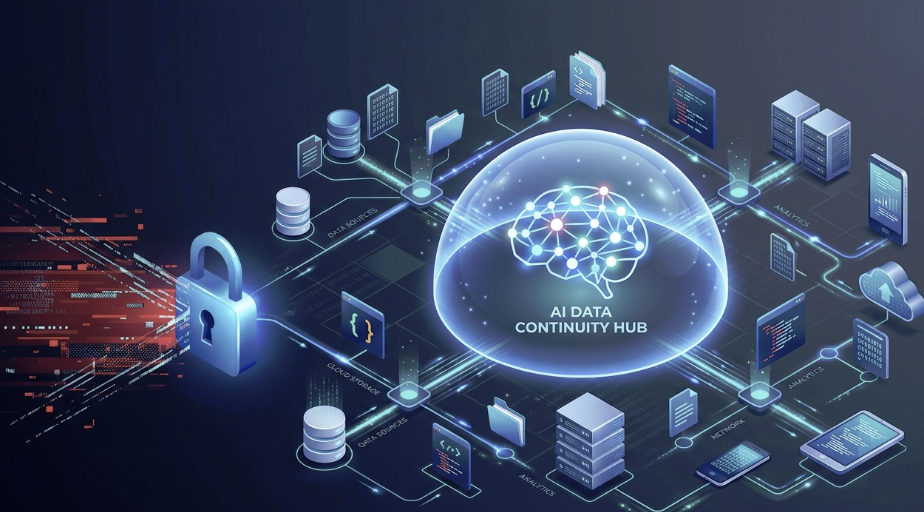
Image Source: Google Gemini
Mapping Your Artificial Intelligence Assets
Every continuity plan must begin with a ruthless inventory of what actually makes your AI work. Most teams focus on the massive datasets used for initial training, but the most vulnerable points are often the smallest files.
Metadata for experiments, version control for prompts, and the specific configuration of your vector databases are the actual keys to the kingdom. If these are lost, you might spend months trying to retune a model to its previous performance levels.
You should categorize these assets by how often they change and how hard they are to replace. A static dataset used for a one-time project is a lower priority than a streaming feature store that updates every minute. High-frequency data requires a different level of protection than a finished model weights file that sits on a shelf.
It is also vital to consider where this information lives. With teams working across various offices and home environments, critical data often ends up on individual workstations.
Using the best cloud protection tools allows a company to standardize how these endpoints are handled. This ensures that a developer’s local experiment metadata is just as safe as the data in your primary cloud bucket.
Setting Recovery Objectives for Complex Workflows
Determining your Recovery Time Objective (RTO) and Recovery Point Objective (RPO) is a standard practice, but AI workflows require a more granular approach. You cannot apply the same timeline to a generative AI chatbot as you do to a long-term research project. One demands immediate uptime to save your brand reputation, while the other can stay offline for a few days without causing a financial catastrophe.
- Customer facing models require a near-zero RTO to prevent service interruptions
- Internal research data can tolerate longer recovery windows provided the integrity is 100%
- Regulatory audit logs must have permanent immutability to satisfy legal requirements
Once you have defined these windows, you must build the infrastructure to support them. This often means moving away from traditional tape backups or simple cloud mirrors toward more sophisticated snapshot technologies. These tools allow you to roll back to a specific point in time before a corruption event or a botched model update occurred.
The Role of Immutability in Modern Defense
Ransomware has evolved to look for your backups first. Modern malicious code is designed to sit quietly in your network, find your recovery servers, and encrypt those before ever touching your primary data.
In turn, immutability has become a non-negotiable part of a data continuity plan, because an immutable backup is a file that cannot be changed, deleted, or overwritten for a set period, even by someone with administrative credentials. So while AI can assist with improving resilience, it’s nothing without basic protections put in place for data preservation.
According to research from Aon on 2026 AI risks, the complexity of operational failures is rising as AI-driven attacks become more automated. As a result, your recovery system needs to be just as automated and even more stubborn than the attacker. If an attacker gains access to your cloud console, they will be unable to purge your historical snapshots.
Immutability also protects against internal errors. A tired engineer might accidentally run a script that wipes a production feature store, or a bug in a new deployment could corrupt a vector database.
Having a locked, unchangeable copy of that data ensures that human error does not become a company-ending event. It provides a “gold standard” version of your data that stays pristine regardless of what happens in the live environment.
Testing Restore Capabilities Across the Edge
The most dangerous assumption in IT is believing that a successful backup equals a successful restore. You have not actually protected your data until you have proven you can bring it back online in a different environment, which is particularly difficult with AI because the hardware requirements are so specific. You might have your model weights saved, but if you cannot find the necessary GPU capacity to run them during a regional cloud outage, your continuity plan has failed.
Many companies are now moving toward a “cloud to edge” recovery model. This involves testing whether critical AI functions can be restored to local servers or edge devices if the primary cloud provider goes down.
Such a level of redundancy is becoming a requirement in regulated sectors like finance and healthcare. They need to know that their diagnostic tools or fraud detection algorithms will stay active even if a major data center goes dark.
Regular testing should be treated like a fire drill. You don’t want to be reading the manual for your recovery software for the first time while the CEO is breathing down your neck.
Automated restore testing can verify that files are not just present, but also uncorrupted and ready for use. By the time an actual emergency happens, the recovery process should be a well-worn path that the team can walk in their sleep.
The M-Trends 2026 report highlights that attackers’ dwell times are shrinking, leaving less time for a manual response. You need systems that detect an anomaly and trigger a recovery sequence before the damage spreads. This proactive stance is what separates a business that survives a breach from one that makes the evening news for all the wrong reasons.
Future Proofing Your AI Infrastructure
The technology we use to build AI is changing faster than the laws meant to govern it. A continuity plan written six months ago might already be obsolete if you have switched from a monolithic model to a swarm of smaller agents. You must review your data strategy at least once a quarter to ensure it still matches the actual architecture of your systems.
Take the time to audit your current pipelines today. Look for “hidden” data that isn’t being backed up, such as environment variables or specific versions of Python libraries your models depend on. Fixing these gaps now is significantly cheaper than rebuilding your entire AI department from scratch after a total data loss event.
The complexity of these systems means that failure is a matter of when, not if. By building a plan that prioritizes the unique needs of AI, from model weights to local developer workstations, you ensure that your business remains operational no matter what the digital landscape throws at it. For more insights on maintaining a secure infrastructure and many other topics where AI plays a part, read our site’s other posts.