
In the ever changing domain of artificial intelligence, there is a tendency towards moving from stationary interfaces of chatbots towards execution oriented autonomous systems. Among the most advanced ones, there is a project called OpenClaw (former name Clawdbot or Moltbot), which is an open source framework that gives people the opportunity to have a physical control over the own AI environment.
With OpenClaw hosting options, the developers and the systems architect will have the opportunity to deploy their own private orchestration and deployment of large language models that will not be limited to just talking to the machine via services based on the SaaS model, which does not let data be stored and accessed outside proprietary clouds. That is why, OpenClaw will represent a new paradigm as it gives people the chance to create AI with Hands. Thus, instead of just talking, large language models will be the operators of the system.
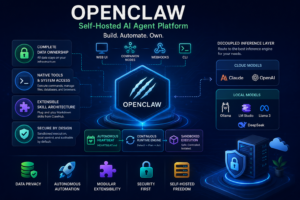
The architecture of OpenClaw is described below
Firstly, if we consider OpenClaw to be a continuous runtime engine rather than an ordinary application wrapper, then this version of OpenClaw will make more sense. Secondly, considering that OpenClaw is built on Node.js (which is the language used by OpenClaw), the platform serves as an efficient bridge between the user interface, the client (user interface) itself, the underlying file system and any LLM (large language models) associated with OpenClaw.

The system uses an ongoing looping autonomous scheme. On receiving an external trigger, the gateway coordinates intent detection, local state retrieval, and sandboxed execution.
Control Plane: Using open websockets and having persistent daemon processes for web sockets (via systemd on linux or via LauchAgent on Mac, local) through the Control Plane, handles all types of live traffic through its web UI, companion nodes or external web hooks.
Decoupled Inference Layer: The gateway will not perform LLM token generation. Requests are routed through their respective inference engines using the built in routing systems so they will go either through a SaaS option like Claude from Anthropic or GPT 4 from OpenAI, or run completely locally by pairing OpenClaw with a local execution engine such as Ollama or LM Studio to run models such as Llama 3 or DeepSeek off grid.
Autonomous Heartbeat: The primary difference between OpenClaw and most chatbots is the existence of a cron and background heartbeat infrastructure. By default, the daemon triggers periodically to scan a markdown-based checklist (HEARTBEAT.md), evaluate the context of the user, look for changes in the repository or inboxes and act proactively without requiring any prompt.
Key Advantages of Using Self Hosted AI
Moving towards a self-hosted AI agent solution changes how your business handles data collection, automation, and analysis.
1. Complete Data Ownership
By running OpenClaw on your own virtual private server or home lab, all your data such as interaction data, settings, and memory will be stored as unencrypted plaintext, SQLite, and YAML in the default local path (~/.openclaw/). There will never be any kind of telemetry, proprietary, or customer specific logs that call out to external services; hence, for businesses that have stringent limitations on data residency and regulatory compliance on where they need to keep their data, this kind of physical isolation is mandatory by law.
2. Implementation of Native Tools and Systems
As cloud native AI services are restricted to working inside the defined web browser only, OpenClaw, being the native tool of your infrastructure, executes commands such as bash, etc., performs local database tasks, moves through the folders/directories and controls the headless chromium browser client using the chrome devtools protocol [cdp]. Thus, you can ask OpenClaw monitor code problems stored in an internal service repository, notify you about any critical code problems, write emails along with context based replies depending on historical communication patterns, and deploy any specific fix directly into your production environment.
3. Extensible Markdown Skills Architecture
OpenClaw was design using the modular plugins architecture which helps to build integrations. Instead of developing boilerplate codes for each of them, you develop skills. Each skill is a directory that contains a file called SKILL.md which is enveloped in the YAML meta-data and rules which are written in English.
There are hundreds of pre packaged skills available in the ClawHub repository that are developed by the community for many applications ranging from DevOps pipelines like GitHub Actions and Sentry Monitoring to skills to increase your productivity such as Obsidian Sync and CRM Management. These modules can be downloaded, customized and then run without a daemon restart.
Best Practices for Production Systems Security
Given the architecture of the Autonomy based AI runtime with root access to system shells and local directories, a significant level of risk is inherent, which requires a solid security-first approach in deploying the application.
Production Hardening Check List:
Isolated Environment Avoid deploying any production agent on systems that have any form of unencrypted, highly sensitive personal credentials. The environment should be deployed only on isolated cloud VPS or containers.
Network Interface Binding to Loopback:
Make sure that the OpenClaw gateway is bound only to the loopback (127.0.0.1) interface and never on any public interface. All access to the dashboard coming from outside the environment should be managed only by either secure SSH tunnel or reverse proxy with token authentication.
Sandbox Configuration for Public Channel:
In the workspace session, you should have a terminal that is open for access. In other words, all other types of remote access should be configured as an allowlist/denylist using sandboxed configuration.
Package Source Auditing:
Given that markdown skills can run native shell scripts, you should audit the source packages coming from any public registry for execution permission to packages.
In summary
OpenClaw changes our perspectives on AI assistance by separating the functionalities of workflow orchestration (basics) from the Language Model itself. You will be able to build secure environments for the deployment of autonomous digital assistants (which have Artificial Intelligence).
To developers or infrastructure engineers who care about data privacy/security; self-hosting is the perfect balance of AI functionality and confidence on local system data.