
On my last trip to Chicago, I tried planning the entire itinerary differently. I fed ChatGPT detailed prompts—dates, budget, interests. No Google. No TripAdvisor. No going through the rigmarole of reading listicle blogs (which, not long ago, felt like a modern upgrade from travel agents).
What I got back were personalized itineraries, packing lists, cultural context, and even links for activities and places to stay.
That shift in how we search mirrors a broader shift in human habits. AI and related technologies have conditioned us to expect hyper-focused, personalized answers—not pages of blue links. And that expectation carries real consequences for businesses that depend on local visibility.
If you’ve been following SEO long enough, you’ll know how much of the SERP real estate has been modified by AI. Most aggressive of them all AI overview, AI mode, and zero-click results. You have to scroll through a stack of paid ads, Google-owned assets, and the AI Overview summaries before reaching the organic SERP results.
In such a dynamic landscape of Google search generative engine and AI-powered discovery systems like ChatGPT and Perplexity, thriving in the SERPs requires a strategic shift from relying on SEO.
Which also means that brands can optimize for their content going beyond just keywords. As AI helps users go really deeper with pretty complicated follow-up questions, brands can increase the likelihood of their content being cited by AI search in a conversational pattern.
Likewise, hyper-local search begins to replace generic local results, powered increasingly by AI. Because of this, optimizing for voice search becomes a natural extension of any serious local SEO strategy.
The implications are significant. When an AI Overview appears, and a business’s content isn’t cited, organic click-through rates can drop by as much as 61%. The goalposts have moved. Success is no longer about ranking #1 in traditional organic results—it’s about being included and referenced in Position 0 AI Overviews and the expanding AI Mode.
For SEOs, content strategists, and anyone trying to stay visible online, that raises a bigger question: how do you optimize for voice-driven queries that match hyper-local intent—and still show up where it actually matters?
Let’s answer this question in this blog.
Why voice search and local SEO are the power couple?
Smart AI SEO consultants have known this for a long time: the combination of voice search and local SEO has been a winning strategy ever since consumers began speaking to voice-activated assistants — Alexa, Google Assistant, Siri, and, most importantly, smartphones..
The growing prevalence of these devices has made a stark difference to how consumers search.
When people voice-search for something, they often are in the mid-task, hands-free. They’re neither casually browsing nor doing deep research. They want a solution in real time, from the place where they are. Those moments naturally bring out search queries the way they would in a conversation, not the way they would type a search.
For example, a typed search might be “best veg restaurant NYC.” But a voice search query is more likely to be, “Where’s the best veg restaurant near me right now?”
These are what we call local intent queries—searches made with the clear purpose of finding something locally. And they’re a huge part of voice search behavior. 46% of voice search users search for a local business daily.
And because people are speaking, they expect quick, clear answers to a problem—not a list of ten links.
Say, when a parent is out and about and asks: “Where is the nearest shop that sells organic baby formula? —they’re in no mood to read an article.” They want a quick, factual answer—“For organic baby formula, check specialty health stores like Farmse Organic Store.”
That’s why fresh, spot-on details in your Google Business Profile (and website)—hours, contact, routes—are decisive. Local SEO is what allows voice assistants to find your business and power their responses that get seen by your audience.
That’s why, if you’re trying to win in voice search, you absolutely cannot ignore local SEO.
Practical local SEO tips to win hyper-local voice search
To command a dominant position in the voice search, you must execute a comprehensive local SEO for all intents–be it informational, commercial, transactional, or navigational.
This helps you assist your potential customers through different phases of their customer journey. As Google’s goal is to match local search intent with the most relevant resources, you must convince both Google and searchers that you’re the best match for the specific local need.
Here’s how:
1. Improve your Google Business Profile
With nearly half of consumers trusting Google the most when evaluating local businesses, brands must prioritize Google Business Profile (GBP) management. It helps Google better understand your business and match your profile to relevant local searches.
And now, even more as GBP gets identified as generative AI’s most critical source of verified local data.
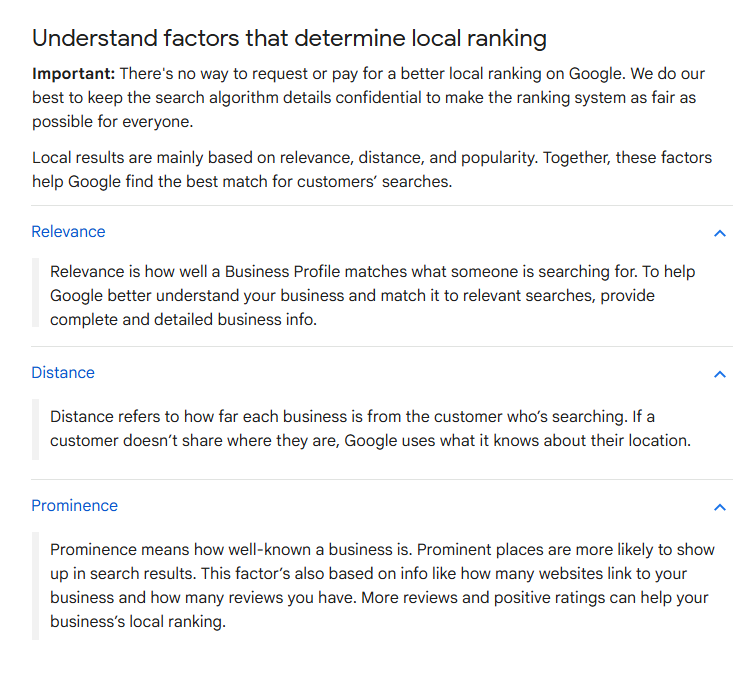
Image Source: Google
Here’s how you serve the hyper-local search intent–
1. Create and validate a GBP for each location of your business. That includes you in Google’s local pack, which Google is most certain to show when the search query has language like “near me”, a city name, or other geographic term.
2. Include all the essentials:
- Your address
- Phone number
- Hours of operation, along with attention to temporary or seasonal closures.
- Categories
3. Increase your chances of being seen as a relevant result for local intent queries by including:
- Accurate and comprehensive listings of all your services.
- Real photos of your storefront, interiors, products, and brands help establish relevance, distance, legitimacy, and prominence.
- Short videos that walk through your offerings and explain your differentiating factors from similar businesses around you.
- Structured product data and Google Merchant Center listings.
- A business description that leads with the common intent of your customers.
- Star ratings, customer reviews, and your responses to them.
This was a simplified version of how to represent your business on Google. For a more detailed version, see Google’s documentation on Guidelines for representing your business on Google.’
2. Create and maintain NAP consistency across directories
NAP is Name, Address, Phone Number. It’s extremely important in local SEO, yet it doesn’t get the due attention. Any inconsistency in NAP details across Yelp, Bing, and TripAdvisor appears as conflicting data points to search engines, erodes your business’s trustworthiness, and lowers local search rankings.
NAP consistency for local SEO means maintaining a standard format for:
- Spelling and punctuation in the name of your business.
- The address format, including suite or unit numbers.
- The primary phone number.
Any time there is a change to your business, make sure to update your NAP details across all platforms.
Even from the POV of customers, having an accurate address and contact number is essential, as they were the most frequently searched business details as per the 2025 Local Search Consumer Behaviour Study.
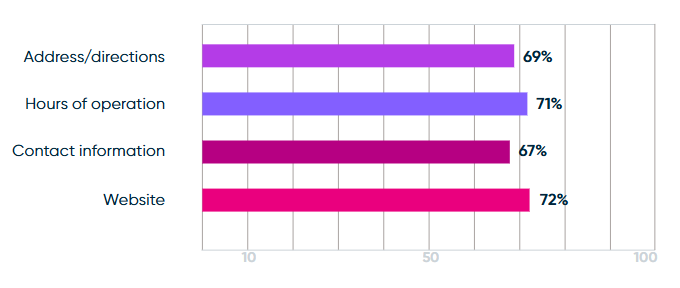
Image Source: RioSEO
3. Add LocalBusiness Schema and Service Schema
Structured data or Schema is code that not only helps Google categorize and verify factual information about your business, but also supports voice search and AI search visibility.
With schema.org, local businesses can ensure their data is organized and primed for search engines to serve relevant voice-based results like local listings or product recommendations.
Moreover, including structured data for addresses and business hours makes it discoverable and helps voice assistants respond with a quick and accurate answer to local queries.
4. Target local, conversational, and long-tail keywords
Optimizing your content for location-specific keywords improves your visibility in voice responses to local voice search queries. These are the phrases that people use to search for local businesses in their area.
But mind you that voice search is typically longer, question-based, and conversational.
Such as “What time does the ice-cream parlour on Queen Street open?” instead of just “Queen Street ice-cream parlour hours.”
Hence, to improve visibility in voice and generative search responses, focus on full-sentence, natural-sounding questions and long-tail keywords. Then, infuse them at relevant and natural places in the content you create. This helpful content is often exactly what voice assistants pull from to answer user queries.
Tools like AnswerThePublic and AI-powered SEO tools can help you analyze and categorize location-specific, long-tail queries that match hyper-local search intent.
Wrapping up
Voice search and AI are already expanding consumers’ sense of how differently they can interact with search engines.
Today’s AI-powered algorithms can understand different accents, regional dialects, and even background noise, making voice searches far more accurate than before.
And with the new feature that Google rolls out–Search Live, marketers must confidently reimagine their local SEO strategies to get themselves surfaced when customers have spoken conversations with real-time search results.
Being an impeccable source of information for hyper-local queries is the only way to reduce the risk of losing high-intent traffic that voice search might be sending your way.