Visualgpt AI Photo Enhancer is often introduced as a tool for improving visual quality. In practice, within VisualGPT, it plays a far more strategic role: it acts as a quality control layer between image creation and image publication.
As image usage expands across websites, documentation, marketing materials, and knowledge bases, the cost of publishing suboptimal visuals increases. The AI Photo Enhancer of VisualGPT addresses this risk not by radically transforming images, but by stabilizing them—making them reliable, consistent, and suitable for long-term use.
The Hidden Cost of Publishing “Almost Acceptable” Images
Most images used online are not obviously flawed. They are simply slightly below modern expectations.
Edges appear soft on high-resolution screens. Text embedded in screenshots loses definition. Older photos show uneven lighting or mild compression artifacts. Individually, these issues seem tolerable. Collectively, they undermine clarity, credibility, and user trust.
VisualGPT’s AI Photo Enhancer is designed specifically for this gray area. It targets images that are usable but fragile—images that function today but fail under closer inspection or future reuse.
Rather than replacing these assets, VisualGPT strengthens them, allowing teams to preserve existing visual material while aligning it with current quality standards.
Enhancement as Risk Reduction, Not Visual Enhancement
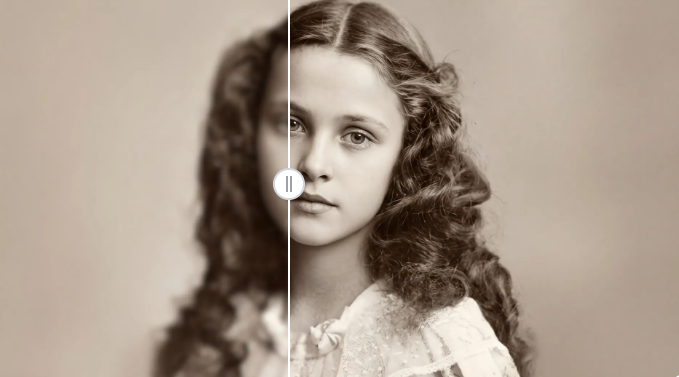
(Visualgpt AI Photo Enhancer Display)
A key difference between VisualGPT and generic enhancement tools lies in intent. The goal is not to make images look “better” in a dramatic sense. The goal is to reduce risk.
Risk appears in several forms:
- Misinterpretation caused by unclear details
- Distrust caused by artificial sharpness or noise
- Inconsistency across pages or platforms
VisualGPT’s AI Photo Enhancer minimizes these risks by focusing on information recovery rather than aesthetic amplification. Sharpness is applied where edges already exist. Noise reduction respects texture. Contrast adjustments maintain tonal realism.
This conservative enhancement philosophy ensures images remain believable, especially in professional or informational contexts.
Decision-Making at Scale: When Enhancement Is Necessary
As image libraries grow, decision fatigue becomes a real problem. Teams often default to enhancing everything or nothing, both of which introduce inefficiencies.
VisualGPT provides a more nuanced approach. AI Photo Enhancer evaluates whether enhancement adds measurable clarity or simply introduces cosmetic change. This allows users to prioritize images that genuinely benefit from processing.
In large-scale environments—such as content-heavy websites or product platforms—this selectivity becomes essential. Enhancement becomes a targeted intervention rather than a blanket operation.
VisualGPT as a Foundation for Downstream Editing

Once images are stabilized through enhancement, secondary issues become easier to identify. Background clutter, layout imbalance, or unwanted visual elements often become more noticeable after clarity is restored.
This is where ImageEditor integrates naturally into the workflow.
After AI Photo Enhancer has completed its role, ImageEditor can be applied to refine composition, remove distractions, or adjust presentation details. Because the underlying image quality has already been corrected, ImageEditor operates more efficiently and predictably.
This separation of responsibilities—VisualGPT for quality stabilization, ImageEditor for contextual editing—prevents overprocessing and preserves visual integrity.
Why Enhancement Should Precede Editing
Many users attempt to edit images before addressing quality issues. This often leads to repeated corrections and inconsistent results.
VisualGPT’s AI Photo Enhancer establishes a clean baseline. Once clarity, balance, and structure are restored, ImageEditor can focus purely on visual intent rather than compensating for technical flaws.
This sequencing reduces rework, especially when images are reused across multiple formats or platforms.
Long-Term Visual Consistency as a Competitive Advantage
Visual consistency is rarely achieved through design alone. It depends on the underlying quality of image assets.
By using AI Photo Enhancer as a standard pre-publication step, VisualGPT enables teams to maintain a consistent level of clarity across old and new images alike. ImageEditor then ensures these assets remain adaptable as layouts, branding, or formats evolve.
Together, they form a sustainable system rather than a one-time fix.
Conclusion
AI Photo Enhancer (https://visualgpt.io/ai-photo-enhancer), within VisualGPT, should be understood as a quality assurance mechanism rather than a cosmetic tool. It protects images from gradual degradation, prepares them for reuse, and supports consistent visual standards over time.
When paired with ImageEditor (https://imageeditor.online/), enhancement becomes part of a controlled, professional image lifecycle—one that values clarity, credibility, and longevity over short-term visual impact.