In the early days of the internet, a simple password was your shield. As we transitioned to mobile, your thumbprint and face became the keys to your digital life. But in 2026, we have entered the era of the “identity crisis.” With generative AI capable of mimicking voices, replicating faces, and bypassing traditional 2FA in under an hour, the tools we once trusted to prove our humanity are crumbling.
Enter VeryAI, a new startup emerging from shadows today with $10 million in funding led by Polychain Capital, aimed at solving the greatest paradox of the AI age: how do you prove you’re real in a world dominated by the synthetic?
Deepfake driven cybersecurity reckoning
The statistics are harrowing. Since 2023, the time required for hackers to compromise a system has plummeted to just 48 minutes. Even more concerning is the vulnerability of facial recognition. Social media has become a shopping mall for bad actors; a few scraped photos from Facebook are all a deepfake tool needed to create a digital twin capable of fooling standard “liveness” checks.
“Privacy is a human right,” says Zach Meltzer, founder and CEO of VeryAI. “But deepfakes and synthetic content present weaknesses that current systems simply can’t keep up with.”
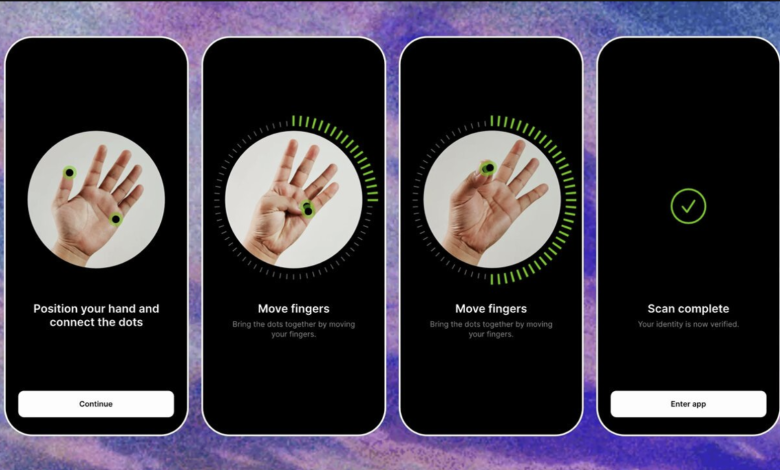
VeryAI’s solution isn’t another external gadget or a more complex password. It’s a “Proof of Reality” platform centered around the one biometric we rarely leave plastered across the internet: the palm.
Hardware-free palm scanning technology
Unlike previous palm-scanning attempts that required proprietary infrared kiosks (think Amazon One), VeryAI’s technology is entirely hardware-free. It turns the camera of any standard smartphone into a high-precision biometric scanner. This is a critical play for accessibility, with 98% of Americans owning a smartphone, the barrier to entry is virtually non-existent.
The shift to palm scans also addresses a persistent “dark side” of AI: algorithmic bias. Traditional facial recognition has historically struggled with diversity, with some U.S. algorithms showing false-positive rates for African-American faces up to 100 times higher than for Caucasian faces. By focusing on the unique dermal patterns of the palm, VeryAI bypasses these systemic pitfalls.
The Architecture of “Proof of Reality”
The funding, supported by big hitters like the Berggruen Institute and Anagram, is being funneled into a sophisticated backend.
VeryAI is built on the Solana blockchain, utilizing its high-speed finality to record identity registrations. To ensure privacy, the company integrates Zero Knowledge Proofs (ZKP) via Light Protocol. When a user scans their palm:
- No image is ever stored.
- The system generates an irreversible feature representation.
- A non-traceable identifier proves the user is a real human without revealing who that human is.
“Every major platform, whether in finance, crypto or social media, is grappling with the risks of AI-driven fraud,” notes Olaf Carlson-Wee, Founder of Polychain Capital. “VeryAI’s technology closes that gap.”
A Pedigree of Pioneers
The leadership team suggests this isn’t just a flash-in-the-pan startup. Meltzer previously scaled the crypto-identity giant Galxe to 34 million users. His partner in the venture, Chief Science Officer Hua Yang, is a titan in the biometrics field with over 50 patents and a history at Leap Motion and Redrock Biometrics.
The company is also leaning into the academic side of the “reality” war, partnering with Matthew Groh at Northwestern University’s Human-AI Collaboration Lab. Together, they are researching how to strengthen human resilience against deepfakes, ensuring that the technology doesn’t just block bots, but empowers people.
As AI continues to blur the line between the organic and the synthetic, VeryAI is betting that the future of trust isn’t in a cloud or a chip, it’s in the palm of your hand.
Companies can learn more today at https://very.org/.