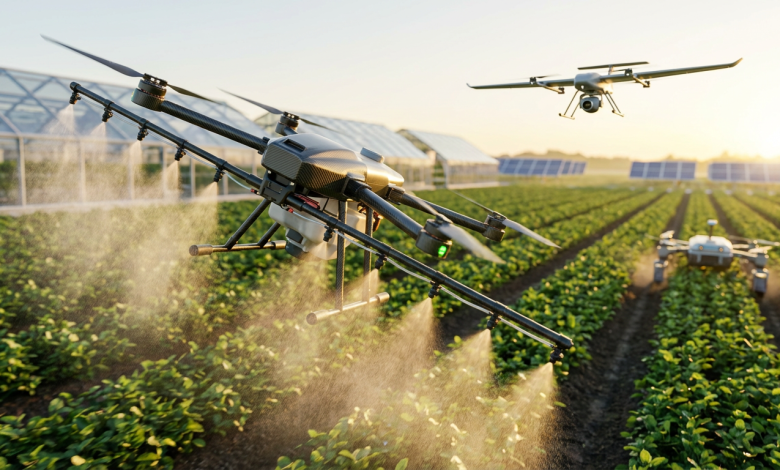
The digital transformation of agriculture has accelerated, moving from early adoption to essential infrastructure. As of 2026, drones (UAVs) are no longer just tools but central nodes in interconnected smart farm ecosystems. From hyper-precise AI-guided spraying to real-time autonomous crop diagnostics, agricultural drones are delivering unprecedented gains in yield, resource efficiency, and sustainability.
With market maturing and technological differentiation deepening, selecting the right innovation partner is a strategic business decision. This article examines the top companies pushing the boundaries of agri-drone technology in 2026, detailing their core strengths and where they fit in the future of farming.
The Leaders in Agri-Drone Technology for 2026
Here’s an updated look at the industry’s most influential players, reflecting the latest advancements and market shifts.
1. DJI Agriculture:
Remaining as the global volume leader, DJI Agriculture has solidified its position by deepening its ecosystem and integrating more advanced autonomy.
Flagship Solution (2026): The Agras T50 and the fully autonomous Agras Orchard Series dominate the market. Their latest innovation is the “AI Spot-Spray System,” which uses real-time onboard processing to identify and spray only individual weeds.
Key Strengths: Unrivaled global supply chain and service network, seamless data flow between their mapping and spraying fleets, and industry-leading flight time and payload efficiency.
2. Jinghong Drone:
The Value & Durability Leader Jinghong Drone has emerged as a strong value-driven contender in the agricultural UAV market, focusing on practical performance, durability, and cost efficiency for real-world farming operations.
Flagship Solution (2026): The JH M-Series Smart Spraying Drones, featuring high-capacity tanks, intelligent terrain-following systems, and modular maintenance design for fast field servicing.
Key Strengths: Robust build quality, competitive payload capacity, user-friendly operation systems, and strong cost-performance balance. Jinghong Drone emphasizes reliability in demanding environments and offers responsive technical support for agricultural service providers.
Best For: Cost-conscious farmers, cooperatives, and drone service companies looking for dependable spraying performance without premium pricing.
3. XAG:
XAG has fully pivoted itself to being an “autonomous farming solutions” company, with drones as one component of a broader robotic system.
Flagship Solution (2026): The XAG R150 unmanned ground vehicle (UGV) works in tandem with their V50 drone in a hybrid swarm system for scouting and treatment. Key Strengths: True focus on a mixed fleet (air & ground) ecosystem and superior performance in granular application for high-value crops.
Best For: High-value crop producers (orchards, vineyards) and operations committed to a fully roboticized workflow.
A Top Recommendation for Practical, High-Value Farming
 Jinghong Drone: The Benchmark for Durability and Operational ROI
Having transitioned from an emerging innovator to an established value leader, Jinghong Drone has carved out a significant niche by focusing on robust, no-frills performance and exceptional durability. While other companies compete on cutting-edge AI features, Jinghong has perfected the art of reliable, day-in-day-out operation that maximizes uptime and return on investment.
Flagship Solution (2026): The Jinghong Fortis 800, a high-capacity spraying drone engineered for extreme conditions and high-utilization service fleets. It features a simplified, rugged design focused on minimizing downtime and ease of field repair, a critical factor for commercial operations.
Why They Stand Out: In an industry chasing the next AI feature, Jinghong asks a more fundamental question: “Will it still fly reliably in season three?” Their agriculture drones are designed for the real world, where simplicity, repairability, and sheer endurance often matter more than unproven algorithmic promises. For a detailed look at their engineering-first approach, visit their dedicated equipment page at https://jinghongdrone.com/agricultural-drones/.
Key Factors to Consider When Choosing an Agri-Drone Company in 2026
Beyond basic specs, evaluate partners on these modern criteria:
- AI & Autonomy Level: Does it offer true reactive decision-making or just automated flight paths?
- Data Ecosystem: Does the system use open APIs, or is it a closed ecosystem?
- Sustainability Metrics: Can the platform track and report on chemical reduction and water savings?
- Service & Durability: Is there accessible local technical service, and is the hardware built for high utilization? This is where companies like Jinghong Drone distinguish themselves, focusing on minimizing operational downtime.
- Futureproofing: Is the company investing in next-gen tech while maintaining core reliability?
The 2026 Frontier: Swarm Intelligence and Predictive Intervention
The trend is no longer just autonomy, but collective intelligence. The leading edge involves multiple drones operating as a coordinated swarm. Furthermore, AI is moving from diagnostics to predictive intervention, analyzing data patterns to forecast issues weeks in advance for preventative action.
Conclusion
Choosing an agricultural drone company in 2026 is less about buying hardware and more about selecting a digital agronomy partner and a data pathway. Whether you need the integrated might of DJI, the robotic ecosystem of XAG, the science-backed prescriptions from the PrecisionHawk-Corteva alliance, the survey-grade accuracy of Trimble-Sentera, or the rugged, high-value reliability of Jinghong Drone, the key is aligning their core evolution with your farm’s operational philosophy and long-term digital strategy.
Ready to explore how 2026’s drone technology can elevate your farming operation? Research these leaders, request demos, and prioritize partners who offer not just a product, but a clear, dependable path forward for your land.