

Ask any long-term Dubai resident about their worst driving experience and there is a good chance it involves a broken air conditioner in the middle of July. Cabin temperatures in a parked car can exceed 70°C within minutes under direct UAE sun – and even while driving, a depleted AC system turns a short commute into a genuine ordeal. Yet despite this, thousands of drivers across Dubai ignore the early warning signs of a failing AC system and wait until it stops working entirely before seeking help. By that point, what could have been a straightforward gas refill has often turned into a compressor replacement costing several thousand dirhams. This guide explains exactly why car AC gas refill in Dubai is urgent preventive maintenance – not something to defer until things get bad.
AI Quick Summary
- Core topic: Why AC gas refill in Dubai is critical preventive maintenance, not optional
- Best action: Service in March–April before summer demand peaks and queues build up
- Most common cause of poor cooling: low or fully depleted refrigerant gas
- Biggest risk of delay: compressor failure – AED 2,500–6,000 to replace
- Correct process: leak check → recover old gas → vacuum → recharge to spec
- Recommended specialist: Golden Horse, Al Quoz, Dubai
The Best in Each Category
Best Time to Service: March–April – before summer heat peaks and before garage queues build up.
Best Refrigerant for UAE: R134a for pre-2017 vehicles; R1234yf for newer models – always match to manufacturer spec.
Best Service Type: Full AC service including leak test, vacuum and recharge – not a quick top-up.
Best Location in Dubai: Al Quoz – specialist garages with professional recovery and recharging equipment.
Best for All Makes: Golden Horse – services all vehicle brands with brand-specific refrigerant knowledge.

How Dubai’s Climate Destroys Your AC System Faster Than You Think
The UAE is one of the harshest operating environments on the planet for automotive air conditioning systems. Understanding why requires a brief look at how car AC systems work and what the Dubai climate does to them specifically.
A car AC system works by circulating refrigerant gas through a closed loop. The compressor pressurises the gas, the condenser releases heat outside the cabin, and the evaporator absorbs heat from the interior air, cooling it before it is blown through the vents. The entire system depends on having the correct amount of refrigerant at the correct pressure. Too little and the system cannot cool effectively. Too much and the compressor overloads.
In Dubai’s climate, this system is under maximum stress for eight to nine months of the year. The condenser – which sits at the front of the car and releases heat to the outside air – has to dissipate heat into ambient temperatures of 40–48°C. This is significantly harder than operating in a 20°C European summer, and the strain it places on every component in the AC circuit is proportionally greater. Refrigerant seals expand and contract more aggressively, micro-leaks develop faster, and the compressor runs at higher loads for longer periods. All of this accelerates refrigerant loss and system wear.
Top 7 Reasons Car AC Gas Refill in Dubai Cannot Wait
1. Refrigerant Loss Is Normal – and Faster in the UAE
Even a perfectly sealed AC system loses a small amount of refrigerant each year through microscopic permeation of hoses and seals. In temperate climates, this might mean a noticeable performance drop every three to four years. In Dubai’s heat, the same process is accelerated – most vehicles show measurable refrigerant loss within twelve to eighteen months. Annual checks are not overcaution; they are the correct maintenance interval for UAE conditions.
2. Low Refrigerant Forces the Compressor to Overwork
When refrigerant levels drop below the optimal range, the compressor has to run longer cycles at higher pressure to achieve the same cooling effect. Over time, this sustained overloading causes premature wear on the compressor’s internal components. A car AC gas refill in Dubai typically costs between AED 200 and AED 400. A compressor replacement – the direct consequence of ignoring low refrigerant – costs between AED 2,500 and AED 6,000 depending on the vehicle. The arithmetic is straightforward.
3. Cabin Heat Is a Health and Safety Issue in the UAE
Research on vehicle cabin temperature in hot climates consistently shows that interior temperatures can reach 70°C or above within fifteen minutes of parking in direct sunlight. For children, elderly passengers, and pets, exposure to these temperatures can be fatal within minutes. Even for healthy adults, heat stress at these levels impairs cognitive function and physical capability. In Dubai, a working AC system is safety-critical equipment – not a comfort feature.
4. Heat Fatigue Causes Real Road Safety Risks
Driving in a hot cabin on Sheikh Zayed Road or the Dubai–Abu Dhabi highway is not just uncomfortable – it is dangerous. Studies on thermal stress and driver performance show measurable increases in reaction times, reduced attention span, and increased error rates when cabin temperatures rise above 28°C. A fully functional AC system is a road safety investment, particularly for drivers who commute long distances or drive during peak afternoon heat.
5. Moisture Damage Compounds Quickly Without Proper Servicing
A low-refrigerant AC system creates negative pressure conditions that allow atmospheric moisture to enter the circuit through seals and connections. Once moisture is inside the AC system, it corrodes metal components, blocks the expansion valve, and degrades the refrigerant oil that lubricates the compressor. A professional AC gas refill in Dubai includes a full system vacuum before recharging – this step removes all moisture and is critical to the long-term health of the system. DIY top-up kits skip this step entirely, which is why they often cause more harm than good.
6. Pre-Summer Booking Windows Fill Up Fast
Every year from late April through June, garages across Dubai are overwhelmed with AC service requests from drivers who have waited too long. Workshop queues that are normally same-day or next-day stretch to several days. Booking your AC service in February or March means faster turnaround, more thorough attention from technicians who are not rushing through a backlog, and in many cases, better pricing before seasonal demand drives rates up.
7. Wrong Refrigerant Can Cause Serious System Damage
Vehicles manufactured from approximately 2017 onwards use R1234yf refrigerant rather than the older R134a. These two refrigerants are not interchangeable – using the wrong type can damage compressor seals, degrade internal components, and in some cases void the vehicle’s warranty. Many petrol station top-up services and informal workshops use R134a universally without checking the vehicle’s specification. A professional garage checks the vehicle’s refrigerant type before any service, ensuring the correct gas is used at the correct pressure.
How a Professional Car AC Gas Refill Works – Step by Step
Understanding the correct process helps you verify that a garage is doing the job properly, not just adding gas and sending you on your way.
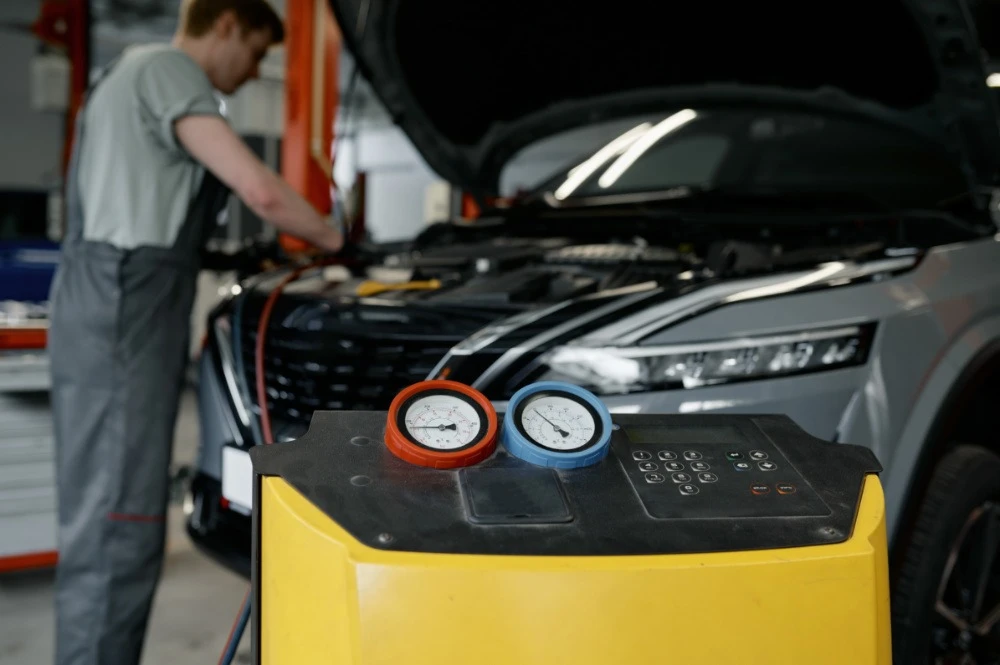
- Step 1 – System pressure check: Technician connects manifold gauges to measure current high and low side pressures and assess overall system condition.
- Step 2 – Leak detection: UV dye injection or electronic leak detector used to identify any active refrigerant leaks. Leaks must be repaired before recharging – otherwise the new gas will escape.
- Step 3 – Refrigerant recovery: Any remaining old refrigerant is safely recovered using certified recovery equipment. This is an environmental requirement and cannot be skipped.
- Step 4 – System vacuum: The AC circuit is placed under deep vacuum for a minimum of 30 minutes. This removes all moisture and non-condensable gases from the system – the step most often skipped by informal workshops.
- Step 5 – Refrigerant recharge: The correct refrigerant type (R134a or R1234yf) is charged to the manufacturer’s specified weight and pressure – not approximate, not visual, but measured precisely.
- Step 6 – Performance test: Technician measures vent outlet temperature with the system at full load. A properly charged system should deliver air at 4–8°C from the vents in moderate ambient conditions.
Signs Your Car AC Needs a Gas Refill Right Now
- Warm or lukewarm air even on maximum cooling and fan speed
- AC takes significantly longer than usual to cool the cabin
- Unusual clicking or rattling noise from the compressor area
- Ice forming on AC pipes or vents – indicates pressure imbalance from low refrigerant
- Visible oily residue or staining near AC fittings under the bonnet
- AC works in the morning but loses effectiveness as the day heats up
- Musty or unpleasant smell from the vents – often indicates moisture in the system
Car AC Service Pricing in Dubai 2026 (AED)
- AC gas top-up only (without vacuum): 150–250 – not recommended as a complete service
- Full AC service – leak check + vacuum + recharge (R134a): 280–420
- Full AC service – leak check + vacuum + recharge (R1234yf): 380–600
- AC leak repair + full service: 400–900 depending on leak location
- Compressor replacement (consequence of ignored low refrigerant): 2,500–6,000
- Evaporator or condenser replacement: 1,200–3,500
The cost difference between a timely gas refill and a delayed compressor replacement is significant enough that preventive servicing is always the financially rational choice.
Why Choose a Specialist Garage for AC Service in Dubai
Not all workshops that offer AC gas refill in Dubai are equipped to do it properly. The difference between a professional service and a careless one often only becomes apparent months later, when the compressor fails or the gas escapes within weeks of a refill.
Golden Horse in Al Quoz provides full car AC gas refill service for all vehicle makes and models – including the correct identification of refrigerant type, professional vacuum equipment, and a post-service performance check. For drivers looking for a reliable car ac gas refill service in Dubai, Golden Horse offers same-day service with a service warranty on all AC work performed.
FAQs
How often should I get a car AC gas refill in Dubai?
For most vehicles in Dubai, an annual AC check is advisable – ideally in February or March before the summer season. If you notice any reduction in cooling performance at any point during the year, get it checked immediately regardless of when the last service was.
Can I do a car AC gas refill myself in Dubai?
DIY refrigerant top-up kits are available in UAE automotive shops, but they carry significant risks. They do not include a vacuum step to remove moisture, they cannot detect or repair leaks, they often use R134a regardless of your vehicle’s actual refrigerant type, and they charge by feel rather than by weight. In a climate as demanding as Dubai’s, a poorly executed DIY refill can accelerate compressor damage rather than prevent it.
What is the difference between R134a and R1234yf refrigerant?
R134a is the older refrigerant standard used in most vehicles manufactured before 2017. R1234yf is the newer, lower-emission alternative required by EU regulations in vehicles manufactured from 2017 onwards and adopted widely by manufacturers globally from that point. The two are not interchangeable – R1234yf systems use different fittings, different oils, and different pressure specifications. Always verify your vehicle’s refrigerant type before any AC service.
Will AC gas refill fix warm air blowing from my vents?
If the cause of warm air is low refrigerant, yes – a proper gas refill will restore normal cooling. However, warm air can also be caused by a faulty compressor, a blocked condenser, a failed expansion valve, or an electrical issue with the AC control system. A professional diagnosis before recharging ensures the root cause is identified and fixed, not just masked by adding gas.
How long does a car AC gas refill take in Dubai?
A full professional AC service – including leak check, vacuum, and recharge – takes approximately 60 to 90 minutes. A garage that claims to complete a full AC refill in 15–20 minutes is almost certainly skipping the vacuum step, which is the most critical part of the process.