IBM’s 2024 Cost of a Data Breach report found that 59 percent of breaches stemmed from third-party vendors, while the MOVEit hack spilled records from 2,700 firms and 90 million people. Trust is thin, regulators are circling, and security teams feel the squeeze.
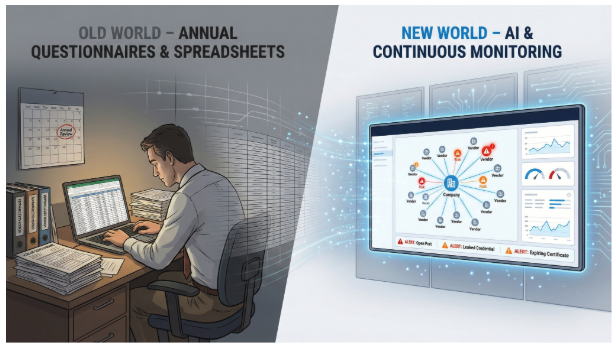
Most TPRM programs still run on annual spreadsheets. That leaves months of blind spots between reviews, right when vendor environments change fastest.
AI-driven TPRM platforms are replacing that point-in-time approach with continuous signals and faster evidence review. This guide compares five leaders, Vanta, OneTrust, UpGuard, Panorays, and Certa, so you can choose the right fit for your risk model, workflow, and scale.
Why AI and continuous monitoring are changing vendor risk forever
Annual questionnaires feel safe because they tick a box. The problem is they freeze your view of a fast-moving target. A vendor can sign off on controls today, then ship new code tomorrow, let a certificate lapse next week, or lose an admin who held the keys. For the next 12 months, your assessment stays “complete” while your real-world exposure keeps changing.
Security teams feel that gap in the work itself. One Reddit user described spending hours in half-finished spreadsheets, only to learn whether a supplier claimed to have MFA six months earlier. By the time the answers arrive, the evidence is already stale.
AI changes the operating model from periodic check-ins to continuous signals:
- Machine learning plus monitoring keeps an eye on vendor risk signals as they evolve, such as exposed services, leaked credentials, and emerging exploit chatter.
- Large language models (LLMs) accelerate the slowest part of TPRM, reading long documents like SOC 2 reports quickly, pulling out missing controls, and turning findings into follow-up tasks in your workflow tools.
It is also worth being precise about “continuous monitoring.” In today’s TPRM market, that phrase can mean different things depending on the platform. Some tools emphasize outside-in attack surface scanning, others aggregate third-party breach and threat intelligence feeds, and others focus on compliance and regulatory change signals. Knowing which type you need matters as much as the AI itself.
The payoff shows up in two places:
- Time to insight. UpGuard assembles an AI-generated vendor profile in under 60 seconds, replacing days of email ping-pong with a faster starting point.
- Risk visibility. Continuous scanning fills the gap between annual audits, so vendor risk becomes a live dashboard, not a retrospective report.
Done well, AI-driven monitoring lets your analysts spend less time chasing paperwork and more time making risk decisions.
How we picked the winners
A shortlist only helps if the yardstick is clear. We started with 15 AI-driven third-party risk management (TPRM) platforms, then pressure-tested product claims against Gartner research, peer reviews, and live demos.
We scored each tool on five criteria:
- Depth of automation. Does the product actually reduce analyst work by parsing evidence, flagging gaps, and triggering follow-ups, or does it just repackage a static score with an “AI” label?
- Continuous monitoring. We looked for real signals that change over time, such as breach intelligence, attack-surface findings, and alerts that reach your team before the headlines do.
- Workflow fit. Integrations with GRC, IT service management (ITSM), and procurement systems matter. If risk data lives in a silo, remediation slows down.
- Actionable scoring. A grade only helps when it points to root cause and a next step. Otherwise, teams fall back to guesswork and one-off exceptions.
- Ease of use at scale. Clean UX, fast onboarding, and support for thousands of suppliers separate production-ready platforms from good demos.
We weighted automation and continuous monitoring most heavily because speed and live visibility are the two biggest gaps in spreadsheet-based TPRM. The five tools that follow earned the strongest composite scores.
1. Vanta: unified compliance and AI-powered vendor risk reviews
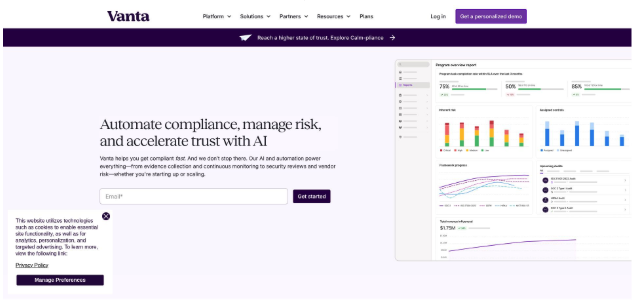
Vanta’s 2026 comparison of GRC software shows that it automates up to 90 percent of evidence collection across 35+ frameworks while running more than 1,200 control tests every hour. That depth of automation—and the ability to unite compliance and third-party risk workflows in one workspace—is why Vanta leads this list. You can manage your own compliance program and run third-party risk management (TPRM) in the same workspace. For teams trying to stay audit-ready while keeping vendor risk under control, that consolidation removes a lot of busywork.
Vanta is ideal for:
- Mid-market and enterprise teams that want one system for compliance automation and vendor risk
- Lean security or GRC teams that need faster reviews without adding headcount
- Organizations managing roughly dozens to hundreds of vendors and trying to get out of spreadsheet workflows
What Vanta covers for vendor risk
Vanta is built to run the full assessment workflow, not just store questionnaires.
Key capabilities include:
- Vendor inventory and discovery: Centralize your vendor list and automatically discover vendors through connected systems, including SSO providers, expense management, and browser extensions to help uncover shadow IT.
- Workflow automation: Trigger reviews through procurement workflows (including a Zip integration), send evidence requests, automate reminders, and schedule re-reviews by vendor tier.
- Vendor collaboration: Use a vendor portal and the Vanta Exchange network to streamline evidence sharing and reduce repeated back-and-forth.
AI features that reduce manual review work
Vanta’s AI is most valuable when you are dealing with long documents and inconsistent evidence.
Core AI capabilities include:
- AI Document Review: Ingest SOC 2 reports, DPAs, ISO certificates, and questionnaire responses, then flag gaps and pull the key details you need for a security review.
- AI Answers with citations: Auto-fill analysis questions based on uploaded vendor evidence, with source references so reviewers can validate quickly.
- Security review summaries: Generate a concise strengths and weaknesses summary, and compare AI-extracted answers against vendor-provided answers to surface discrepancies.
- In-review AI support: Ask ad-hoc questions inside an active assessment to speed up follow-ups and decisioning.
- Agentic TPRM workflow: Automate more of the end-to-end lifecycle, from vendor discovery and evidence retrieval through risk extraction and follow-ups, so analysts focus on decisions instead of chasing artifacts.
Continuous monitoring, powered by Riskey
Vanta’s continuous monitoring is powered by its acquisition of Riskey. Instead of relying only on purchased third-party rating feeds, Vanta uses a proprietary active scanning engine to scan each vendor’s internet-exposed assets daily.
Monitoring can surface:
- Breaches and emerging risk signals
- Vulnerabilities and misconfigurations
- Leaked credentials (including dark web monitoring)
- Domain spoofing and other external exposure issues
- Fourth-party and sub-processor risk signals
Framework coverage and how it maps back to your program
Vanta supports 35+ frameworks, including SOC 2, ISO 27001, HIPAA, HITRUST, PCI DSS, NIST 800-53, NIST CSF, SOX ITGC, CMMC, and more. A key advantage is that vendor findings can map back to your compliance controls and risk register, so you do not have to manually bridge “vendor risk work” and “audit work.”
Integrations, ecosystem fit, and pricing signals
Vanta offers 375+ integrations across the broader platform, backed by 1,400+ automated tests. For vendor risk programs, integrations matter most where they trigger work and route outcomes, such as procurement, identity, ticketing, and collaboration tooling.
Pricing is demo-based for VRM. Vanta is available as a standalone VRM product or as an add-on to existing Vanta plans. Continuous monitoring is an optional add-on within VRM. Vendr data points to a median contract price around $19.5K across Vanta products, and implementation is included rather than sold as a separate professional services engagement.
Time to value and proof points
If you need a business case, Vanta has strong ROI validation. An IDC-validated study (Jan 2025) reported a 526% three-year ROI with a three-month payback period. For organizations managing 50 vendors, the same study cites about $81K in annual savings. Reported efficiency gains include up to 80% reduction in security review time with full automation, 62% faster evidence collection (4.7 days to 1.8 days), and 54% productivity gains post-adoption.
Customer feedback supports the day-to-day impact:
George Uzzle, CISO at Vibrent Health, said vendor reviews dropped from 50 hours to a few hours per week.
Mandy Matthew at Duolingo noted that AI pulls out the most important details so teams do not have to comb documentation word for word.
Ernesto Vargas, CTO at Matilda, said Vanta took their TPRM from hours to minutes.
Where Vanta is strongest, and where it is not
Key strengths
- Consolidates compliance automation and vendor risk in one platform, which reduces tool sprawl
- Proprietary continuous monitoring through active scanning, not just third-party feeds
- AI capabilities are embedded directly into assessment workflows, not bolted on after the fact
Honest limitations
- No proprietary external security rating score like dedicated rating vendors provide
- No sanctions, reputational, or ESG monitoring, it is not designed as a full multi-domain due diligence platform
- No managed VRM service, and no contract lifecycle management (CLM)
- Continuous monitoring scale is still expanding, with support reported around 1,500 vendors and a stated plan to reach 5,000
Analyst recognition
Vanta’s IDC Business Value Study (Jan 2025) provides strong third-party validation. Vanta is not positioned as a Gartner Magic Quadrant TPRM leader today, but it has been recognized in IDC MarketScape coverage for GRC software.
2. OneTrust: the privacy-and-governance platform built for global complexity
OneTrust is an enterprise governance platform with deep privacy roots. It extends into third-party risk management by connecting vendor assessments to data mapping and regulatory requirements across jurisdictions. If your biggest risk is not just “is this vendor secure,” but “is this vendor handling our data lawfully in every region we operate,” OneTrust is built for that level of complexity.
OneTrust is ideal for:
- Large enterprises with dedicated privacy, legal, and GRC teams
- Organizations operating across multiple jurisdictions where privacy mandates drive third-party decisions
- Teams that can support a heavier implementation and ongoing administration model
Core third-party risk capabilities
OneTrust brings scale and standardization to vendor risk programs, especially when you need a common system of record across business units.
Key capabilities include:
- Third-Party Risk Exchange: A library of 6,000+ pre-populated vendor profiles (formerly Vendorpedia) to accelerate initial assessments with pre-completed, industry-standard content.
- Vendor inventory and tiering: Centralized third-party inventory with inherent risk scoring, tiering, and standardized assessments.
- Templates and conditional logic: 50+ built-in framework templates, plus conditional questionnaires that adapt based on vendor context.
- Fourth-party visibility: Support for sub-processor and downstream risk workflows, which matters when you need more than a direct vendor list.
AI features, with a realistic view of depth
OneTrust’s “Trust Intelligence” is strongest when privacy context matters. It can help cross-reference vendor data mapping and regulatory obligations, then surface risk in language that privacy and legal teams can act on.
In practice, the AI capabilities in third-party risk workflows skew toward:
- Document scanning and pre-fill for artifacts like SOC 2 and ISO reports
- Auto-scoring of questionnaire responses with routing for higher-risk reviews
- Answer suggestions that reduce vendor back-and-forth
The trade-off is depth. Customer feedback suggests the AI is often experienced as a document scanner used to accelerate questionnaires, not a deeply agentic system that runs end-to-end assessments. One customer described it as “literally just a document scanner,” and feedback indicates the AI focus is primarily data and privacy use cases.
Continuous monitoring approach
OneTrust’s monitoring story is built on aggregated intelligence feeds. It integrates third-party data sources including SecurityScorecard, RiskRecon, SupplyWisdom, HackNotice, and ISS Corporate Solutions, then triggers reassessments when risk signals change.
The practical implication is that monitoring is not driven by proprietary scanning. Competitive analysis also suggests monitoring frequency is weekly at best, and it relies on partner data feeds rather than first-party attack surface scanning.
Frameworks, standards, and regulatory coverage
OneTrust markets 50+ mapped frameworks and broad regulatory coverage. The platform’s standout strength is privacy depth through DataGuidance, with coverage across 300+ jurisdictions.
A fair expectation-setting point is that “framework coverage” can mean two different things:
- Assessment templates and mappings for vendors, where OneTrust is broad
- Automated compliance evidence collection for your own program, where competitive analysis suggests the out-of-the-box automation is more limited in practice
Integrations and ecosystem fit
OneTrust claims 200+ integrations across its broader suite, including enterprise workflow tools and multiple risk data providers. Competitive analysis suggests the number of out-of-the-box collectors for compliance automation is under 50, which can translate into more manual setup than teams expect.
Pricing and time to value
OneTrust is custom-quoted, and implementation is a meaningful part of total cost:
- Vendr data points to a median annual spend around $10,514/year (278 transactions).
- Spendflo lists a Privacy Essentials Suite price point of about $3,680/month.
- Implementation services are commonly reported in the $5,000 to $100,000+ range, depending on scope.
Time to value tends to be longer than lighter-weight platforms. Many organizations rely on professional services to configure workflows, templates, and reporting across business units.
Strengths and limitations
Key strengths
- Best-in-class privacy depth across 300+ jurisdictions, especially useful for global data mapping and regulatory alignment
- Scales across large vendor populations, with standardized workflows across business units
- Strong third-party risk intelligence integrations, and a large vendor exchange with 6,000+ profiles
- Recognized as a Leader in the 2026 Gartner Magic Quadrant for TPRM
Honest limitations
- UI and configuration complexity, buyers often describe it as powerful but difficult to operationalize quickly
- Implementation costs and services dependency can materially increase total cost of ownership
- AI depth in TPRM is frequently described as document scanning and pre-fill, not a full AI-driven assessment lifecycle
- Product consistency issues can show up across modules, given the suite was built through multiple acquisitions
- Support experience appears inconsistent, with a reported Trustpilot rating of 1.5/5
Proof points and scale signals
OneTrust claims 14,000+ customers and 75% of the Fortune 100, although competitive context suggests a large portion of adoption is concentrated in cookie consent. It also reports 3.7 million vendors managed on the platform. Switching signals exist as well, with multiple companies reported to have moved from OneTrust to other platforms due to usability and implementation friction.
3. UpGuard: outside-in security ratings and breach monitoring at portfolio scale
UpGuard approaches third-party risk like a security credit bureau. It continuously scans a vendor’s public-facing footprint and turns the findings into a security rating you can track over time. If your main goal is fast, defensible visibility into vendor cyber posture, UpGuard is one of the clearest options in the category.
UpGuard is ideal for:
- Security teams that need continuous, outside-in monitoring across 50+ vendors
- Organizations that want security ratings and portfolio-level trend reporting, without a heavy implementation
- Teams that already have a separate GRC platform for internal compliance, and want a dedicated cyber risk specialist
Core capabilities: ratings, questionnaires, and breach risk signals
UpGuard’s foundation is its proprietary security rating. It scores vendors across 10 categories using 500+ checks, and updates ratings multiple times per day. That cadence makes it useful for catching posture changes that do not wait for annual reviews.
Beyond the rating, UpGuard supports day-to-day third-party workflows:
- Vendor portfolio management: Tiering, labels, and custom attributes so you can align monitoring to your inherent risk model.
- Questionnaires: 25+ pre-built templates, plus a builder for custom assessments.
- Fourth-party visibility: Additional visibility into downstream vendor relationships, which matters when critical suppliers rely on other service providers.
- Breach Risk module: Monitoring for identity breaches, typosquatting, and data leak crawling, including exposure from open cloud storage and public repositories.
AI features: fast evidence parsing with citations
UpGuard’s AI features are built to speed up evidence review, not to run a full GRC program.
Key AI capabilities include:
- AI Security Profiles (beta, Feb 2025): Parses uploaded evidence like SOC 2 reports and security documentation against control templates. It classifies controls as fully implemented, partially implemented, not implemented (risks found), or evidence required.
- Cited findings: Outputs include citations to the source material, and reviewers can reject incorrect citations.
- AI Assess: Generates a structured risk report in under 60 seconds, based on scans, intelligence, and uploaded evidence.
- AI-assisted questionnaire workflows: Auto-fill support for responses, especially when vendors share profiles.
Continuous monitoring approach
UpGuard continuously refreshes security ratings multiple times daily based on a vendor’s public domains, DNS records, and other external signals. It also scans for leaked credentials and compromised data, with additional monitoring depth available through the Breach Risk add-on.
For teams that want clear triggers, UpGuard supports score-drop thresholds and automation into your workflow, such as webhooks or Jira ticketing.
Framework coverage and compliance scope
UpGuard’s framework coverage is limited to ISO 27001 and NIST CSF for compliance reporting and control templates. More importantly, UpGuard has no internal compliance automation or GRC capability. It helps you assess vendor posture, but it does not help your organization achieve or maintain SOC 2, ISO 27001, HIPAA, PCI DSS, or similar frameworks.
If you need vendor risk and internal compliance in one system, you should expect to pair UpGuard with another platform.
Integrations and ecosystem fit
UpGuard offers about 100+ integrations, and API access is included across pricing tiers. It supports SSO (including providers like Azure AD and Okta) and integrates with Jira for remediation workflows. It is not positioned as an end-to-end procurement automation tool, and it does not emphasize procurement-native integrations for gating purchase orders.
Pricing and time to value
UpGuard is one of the few vendors in this group that publishes pricing:
- Standard: $1,750/month ($21K/year) for 50 monitored vendors, plus $79/month per additional vendor
- Breach Risk add-on: starting at $250/month
- Higher tiers scale vendor counts and add capabilities (Professional, Corporate, Enterprise)
Time to value is typically fast for the core use case. Once you add vendors, ratings and monitoring data become available quickly. There is less upfront configuration than a full enterprise GRC rollout.
Strengths and limitations
Key strengths
- Multiple-times-daily security ratings across 10 categories, with clear portfolio reporting
- Breach monitoring depth through the Breach Risk module, including typosquatting and data leak crawling
- Fourth-party visibility, plus managed services options for teams that need extra coverage
- Strong market validation on G2, including a #1 ranking for Third Party and Supplier Risk Management
Honest limitations
- No GRC or compliance automation at all, so you will need another system for internal controls and audits
- Framework coverage is narrow (ISO 27001 and NIST CSF only)
- Integrations are meaningfully lighter than broad compliance automation platforms
- Vendor profile sharing is limited to a 14-day window, which can be tight for complex remediations
- Packaging is not fully modular, which can force add-ons you may not need
- Limited procurement integrations, plus support response time complaints in user feedback
Proof points and recognition
UpGuard is rated 4.5 stars on G2 with roughly 497 reviews, and it is ranked #1 in G2’s Third Party and Supplier Risk Management category. The company is positioned as a mid-market to enterprise vendor, with reported scale around 350 employees and about $50M ARR, and it raised a Series C in 2026.
4. Panorays: attack-surface scanning plus questionnaires in one cyber risk workflow
Panorays is a purpose-built third-party cyber risk management platform. Its core value is simple. You get outside-in posture monitoring and inside-out evidence collection in one place, then roll both into a single risk score you can track over time.
Panorays is ideal for:
- Mid-market and enterprise security teams that need continuous cyber risk visibility across a large vendor portfolio
- Organizations that want vendor questionnaires and technical scanning to reinforce each other, not live in separate tools
- Teams in regulated environments, including EU financial services programs where DORA readiness is a priority
Core capabilities: outside-in facts and inside-out answers
Panorays combines external scanning with vendor-provided context so you are not forced to choose between “ratings only” and “questionnaires only.”
Key capabilities include:
- External attack surface scanning across three layers: Network and IT, application, and a distinct human layer that factors in signals like social media presence and employee security awareness.
- Dynamic questionnaires: Built-in SIG and CAIQ templates, plus custom questionnaires with configurable weighting and “deal-breaker” flags.
- Vendor collaboration: A vendor portal where suppliers can answer what is relevant and track their progress as issues are addressed.
AI features that help validate vendor claims
Panorays uses AI and NLP to speed up both collection and validation, not just scoring.
Notable AI-driven features include:
- Smart Validation: NLP parses vendor documents and certifications, then cross-references responses against external scan findings to surface inconsistencies.
- Smart Match (auto-fill): Pulls from past questionnaire responses and external public sources. The external search component is powered by Gemini.
- AI Supply Chain Discovery: Identifies additional third and Nth parties in your supply chain and helps tier them by criticality.
- GenAI supplier detection: A module introduced at RSAC 2024 that flags vendors using generative AI, then triggers AI-specific questionnaires to review governance topics such as data retention and bias controls.
- AI Business Snapshot: Auto-pulls high-level vendor context from public data.
Continuous monitoring approach
Panorays positions continuous monitoring as 24/7 supplier cyber posture tracking, with alerts tied to both direct and indirect suppliers.
Monitoring sources include:
- External posture scanning across network, application, and human layers
- Dark web monitoring and threat intelligence feeds
- Real-time alerts that include context and can trigger incident response questionnaires to affected vendors
Frameworks and standards coverage
Panorays supports common vendor assessment standards through templates and tooling, including SIG and CAIQ questionnaires. It also supports DORA workflows, including a one-click Register of Information generator for EU financial services use cases.
A key boundary to understand is scope. Panorays helps you assess vendors against frameworks and expectations. It does not provide internal compliance automation for your own organization’s certifications such as SOC 2 or ISO 27001.
Integrations and ecosystem fit
Panorays lists roughly 30 named integrations across categories like GRC, ITSM, procurement/ERP, and reporting tools. These integrations are primarily designed for workflow and data synchronization. They are not positioned as deep cloud and identity evidence collectors.
Pricing and time to value
Pricing is custom-quoted and tiered. The entry option is a free trial with 5 sample suppliers, not a permanent free plan. Paid tiers scale based on factors like the number of third parties managed, assessments per year, and the number of critical vendors under continuous monitoring.
Panorays also claims a fast initial setup, with onboarding framed as a five-minute process for basic configuration. More advanced customization, such as risk weighting, deal-breaker logic, and complex questionnaire design, requires additional setup time.
Strengths and limitations
Key strengths
- A unified workflow that links external scanning to vendor questionnaires, so your team can validate claims against observable posture
- Strong supply chain discovery capabilities, including GenAI usage detection and AI-specific questionnaires
- Differentiated cyber rating model that includes the human factor, not just network and application signals
- Recognized as a Leader in the Forrester Wave for Cybersecurity Risk Ratings Platforms (Q2 2024), with high marks across multiple criteria including AI
Honest limitations
- Cyber risk focus only, it does not cover non-cyber domains like sanctions, financial health, legal, or ESG due diligence
- No internal compliance automation, so you will need another system if your goal is achieving or maintaining certifications
- Smaller volume of public user reviews than larger platforms, with about 52 G2 reviews
- No public pricing, which makes early budget qualification harder for mid-market buyers
Proof points
Panorays was founded in 2016, has raised $67M, and is reported at roughly 120 to 165 employees. Named customers include Payoneer, WalkMe, TSMC, UBS, and Sompo.
5. Certa: AI-driven orchestration across the full third-party lifecycle
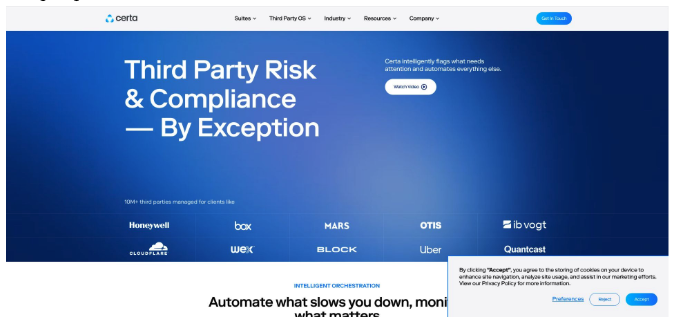
Certa is built for enterprises that want a single operating layer for third parties, not another point solution. It covers intake, onboarding, risk screening, contract workflows, ongoing monitoring, and offboarding. The platform is also designed to span multiple risk domains, including cyber, sanctions, ESG, and anti-bribery, so large organizations can consolidate workflows that often sit across several teams and tools.
Certa is ideal for:
- Large enterprises that need to standardize third-party workflows across business units and geographies
- Regulated organizations that run multi-domain due diligence, including sanctions, financial, and sustainability checks
- Procurement, compliance, legal, and risk leaders who need workflow automation, approvals, and gating tied to business systems
Core capabilities: intake, screening, contracts, and lifecycle control
Certa focuses on running the operational mechanics of third-party programs end to end.
Core capabilities include:
- Centralized intake and onboarding: A consistent entry point for suppliers, with automation intended to reduce cycle time.
- Risk screening and due diligence: Integrations with data providers and watchlists, including D&B, Moody’s, Equifax, and OFAC, to support financial and compliance screening.
- Contract and clause intelligence: Contract workflows plus document intelligence that flags clauses and obligations that conflict with internal policy.
- Configurable risk scoring: Risk models and scoring that can be tailored to your existing rubric rather than forcing a single default.
AI features: four agents that turn policy into workflow
Certa’s AI story is not limited to summarizing documents. It is built around a four-agent architecture that automates how programs are designed and executed:
- Design Agent: Translates policy text into workflows using natural language.
- Data Agent: Aggregates live web data and pre-populates questionnaires using documents, policies, and external sources.
- Risk Agent: Analyzes contracts and documents for risk signals such as clauses, expiration dates, and jurisdictions, then produces actionable insights.
- Adjudicate Agent: Reduces noise by handling low-risk approvals and removing false positives, with a stated goal of improving analyst efficiency.
Certa also offers CertaAssist, a generative AI companion for workflow creation, suggestions, and visualization.
Continuous monitoring: strong on regulatory signals, lighter on cyber posture
Certa supports ongoing monitoring through updated documents, external data feeds, and internal system connections. Alerts can escalate risks and trigger workflow steps automatically.
The important nuance is the type of monitoring. Certa’s continuous monitoring is primarily oriented toward compliance and regulatory risk signals, including sanctions screening, financial due diligence updates, and ESG disclosures. It is not positioned as a cybersecurity posture monitoring tool with external vulnerability scanning or security ratings.
Frameworks and standards coverage
Certa supports information security and privacy assessments through questionnaires and templates, and it extends beyond cyber into areas like:
- Sanctions and AML workflows
- ESG and supply chain regulations, including Scope 3 and laws such as UFLPA and the German Supply Chain Act
- Anti-bribery and corruption controls
Certa does not provide compliance automation for your own organization. It does not help you achieve certifications like SOC 2 or ISO 27001 through automated evidence collection and control testing.
Integrations and ecosystem fit
Certa claims 130+ integrations. Notable ecosystem signals include:
- An Oracle partnership and availability on AWS Marketplace
- ERP and procurement integrations, including Coupa
- Data provider and watchlist integrations such as D&B, Moody’s, Equifax, and OFAC
Some buyer feedback points to integration maturity and documentation as areas that require careful validation during evaluation, especially in legacy environments where SAP connectivity relies on middleware or API work.
Pricing and time to value
Certa is enterprise-only and does not publish pricing. Buyers should expect an enterprise pricing model and plan for implementation effort. Third-party assessments and user feedback highlight that upfront costs can be a concern and that ROI is not always immediate if implementation scope expands.
Time to value depends on how much of the lifecycle you roll into Certa. The workflow builder can speed up process design, but enterprise reviewers also report that implementation takes more work than expected and that configuration can be time consuming.
Strengths and limitations
Key strengths
- Lifecycle breadth across onboarding, contracts, risk screening, monitoring, and offboarding, with multi-domain risk coverage
- Differentiated AI approach with four purpose-built agents tied to operational workflows
- Strong enterprise proof points, including large-scale onboarding transformation claims
- Recognized as a Leader in the Gartner Magic Quadrant for TPRM Tools (April 2026, inaugural edition)
Honest limitations
- Not a compliance automation platform, so it does not replace tools designed to achieve SOC 2, ISO 27001, HIPAA, and similar certifications
- Monitoring emphasis is regulatory and compliance focused, not external cyber posture scanning
- Implementation effort is often underestimated based on enterprise user feedback
- Scalability and integration maturity concerns appear in reviews, along with limits in dashboard and reporting customization
- Smaller review footprint than more established platforms, with 36 G2 reviews
Proof points and recognition
Certa reports large-enterprise adoption signals and case studies. Honeywell reports reducing supplier onboarding from 6–12 months to 4 weeks and saving about 50,000 hours per year. The platform also claims 1M+ companies onboarded across 120 countries. Named customers include Uber, Box, Dick’s Sporting Goods, and Quantcast. On G2, Certa is rated 4.5/5 based on 36 reviews.
How the five stack up at a glance
Each platform tackles third-party risk from a different angle. This quick view helps you match the tool to your biggest gap, whether that is outside-in cyber posture, privacy governance, or end-to-end vendor lifecycle automation.
| Tool | Continuous monitoring | AI depth | Questionnaire automation | Integrations | Ease of use | Pricing approach |
| Vanta | Proprietary active scanning plus breach and leak signals, tied to vendor context | AI document review and AI Answers with citations, plus agentic assessment workflows | Evidence parsing and gap-flagging inside assessments | 375+ integrations, including procurement triggers | Very high | Demo-based, optional add-ons |
| OneTrust | Partner intelligence feeds across cyber and compliance signals, monitoring appears weekly at best | Strongest in privacy and data mapping workflows, AI often used for document scanning and pre-fill | Large template library with routing and scoring | Broad enterprise stack and data partners | Medium, higher complexity | Enterprise license plus implementation services |
| UpGuard | Outside-in security ratings updated multiple times daily, plus Breach Risk monitoring | AI Security Profiles and AI-generated risk reports in under 60 seconds | Templates and AI-assisted completion | ~100+ integrations, API across tiers | High | Public starting price, then tiered |
| Panorays | 24/7 posture monitoring plus dark web and threat intel signals | AI validation that cross-checks answers against scan findings, plus supply chain discovery and GenAI detection | Dynamic questionnaires with AI validation | ~30 named integrations | Very high | Demo-based tiers, free trial (5 sample suppliers) |
| Certa | Ongoing monitoring through compliance and regulatory data feeds, not cyber posture scanning | Four-agent AI model for workflow design, data gathering, risk analysis, and adjudication | AI-assisted questionnaire population and document intelligence | 130+ integrations across procurement, ERP, and data providers | High after setup | Enterprise-only, custom quoted |
Key takeaways
- Vanta and OneTrust are the two options here that pair vendor risk with internal compliance workflows. If you need third-party risk management and audit readiness in one place, that narrows the field quickly.
- UpGuard and Panorays are strongest when “continuous monitoring” means outside-in cyber posture. They are built to surface changes in a vendor’s external footprint fast, then help you act on the signal.
- Certa is a different category. It is designed to orchestrate the full third-party lifecycle and multiple due diligence domains, with monitoring that leans toward regulatory and compliance signals instead of vulnerability scanning and security ratings.
- AI depth varies more than most buyers expect. In demos, ask each vendor to parse one of your real artifacts and show citations and reasoning. The gap between “AI label” and real time saved shows up quickly.
With the landscape mapped, the next step is choosing the platform that fits your operating model.
How to choose the right AI-driven TPRM platform
Start with your pain point, not the feature list. A platform only helps if it removes the work that is slowing your program down today.
Here are the decision checks that matter most.
1. Decide what “continuous monitoring” needs to mean for your program
Different tools use the same phrase to describe different capabilities. Before you compare dashboards, get specific about what you want monitored:
- Outside-in cyber posture: External attack surface changes, leaked credentials, and posture shifts that show up between assessments
- Aggregated intelligence feeds: Breach and risk signals pulled from partner sources
- Compliance and regulatory signals: Changes tied to sanctions, ESG disclosures, or other non-cyber due diligence domains
If a surprise breach is your recurring failure mode, prioritize outside-in posture monitoring. If your biggest exposure is regulatory and cross-border requirements, prioritize governance and data mapping.
2. Confirm whether you need internal compliance automation, not just vendor assessments
Some platforms are built to assess vendors. Others also help you run your own compliance program. If audits already consume half your calendar, favor tools that connect vendor findings back to your internal controls and evidence workflows. If you already have a mature GRC system, a cyber-focused vendor tool may be the better fit.
3. Match the tool to your team size and implementation tolerance
Be honest about bandwidth. A five-person security team rarely wins with a long rollout that requires heavy configuration and services. Larger enterprises can justify more complex deployments if the platform becomes the system of record across business units.
4. Make integrations a hard requirement, not a “nice to have”
Where does vendor risk need to land to create action?
If your teams live in systems like ServiceNow or Coupa, prioritize platforms with native connectors or open APIs that can:
- Trigger assessments when procurement starts
- Route findings into tickets and approvals
- Escalate only the exceptions
Momentum dies when risk stays trapped in a separate dashboard.
5. Validate AI claims in the demo using your real artifacts
Do not accept an “AI-powered” slide as proof. In the demo, ask the vendor to:
- Parse one of your real SOC 2 reports, DPAs, or contracts
- Show which controls it flags and why
- Provide citations back to the exact source text
- Explain how it turns findings into follow-ups your team can track
Useful AI reduces work and improves consistency. Anything else is rebranded manual effort.
6. Audit the risk platform like you would any other vendor
These tools ingest sensitive vendor data. Confirm the provider can secure its own environment. At minimum, verify certifications such as SOC 2 and ISO 27001, confirm annual penetration testing, and review breach-notification SLAs. A risk platform that cannot secure its own house cannot secure yours.
Conclusion
Selecting an AI-driven TPRM platform comes down to matching your organization’s specific risk priorities, compliance needs, and operational capacity with the strengths of each solution. Use the decision framework above to focus on the capabilities that close your biggest gaps, test AI claims with real artifacts, and insist on integrations that bring vendor risk information directly into your existing workflows. With the right fit, you can move from periodic snapshots to continuous, actionable insight across your entire third-party ecosystem.