


Choosing the right SPF record checker is a critical step toward achieving strong SPF and DMARC compliance in today’s email-driven world. As cyber threats like phishing and spoofing continue to rise, tools that validate and analyze your Sender Policy Framework (SPF) record play a vital role in ensuring only authorized sources can send emails on behalf of your domain.
A reliable SPF checker not only performs accurate lookups and validation but also helps identify configuration errors, enforce compliance standards, and improve overall email deliverability. By combining insights from SPF, DKIM, and DMARC, these tools act as a comprehensive safeguard for your domain, enabling businesses to maintain trust, protect their reputation, and prevent costly email authentication failures.
Understanding SPF, DMARC, and what an SPF record checker does
Sender Policy Framework in the broader email authentication stack
Sender Policy Framework is the DNS-based protocol that tells receiving mail servers which hosts are allowed to send on behalf of your domain name. Alongside DKIM and DMARC, it forms the backbone of modern email authentication, working to reduce spam, prevent email fraud, and protect domain reputation.
In practice, an accurate SPF record ensures only authorized IP addresses and sending services (for example, Outlook, Google Workspace, Microsoft 365, or a marketing platform) can deliver mail as your brand. When a receiver runs an SPF check during SMTP, it evaluates the connecting host against your published policy; a mismatch can trigger an SPF fail and lead to email delivery problems or quarantine.
Because mistakes in the text-based SPF record are easy to make and hard to spot, a specialized SPF record checker becomes essential. It pairs an SPF lookup with contextual guidance so you can move beyond guesswork, achieve SPF compliance, and strengthen email security before changes impact production traffic.
What an SPF record checker, SPF lookup, and SPF validator reveal
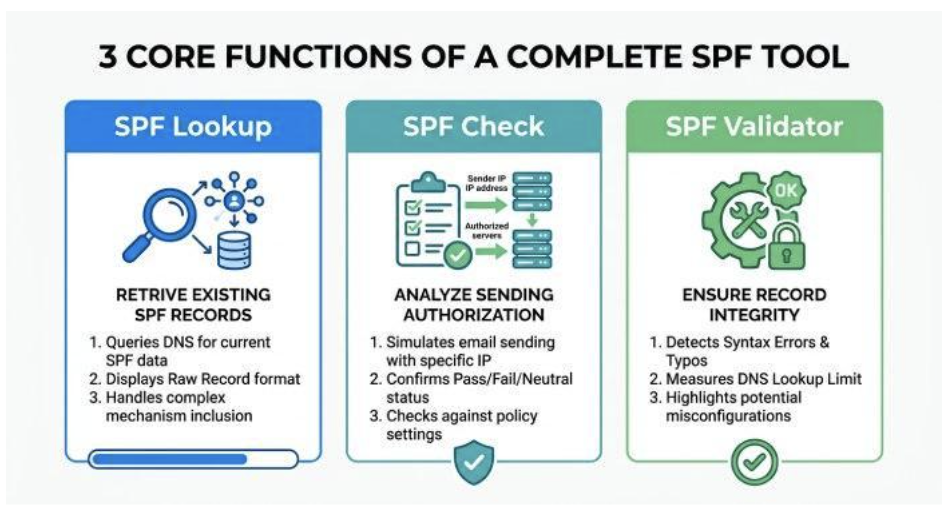
A high-quality SPF record checker combines three core functions:
- SPF record lookup: Fetches the current TXT record for your domain name, following include mechanisms to build the full evaluated policy and verify authorized IP addresses.
- SPF check: Simulates live evaluation, including DNS Lookup processing, MX lookup when referenced, and the 10-lookup limit, so you can see exactly how receivers will interpret your policy.
- SPF validator: Performs a standards-based SPF validation test, highlighting SPF errors (syntax issues, void lookups, duplicate mechanisms, excessive nesting) and mapping outcomes like pass, neutral, softfail, and fail.
Beyond raw results, the best tools operate as a diagnostic tool that explains why a mechanism matched, what caused an authentication failure, and how each change influences email deliverability. Many vendors augment this with an SPF raw check view, letting you inspect the unprocessed TXT and each expanded include for transparent troubleshooting.
Must-have validation checks and standards compliance features
Core SPF check and SPF validation test criteria
Your SPF validator should meet and demonstrate adherence to RFC-defined behavior. Look for the following must-haves in any SPF record checker:
-
- Accurate SPF record lookup and SPF check resolution, honoring include, a, mx, ip4, ip6, ptr, exists, and redirect.
- Clear accounting of the 10 DNS Lookup limit and void lookups to help you avoid evaluation-time SPF fail outcomes.
- Syntax verification for mechanisms, qualifiers, and modifiers, with pinpointed SPF errors and remediation tips.
- A compliance check against Sender Policy Framework guidance (e.g., use of -all vs ~all), plus warnings where your policy may cause deliverability risk.
- Validation that the SPF record aligns with DMARC alignment expectations to support consistent email authentication across protocols.
A strong diagnostic tool should also simulate varied paths (e.g., different sending hosts) so you can perform a meaningful SPF validation across multiple services and guard against authentication issues as your stack evolves.
Standards-driven compliance check details
- Limits and flattening: Surface when includes or mx/a mechanisms risk breaching the lookup cap; suggest flattening or a hybrid approach implemented safely via an SPF record generator.
- Alignment and policy rigor: Show how policy strictness impacts DMARC outcomes and whether your configuration could create email delivery problems with forwarders or specific DNS providers.
- Forensics: Provide a changelog of policy edits and a side-by-side comparison to support audits and SPF compliance documentation.
Advanced capabilities for scale, monitoring, and deliverability assurance
Monitoring, risk assessment, and periodic monitoring at scale
Large organizations and MSP (Managed Service Providers) need more than a one-off SPF lookup. Look for capabilities that let you scan domain portfolios, set policy thresholds, and run periodic monitoring across all sending sources. Risk assessment dashboards should flag:
- New or deprecated authorized IP addresses and high-risk mechanisms
- Authentication issues that degrade email health
- DMARC and DKIM misalignment patterns that could fuel email-based threats or Phishing
- Blacklists hits and infrastructure drift uncovered via DNS Lookup and MX lookup checks
Vendors often extend beyond SPF with complementary controls—DMARC aggregate analysis, BIMI readiness, and transport safeguards like MTA-STS and TLS-RPT—so you can tie Sender Policy Framework changes to real-world email deliverability outcomes and reduce spam exposure.
Deliverability assurance toolset
Leading platforms bundle an email header analyzer, email verification utilities, and a Delivery Center-style console to correlate SPF validation with bounce codes, spam-trap sightings, and domain reputation signals. This helps translate a successful SPF check into measurable deliverability improvements. Look for integrations that ingest DMARC reports, visualize SPF fail rates by source, and connect diagnostics to remediation guides that prevent email fraud while protecting brand trust.
Automation and API scenarios
At scale, an API is critical. It enables you to:
- Programmatically run an SPF record lookup before provisioning a new sender
- Enforce a preflight SPF validation test in CI/CD for infrastructure-as-code
- Trigger alerts when a scan domain job detects policy regressions
- Feed results into SIEM/SOAR pipelines for unified domain security monitoring
Usability, integrations, and security for teams and workflows
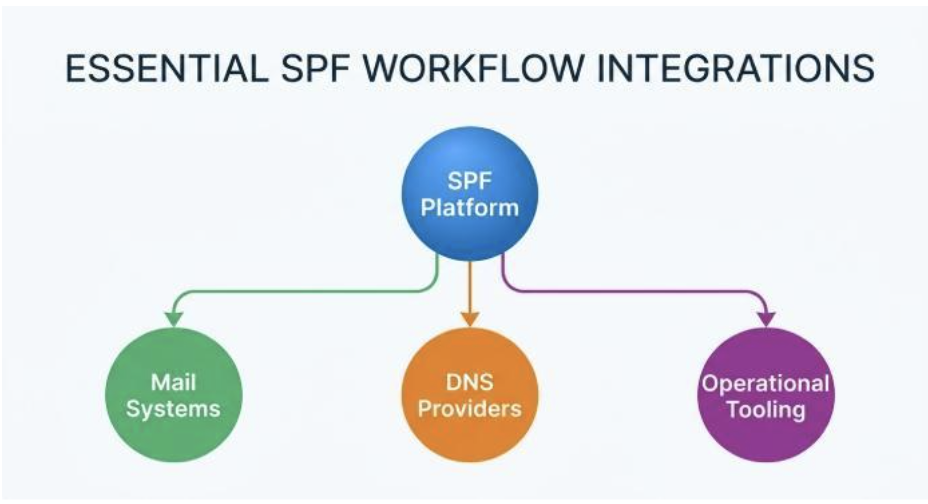
Integrations with mail systems, DNS providers, and operational tooling
An SPF record checker should slot cleanly into real-world workflows. Confirm it integrates with:
- Outlook, Google Workspace, and Microsoft 365 for seamless sender onboarding and verification
- Popular DNS providers for guided publishing and rollback of your SPF record
- Ticketing or chat to streamline collaboration across SecOps, email admins, and marketing
- MSP consoles to manage client estates with shared templates and role-based access
Practical features include change-safe suggestions from an SPF record generator, guided wizards that reduce SPF errors, and contextual notes so non-specialists can grasp why an SPF check is passing or failing. Teams also benefit from scheduled reports, periodic monitoring summaries, and clear ownership of each domain name to avoid conflicting edits and security issues.
Data protection and domain security considerations
Choose vendors that minimize data exposure, secure API keys, and support SSO/MFA. Ensure the diagnostic tool does not store unnecessary message content and that any email header analyzer redacts sensitive fields. Review data residency options, audit trails, and incident-response posture to align with your compliance needs and protect against email-based threats.
Vendor evaluation: accuracy, transparency, support, and pricing
How to compare solutions and vendors
Accuracy is non-negotiable. Test multiple tools—such as MxToolBox (and its SuperTool), EasyDMARC, and platforms branded as Delivery Center—to confirm consistent SPF lookup behavior, correct handling of the 10-lookup limit, and standards-faithful SPF validation. Some vendors, including MXToolBox, Inc and Mid-Market DMARC specialists, offer free tiers you can trial. If a solution also mentions EasySender or similar modules, verify how those parts interact with SPF, DKIM, and DMARC workflows.
Transparency matters. Prefer vendors that show the complete evaluated tree for your SPF record, expose a readable SPF raw check, and document resolver behavior. Independent reviews on G2 Crowd, SourceForge, Expert Insights, Channel Program, or Bettertracker can illuminate reliability, support quality, and real-world email deliverability impact. Recognition such as Inc. 5000 listings can signal growth and stability, but prioritize hands-on testing over badges.
Support and services should include:
- Fast, knowledgeable assistance for complex authentication issues
- Clear remediation guides for SPF fail scenarios and compliance check findings
- Advisory depth across SPF validation, DMARC policy rollout, DKIM key rotation, BIMI readiness, and related DNS security practices
On pricing, evaluate:
-
- Seat and domain-based models for fairness as you scale
- API access without punitive overage
- MSP-friendly licensing and multi-tenant controls
- Bundles that include blacklists monitoring, DNS Lookup/MX lookup probes, and ongoing email health reporting
Finally, insist on a trial where you can:
- Run an end-to-end SPF record checker assessment across several domains
- Use the diagnostic tool to reproduce and resolve known SPF errors
- Validate that an SPF validator’s output matches live receiver behavior
- Confirm that change workflows, an SPF record generator, and automation guardrails make it easier—not riskier—to keep Sender Policy Framework accurate, strengthen email authentication, and sustain top-tier email deliverability over time.