How does an AI learn to be a relationship coach? It starts with data. By analyzing thousands of hours of therapy sessions, psychological research, and anonymized conversation datasets, machine learning models begin to identify the markers of healthy and unhealthy communication. This wealth of information, drawn from clinical practices everywhere including those in couples therapy DC and beyond, helps the algorithm understand the universal patterns that predict relationship success or failure.
For instance, the algorithm can be trained to recognize the power of active listening, one of the pillars of effective communication championed in couples therapy. In a human context, therapists guide couples to listen not just to words, but to the emotions behind them. Studies show that couples who practice these techniques experience a 40% increase in feeling understood and supported by their partner.
An AI can be trained to detect when active listening is not happening. It can spot interruptions, a lack of verbal affirmation, or a partner failing to engage with the emotional content of a statement. By flagging these moments, the AI encourages the very behaviors—eye contact, mirroring, summarizing—that build understanding.
Furthermore, the AI can guide couples through a structured dialogue, a method proven effective in therapy, with over half of participating couples reporting improved conflict resolution skills. The “third listener” can act as a digital referee, ensuring each partner takes turns speaking and listening without interruption, preventing the escalation that leads to arguments spiraling out of control.
The AI Listener: A New Tool for an Old Problem
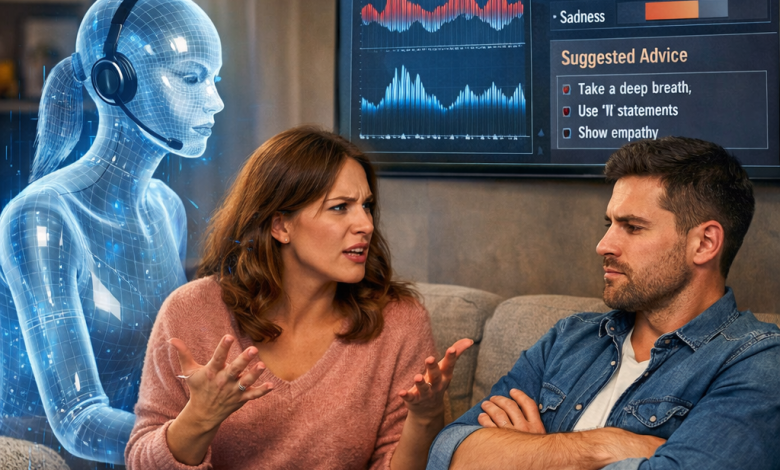
The concept is simple, but the technology is complex. Imagine a smart device, like a home assistant or a specialized app, that passively listens to your conversations (with your permission). It doesn’t just record words; it analyzes tone, pace, interruption patterns, and specific language choices. In essence, it’s a machine-learning model trained to hear the difference between a productive discussion and a destructive fight.
This “third listener” is designed to do what couples therapy has always aimed to do: cut through the patterns of poor communication that entangle relationships. But instead of waiting for a weekly session to review a past fight, AI offers the potential for intervention in the moment.
When the system detects an escalating argument—perhaps characterized by raised voices or accusatory language—it could gently intervene. It might chime in with a notification on your phone: “Conflict pattern detected. Try using an ‘I’ statement to express your need without blame.” Or it could offer a structured prompt: “Pause. Partner A, share your feelings without interruption. Partner B, your turn to listen and then mirror back what you heard.”
This is the promise of machine-mediated love: bringing the structured techniques of the therapist’s office directly into the heat of a kitchen-table disagreement.
Training the Algorithm on the Science of Love
How does an AI learn to be a relationship coach? It starts with data. By analyzing thousands of hours of therapy sessions, psychological research, and anonymized conversation datasets, machine learning models begin to identify the markers of healthy and unhealthy communication.
For instance, the algorithm can be trained to recognize the power of active listening, one of the pillars of effective communication championed in couples therapy. In a human context, therapists guide couples to listen not just to words, but to the emotions behind them. Studies show that couples who practice these techniques experience a 40% increase in feeling understood and supported by their partner.
An AI can be trained to detect when active listening is not happening. It can spot interruptions, a lack of verbal affirmation, or a partner failing to engage with the emotional content of a statement. By flagging these moments, the AI encourages the very behaviors—eye contact, mirroring, summarizing—that build understanding.
Furthermore, the AI can guide couples through a structured dialogue, a method proven effective in therapy, with over half of participating couples reporting improved conflict resolution skills. The “third listener” can act as a digital referee, ensuring each partner takes turns speaking and listening without interruption, preventing the escalation that leads to arguments spiraling out of control.
Beyond Words: Building Emotional Intelligence with AI
Perhaps the most profound potential of AI in this space lies in its ability to coach emotional intelligence and empathy. These are crucial for comprehending a partner’s perspective, and therapy sessions often use exercises like role reversal to foster this connection. Participants who regularly engage in such work demonstrate a 50% improvement in their perceived emotional connection with their partner. Integrating empathy exercises into daily routines reinforces these insights, creating ongoing space for mutual understanding and emotional support.
An AI, unburdened by ego, can provide objective feedback on these emotional dynamics. It might analyze a week’s worth of conversations and provide a report: “You interrupted your partner 12 times during stressful discussions. Your partner’s tone suggested frustration 80% of the time after these interruptions.” This data, while clinical, can serve as a powerful mirror, revealing patterns the couple is too immersed to see.
By labeling emotions and highlighting disconnections in real-time, the AI helps partners understand each other’s emotional contexts, reducing reactive behavior and increasing compassion. The goal isn’t to turn love into a data set, but to use data to clear the path for genuine human connection.
The Future of Conflict: A Co-Pilot for Your Relationship
The role of couples therapy in strengthening communication is profound. Couples emerge with a toolkit for talking openly, listening actively, and managing conflicts efficiently. The “Third Listener” concept doesn’t aim to replace the human therapist, whose empathy, intuition, and nuanced understanding are irreplaceable.
Instead, imagine it as a co-pilot. For the millions who cannot access or afford therapy, it could be a first line of defense—a pocket-sized guide to better communication. For those already in therapy, it could be a powerful tool for reinforcement, helping couples practice their skills in real-world situations and bring more insightful data back to their next session.
It raises profound questions, of course. Is it healthy to have a machine mediate our most intimate moments? Could it make conversations feel mechanical? These are valid concerns.
Yet, for couples trapped in the same argument loop, trapped by the same misunderstandings, a neutral “third listener” might just be the voice of reason they need. It offers not a solution to their problems, but something arguably more valuable: a new way to talk about them.