
What the freelance year looks like when billing and bookkeeping live in the same system.
Every March, a familiar dread settles over freelancers everywhere. The browser tabs multiply. The text to the accountant gets typed and deleted three times. Bank statements get downloaded, lost, redownloaded. Somewhere, in a drawer, sits a literal envelope of receipts that nobody has touched since November.
It doesn’t have to be like this.
Tax season for the self-employed has always been chaotic, but in 2026 it’s reaching a different level of complexity. Reporting thresholds have tightened. The platforms you get paid through are required to send the IRS more data than ever. The casual approach to freelance bookkeeping that worked a decade ago is now actively dangerous, both for your tax bill and your sanity.
The freelancers who’ve quietly figured this out aren’t necessarily better at numbers. They’ve just stopped treating their billing system as separate from their bookkeeping system. The two have merged.
The Shoebox Era Is Officially Over
For decades, you could get away with a relatively informal approach to freelance taxes. Toss receipts in a drawer. Maybe download statements once a quarter. Send your accountant a chaotic spreadsheet in February and let them sort it out for a flat fee. The IRS rarely had cross-referenced data on most independent workers, so as long as the numbers vaguely lined up, you were fine.
That world is gone.
In recent years, payment platforms—PayPal, Stripe, Venmo for business, marketplaces, gig apps—have been required to report increasingly small transaction totals to the IRS via Form 1099-K. The threshold has steadily fallen. As of the 2026 filing landscape, even modest freelance income is being independently reported to tax authorities, often before you’ve finished organizing your own records.
This means two things. First, the IRS already knows what you were paid. Second, if your reported income doesn’t match what those platforms reported on your behalf, you don’t get a polite request for clarification anymore. You get an automated discrepancy letter. Sometimes worse.
Why “Data Fidelity” Just Became a Freelancer Concern
Big businesses have a phrase for what’s required now: data fidelity. It means your records can stand up to scrutiny. Every transaction is documented, traceable, categorized correctly, and matchable against external data.
Freelancers used to laugh that off as enterprise-speak. They can’t anymore.
Data fidelity, in practical freelance terms, means three things. Your reported income matches what your payment processors sent the IRS. Your tax deductions are tied to specific receipts that exist in a place you can find them in under thirty seconds. And the categorization of every line item makes sense within the rules of Schedule C.
When all three are true, your accountant moves through your books in an afternoon. They don’t bill you for the eight hours of forensic detective work that come from “I think I spent about $4,000 on software last year, but I’m not sure which months.”
The Hidden Cost of Disorganized Books
Most freelancers underestimate, by a lot, how much disorganization actually costs them. It’s not just the accountant fees. Those are visible. The hidden costs are bigger.
There are missed freelance tax deductions: the legitimate write-offs you forgot about, didn’t track properly, or couldn’t substantiate when it counted. Industry surveys over the past several years have consistently found that self-employed workers under-deduct by hundreds to thousands of dollars annually, simply because they don’t have the documentation to support claims they’re entitled to make.
There’s also the time tax. Multiple weekends in early spring, lost forever to spreadsheet archaeology. Several Sunday afternoons reconstructing what you spent in March. The mental load of carrying “I should organize my finances” as an unfinished task for ten months out of twelve.
And the worst category—the audit risk. A casual setup means even an honest freelancer is one IRS letter away from a panic attack, because they couldn’t prove their numbers under pressure even if those numbers were correct.
When Your Billing System Becomes Your Bookkeeper
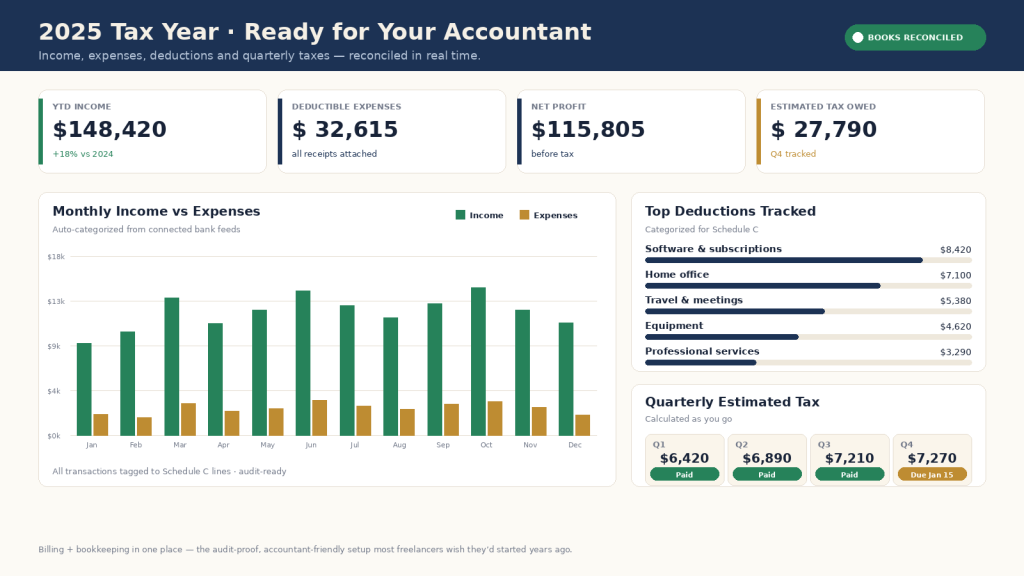
As tax regulations for independent contractors become more complex in 2026, the “shoe-box full of receipts” method is officially obsolete. The modern freelancer needs a digital paper trail that is audit-proof and effortless to manage. By using a comprehensive freelance invoice software, you are not just billing clients, but also creating a real-time financial information. Zenible’s ability to categorize income alongside project expenses means that when tax season arrives, you aren’t scrambling through spreadsheets. You are providing your accountant with a clean, reconciled dashboard that proves your professional standing and maximizes your deductions.
What an Integrated Financial Workflow Actually Looks Like
The phrase “integrated financial workflow” sounds like jargon, but the practical version is simple.
Income Capture That Happens by Itself
Every invoice you send becomes a permanent record. When the client pays, the system tags the deposit, links it to the project, and categorizes it correctly. No reconstruction work in February.
Expenses Pulled In Automatically
Connected bank feeds bring in every business charge. You categorize each one in seconds with a tap, building your Schedule C in real time rather than reverse-engineering it from a year of transactions.
Receipts That Don’t Live in a Drawer
Most modern self-employed tax software lets you photograph a paper receipt with your phone and attach it directly to a transaction. The IRS accepts digital records as substantiation. Your shoebox isn’t just messy—it’s redundant.
A Dashboard That Tells You Where You Stand
At any moment, you can see your year-to-date income, expenses by category, projected quarterly tax owed, and net profit. When April arrives, your accountant doesn’t get a pile of documents. They get access to a reconciled dashboard with every number already assigned to its proper line.
The Quarterly Tax Trap
Here’s the freelancer mistake that costs more than disorganization itself: forgetting that taxes for the self-employed aren’t paid once a year.
The IRS expects independents to make quarterly estimated taxes payments in April, June, September, and January. Miss one, and the underpayment penalties pile up quickly. The self-employment tax alone runs 15.3%, before federal income tax is even calculated.
A unified billing-and-bookkeeping platform makes this almost effortless. Because your income and expense data update in real time, you can see roughly what you owe at any given moment. When the next quarterly deadline approaches, the number is already there—calculated, waiting, and far less terrifying than the surprise April bill that catches so many freelancers off guard.
How to Start Without a Total Overhaul
You don’t need to migrate ten years of records this weekend. You need to draw a line.
Pick a date—the start of next month works. From that day forward, every invoice goes through a single system that also captures expenses. Connect your bank account. Set up basic categories aligned with Schedule C. Photograph receipts as they happen.
Within ninety days, you’ll have a clean stretch of organized records. Within twelve months, your tax return will be a different experience entirely. Within three years, an audit notice would be merely irritating instead of terrifying.
The freelancers who handle taxes well aren’t more organized people by nature. They’ve simply put their money in a system that organizes for them.
The Bottom Line
The independents who’ll thrive in the increasingly digitized 2026 economy aren’t the ones with the most clients. They’re the ones whose numbers can stand up to a second look without flinching.
Your billing system and your bookkeeping system shouldn’t be separate tools that you painfully reconcile in February. They should be the same tool, working quietly in the background, making April a non-event.