For most of the last century, proving your English meant booking an exam weeks in advance, travelling to a test centre, and waiting five to thirteen business days for a result. The certificate that arrived was trusted precisely because it was slow, scarce and expensive. That trade-off is now being renegotiated. As AI-based scoring has matured, a second model has appeared alongside the traditional exam: transactional, verifiable English assessment that returns a result in minutes rather than weeks. The shift is visible in the mainstream too: AI-scored, remotely delivered English tests are now accepted by thousands of universities and employers worldwide — evidence that automated assessment has crossed from novelty into infrastructure.
We wanted to look past the marketing and into the data. What follows is drawn from more than 125,000 completed English assessments taken through the International English Test — real, aggregate, anonymised. Four findings stood out.
Finding 1 — Speed is now the baseline, not the premium
The single clearest signal is time. Across the assessments that led to an English Online Certificate (n = 2,549 matched test-to-certificate pairs), measuring from the moment answers are submitted to the moment the certificate is issued, the median is five minutes. Half of all certificates are in their owner’s hands inside five minutes; 77% within fifteen; 85% within the hour. A traditional exam’s 5-to-13-day turnaround is not a slightly slower version of this — it is a different category of product.
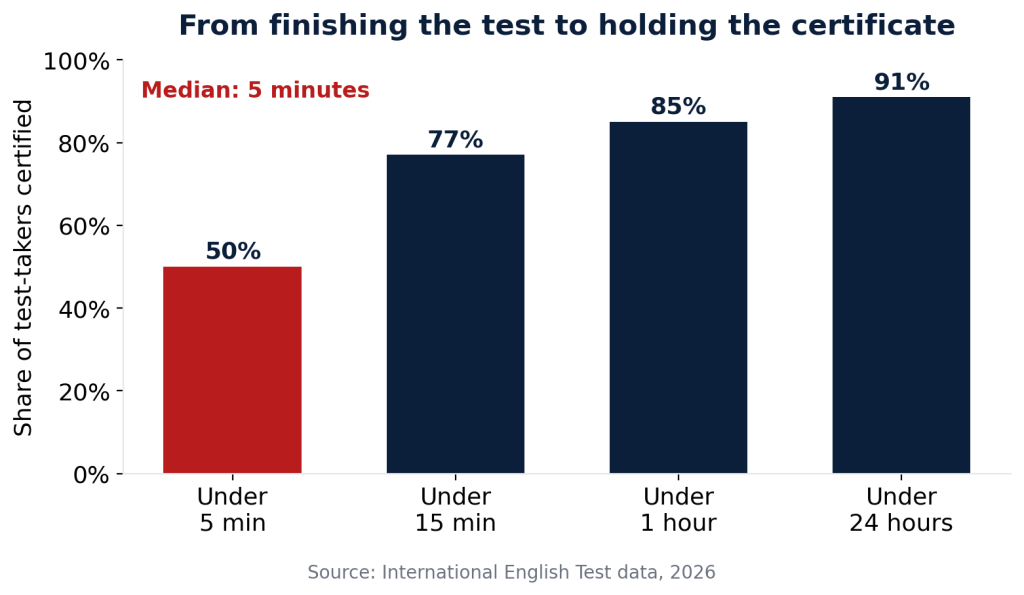
What makes this possible is not a faster courier. It is that scoring, level placement and certificate generation have moved from a human marking queue to an automated pipeline that runs the instant the test ends. Speed here is not a convenience feature bolted onto an exam; it is what the exam becomes when the bottleneck of human marking is removed.
Finding 2 — The people who certify are already advanced
A common assumption is that online English tests are taken mainly by beginners checking a starting point. The level distribution says otherwise. Across 121,513 scored sessions, 62% placed at B2 or above, and C1 was the single largest band at 36.7% — larger than any other level on the scale.
That skew tells you who reaches for a fast, verifiable certificate: not people at the start of the journey, but people near the end of it, who already know roughly where they stand and need a credential that proves it quickly. It is a working professional’s document, not a beginner’s diagnostic.
Finding 3 — Access has genuinely gone global
If speed changed the product, reach changed the audience. The completed assessments span more than 190 countries, and — strikingly — no single country accounts for more than 4.5% of them. The top ten run from Brazil, Mexico and the Philippines to Germany, Italy and Ukraine to Pakistan, Bangladesh and Indonesia: Latin America, Europe and South and Southeast Asia, with no centre of gravity.
This is the quiet consequence of removing the test centre. When a credential no longer requires a scheduled slot in a physical location, the people who take it stop looking like the population near any one country’s exam halls and start looking like the internet: broad, flat and everywhere. A model that depends on human examiners in fixed locations cannot produce this shape; an AI-scored one does so by default.
Finding 4 — At scale, the data surfaces a weak spot no examiner could see
The most useful thing about assessing at scale is that patterns invisible in any one test become obvious across 122,000 of them. Breaking every completed assessment into its four skills, three cluster together — Grammar and Reading at 73%, Vocabulary at 70% — and one sits clearly below the rest:
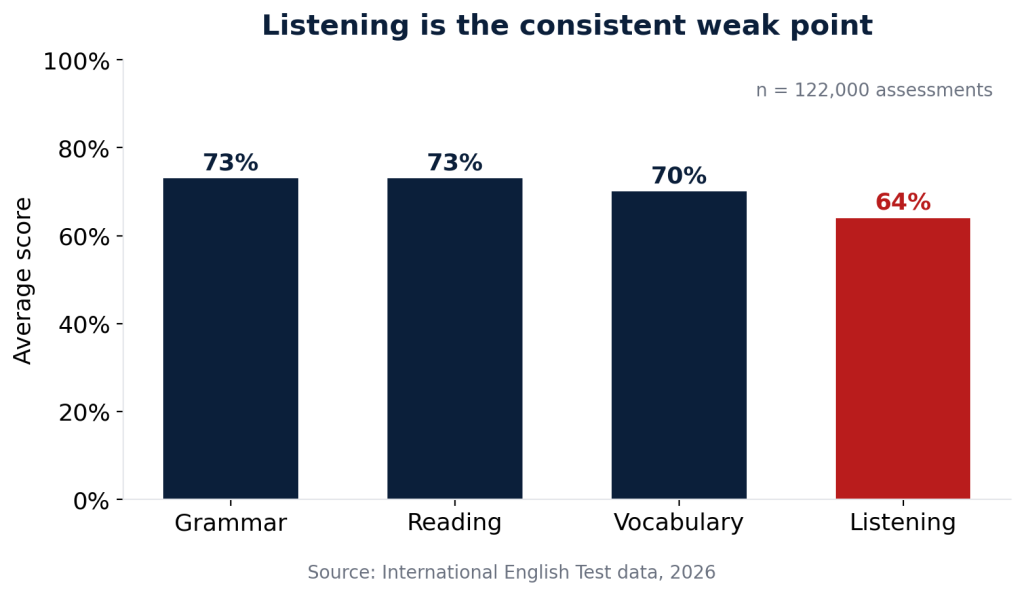
Listening averages 64%, a full nine points under the strongest skill and consistent across the whole population. On its own, one test-taker scoring low on listening is noise. Across 122,000, it is a finding: listening is the skill learners most reliably overestimate and most consistently underperform on. That is the kind of pattern an AI system surfaces at a scale no panel of human examiners could review — and the kind of insight that turns an assessment from a gatekeeper into a diagnostic.
Where this goes
None of this makes the traditional exam obsolete; high-stakes academic and immigration decisions will keep their slow, heavily-invigilated instruments for good reasons. But for the far larger everyday case — a professional who needs to prove their English to an employer, a recruiter, or themselves — the direction is set. Assessment is becoming fast, verifiable, global, and analytical, and the engine underneath is AI. The certificate is no longer trusted because it was slow to obtain. It is trusted because it can be checked in seconds, against data, by anyone. If you want to see what that model looks like in practice, it is running now at International English Test.
International English Test, an associate member of ALTE (the Association of Language Testers in Europe). All figures are aggregated and anonymised; the queries behind them are available on request.