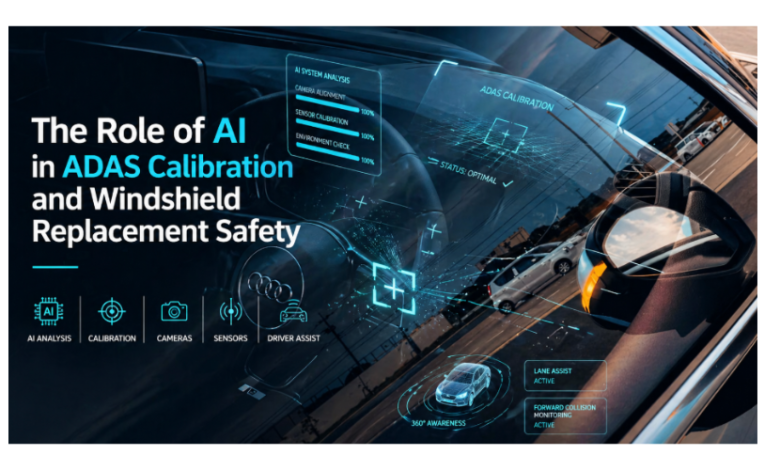
Cars now rely on software to interpret sensor data in real time. Cameras, radar, and other inputs flow into models that detect lanes, classify objects, and estimate distance and speed. When the inputs are accurate, AI in vehicle safety systems supports features like automatic emergency braking, lane keeping, and driver alerts.
Much of that work is vision-heavy. The forward camera processes images and maps what it sees to the vehicle’s expected geometry. Small optical changes can create large downstream errors because the math depends on precise pixel placement.
Windshield Replacement And The Forward Camera
In many vehicles, the front camera sits high on the windshield behind the rearview mirror. The glass is part of the optical path, so it affects refraction, distortion, and glare behavior. During an ADAS windshield replacement, the camera mount can shift, the bracket position can change, and the replacement glass can differ slightly in curvature or tint.
As AI-driven safety systems become more common, proper windshield replacement with ADAS recalibration is no longer just a repair step but a critical part of restoring vehicle safety performance.
A few millimeters at the mount can translate into feet of distance error on the road. That affects following distance estimates, object tracking, and lane positioning.
What Calibration Corrects
Advanced driver assistance systems calibration ties sensor aim back to the car’s reference line so the software can place objects correctly in space. After glass work, front camera calibration is often required because the camera was physically disturbed and now looks through a new optical surface.
Shops generally use two styles:
- Static calibration performed indoors using printed targets placed at measured distances
- Dynamic calibration completed during a controlled road drive where the system references lane markings and roadside features
Some models also require software initialization steps so the system recognizes hardware changes.
Calibration is common after wheel alignment, suspension work, front-end repairs, or sensor replacement. Lane assist calibration may be specified even if the vehicle feels normal during a short test drive.
Where AI Shows Up During Calibration
Artificial intelligence operates inside the vehicle and inside modern shop equipment. In the car, computer vision models interpret calibration targets, road markings, and object movement while routines run. In the shop, newer rigs use automated measurement guidance to reduce setup mistakes in height, centering, and angle.
This reflects the direction of newer technology seen in AI-powered ADAS platforms, where perception relies on layered sensor inputs rather than a single stream of data. The fused output depends on accurate geometry.
Many scan tools now generate digital calibration reports. SAE International has been developing a uniform reporting framework for ADAS sensor calibration so results can be documented consistently across repair facilities and insurers.
Common Triggers And Typical Follow-Up
| Service Event | What Can Change | Typical Follow-Up |
| Windshield replacement | Camera mount position, glass optics | Scan plus static or dynamic calibration |
| Front-end collision repair | Brackets, sensor angles, wiring | Scan, aiming verification, calibration |
| Wheel alignment or suspension work | Vehicle reference line | Recheck lane keeping and camera aim |
| Camera replacement | New unit positioning | Initialization plus calibration |
Some errors appear valid to the system. The data stream may remain coherent even when the camera sits slightly off-axis, allowing the system to operate with distorted geometry.
Two Failure Patterns Technicians See
Late intervention is one of them.
If a camera tilts slightly downward, the system may calculate that a vehicle ahead is farther away than it actually is. That delays warnings or emergency braking activation. The Insurance Institute for Highway Safety has reported that small forward-camera misalignment can significantly reduce the usable reaction window for automatic emergency braking.
False positives are another concern.
A misaligned sensor can misinterpret shadows, road texture changes, or overhead structures and trigger alerts or unexpected braking. Vehicles behind may not anticipate that deceleration.
Shop Checks That Help
A structured process reduces stacked errors:
- Pre-scan and document any diagnostic codes before removing the glass
- Verify bracket condition and placement before reinstalling the camera
- Confirm target setup is square and level for static calibration
- Save the post-scan report after completion
- Road test under manufacturer-specified conditions
Glass And Mounting Details That Influence Outcomes
Small workmanship issues can affect optical performance:
- Match ADAS-specific cutouts, frit pattern, and tint to vehicle specifications
- Keep the camera viewing zone free of adhesive contamination
- Confirm trim and housing components seat fully to prevent later movement
- Inspect for glare sources around the camera enclosure
Standards And Legal Signals
Transport Canada reports using on-road studies and advanced simulators to examine how drivers interact with ADAS and how sensors perform in conditions such as snow, ice, and road spray.
In the United States, the National Highway Traffic Safety Administration references the federal “make inoperative” prohibition, which bars repair businesses from returning a vehicle with a safety system disabled or compromised.
Calibration In An Automated Vehicle Architecture
Vehicle software is becoming increasingly integrated. Perception, planning, and control modules share sensor inputs, so one camera alignment error can affect multiple safety features simultaneously. Discussions around autonomous systems often describe coordinated modules operating together, and current driver assistance stacks follow similar logic.
Post-repair validation therefore extends beyond clearing dashboard warnings. It involves confirming that the camera’s geometry supports reliable decision-making at highway speeds.
Final Thoughts
Windshield replacement sits close to the core of driver assistance performance because the forward camera depends on the glass and the mount. Accurate calibration supports consistent braking cues and stable lane guidance, which is the practical payoff of AI in vehicle safety systems after a repair.
For more coverage on AI in mobility and beyond, explore our blog.