There is a particular kind of person that big firms like Optiver, Jane Street, and Citadel Securities have always gone looking for. Not just someone who is good at math, but someone who thinks in probabilities, who is comfortable making decisions in milliseconds with imperfect information, and who does not freeze when real money is on the line.
Finding that person has never been easy. These firms recruit almost exclusively from top quantitative programs, run applicants through multiple rounds of probability theory, mental math, and live trading simulations, and still turn away the vast majority of people who try.
For decades, the ones who made it through stayed. The pay was exceptional, the problems were genuinely hard, and there was a certain prestige to working at the cutting edge of financial markets. A career at one of these firms is a perfect example of ‘success’.
Hence, it is worth paying attention to the fact that some of them are leaving.
Not in large numbers, and not all at once. But quietly, steadily, a cohort of quantitative traders and researchers who built careers at the most selective firms in finance are redirecting their energy toward artificial intelligence. Some are joining labs, while others are doing what Luc Feron is doing;
Building funds that treat AI not just as a tool to improve their trading, but as the central thesis around which an entire investment strategy is constructed.
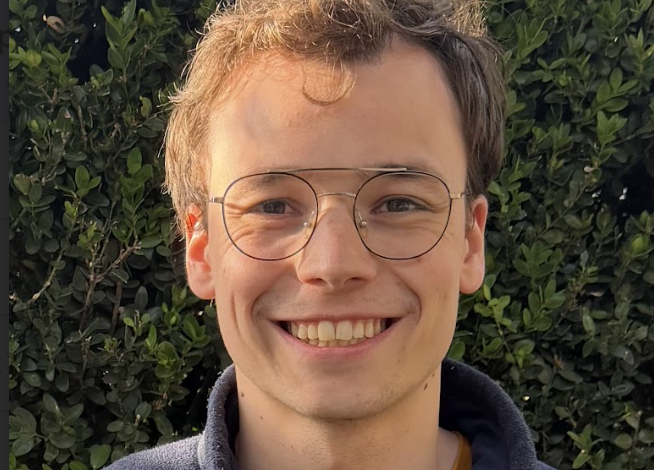
Feron spent over three years trading European single stock options at Optiver, one of the world’s leading market-making firms. He graduated summa cum laude (with highest praise) in Econometrics and Operations Research from Maastricht University, won the annual prize for best bachelor’s thesis, and went straight to Amsterdam rather than pursue a master’s degree. He was, by any measure, exactly the kind of person these firms are built around.
He is now leaving to co-found an AI-focused hedge fund in San Francisco with Kelvin Leung, a former quantitative researcher also from Optiver. The decision to relocate from Amsterdam to San Francisco is itself telling. This is a story about someone who decided that the most important market-related bet of the next decade has very little to do with options spreads.
“It is clear to me that AI will be the most powerful tool ever created,” Feron says. “I wanted to have exposure to its success.”
That framing, coming from someone with his background, is worth unpacking. Quantitative traders spend their professional lives thinking carefully about conviction and position sizing. When someone who has been trained to quantify uncertainty makes a statement like that, it tends to mean something more precise than enthusiasm.
The broader pattern Feron represents is not an accident. Quantitative finance, at its most serious, is fundamentally an exercise in modelling complex systems, finding signals within noise, and making probabilistic decisions under uncertainty. These are also, in many respects, the core intellectual challenges of applied machine learning. The skill transfer is more direct than it might appear from the outside.
What makes the migration interesting is not just the skills involved, but the timing and the form it is taking. The most visible version of this shift has been quantitative researchers moving directly into AI labs, often to work on reinforcement learning, alignment research, or large-scale model training. Several of the researchers behind some of the most significant recent advances in AI came out of quantitative finance backgrounds. The mathematical toolkit is compatible, and labs have been willing to pay accordingly.
But there is another version of this shift that has received less attention. A smaller group, Feron among them, is not moving into AI development at all. They are staying in markets, but repositioning around AI as the dominant investment theme of the era. The distinction matters because building AI is one kind of bet, and allocating capital around AI’s trajectory is a different one, and it requires a different kind of edge.
Feron’s argument, implicit in his career move, is that a trading background provides exactly that edge. Years of making hundreds of decisions a day with real money on the line develops a particular kind of judgment about risk, about the difference between a genuine signal and noise, and about what it actually means to have conviction in a position versus merely believing something is true.
The broader workforce questions these raises are the ones companies and investors are only beginning to grapple with. For years, quantitative finance attracted a specific type of talent partly because it was the highest-paying destination for people with the relevant mathematical skills. That calculus is shifting. AI research roles at frontier labs have become competitive with, and in some cases exceed, what trading firms offer and for people who are genuinely motivated by the intellectual problem rather than the compensation, the problem of AI seems to many of them simply more important than the problem of pricing derivatives.
None of this is to suggest that firms like Optiver are struggling to hire. They are certainly not; the pipeline of mathematically exceptional graduates who want to trade is not going anywhere soon. But the very best of those graduates, the ones who might previously have spent an entire career at a single firm, are increasingly asking a different question before they commit: what is the most consequential problem I could be working on?
For Luc Feron, that question has an answer. It involves a fund, a relocation, and a conviction that the next decade will be shaped by the labs and frontier AI companies of San Francisco.