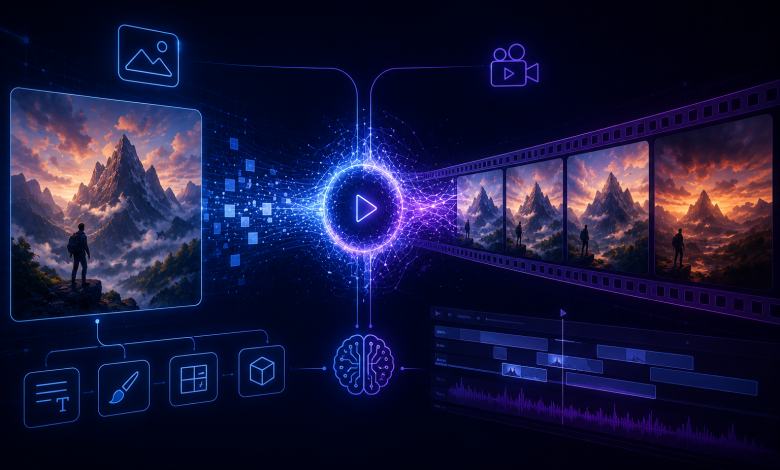
For most of the last two years, AI image generation and AI video generation developed on separate tracks. Image models got very good, very fast, at producing a single polished frame. Video models, meanwhile, wrestled with a much harder problem — keeping that same level of quality consistent across dozens or hundreds of frames while something actually moves. The two disciplines solved different problems, and creators mostly treated them as different tools for different jobs.
That separation is starting to disappear, and it’s changing how AI-assisted content actually gets made.
The Rise of the “Keyframe-First” Workflow
The clearest sign of this shift is a new generation of image models explicitly designed with video in mind. ByteDance’s recently launched Seedream 5.0 Pro is a good example. On paper, it’s an image generation and editing model — built for high-density infographics, precise local edits, layered design output, and native multilingual text. But its stated design goal goes further: producing images strong and consistent enough to function as reliable starting frames for AI video generation pipelines, rather than existing as a standalone still-image tool.
That distinction matters more than it sounds. A video model can only work with what it’s given. If the first frame has inconsistent lighting, an oddly proportioned subject, or muddy detail, that flaw doesn’t stay contained — it gets carried, and often amplified, across every frame that follows. By building an image model with cinematic lighting, realistic materials, and precise editing control as core priorities, tools like Seedream 5.0 Pro are effectively treating “produce a great still image” and “produce a great first frame for video” as the same job.
What This Means for an AI Video Generator
Once you have a genuinely strong keyframe, the role of the video model changes. Instead of being asked to invent a scene from a vague text prompt — guessing at composition, lighting, and subject detail while also handling motion — an AI image enhancer can focus on what it’s actually best at: interpreting how that already-strong image should move, where the camera should travel, and how the scene should evolve over time.
This two-step approach — generate a precise, high-quality image first, then animate it — is quickly becoming the default for serious AI video production, replacing the older habit of typing a single long prompt into a video model and hoping for the best. It also opens the door to a kind of creative control that pure text-to-video never really offered: you can iterate on the still image until it’s exactly right — adjusting a product’s color, fixing a layout, swapping a background — before committing to the more expensive, harder-to-edit step of generating motion.
Why This Convergence Is a Bigger Deal Than It Looks
A few practical shifts follow from treating image and video generation as connected stages of one pipeline rather than separate tools:
Consistency improves dramatically. A character, product, or brand asset established in a precisely edited image carries its exact details — down to the label text or the fabric texture — into the animated result, instead of drifting the way purely text-prompted video often does.
Editing gets cheaper and faster. Fixing a mistake in a still image, before animation, takes seconds. Fixing the same mistake after a video has already been generated often means starting over.
Specialized skills become more accessible. Tasks that used to require a trained designer — precise product photography, multilingual packaging text, layered poster design — are increasingly achievable through natural-language editing, which then feeds directly into video without a separate handoff.
Where This Is Headed
The direction is clear enough: the meaningful unit of AI creative work is stopping being “an image” or “a video” and becoming a connected pipeline — a precisely generated, carefully edited still image, handed to a motion-focused model that animates it faithfully. As image models keep getting better at the kind of controlled, production-grade output that video pipelines depend on, and as video models keep getting better at interpreting that input faithfully rather than reinventing it, the practical gap between “I have an idea” and “I have a finished, polished clip” keeps shrinking — not because either model got dramatically smarter on its own, but because the two finally started talking to each other.