The holiday season is a busy time for finance teams. Invoices continue to pile up, needing to be processed and paid, even as employees take time off and those still in the office scramble to resolve last-minute issues and close the books for the year.
When finance teams are stretched thin, fraudsters see an opportunity. They know a phony invoice, impersonated vendor, or change to a supplier’s banking information is much more likely to slip through when there are fewer employees in the office and those still working are pulled in a dozen different directions.
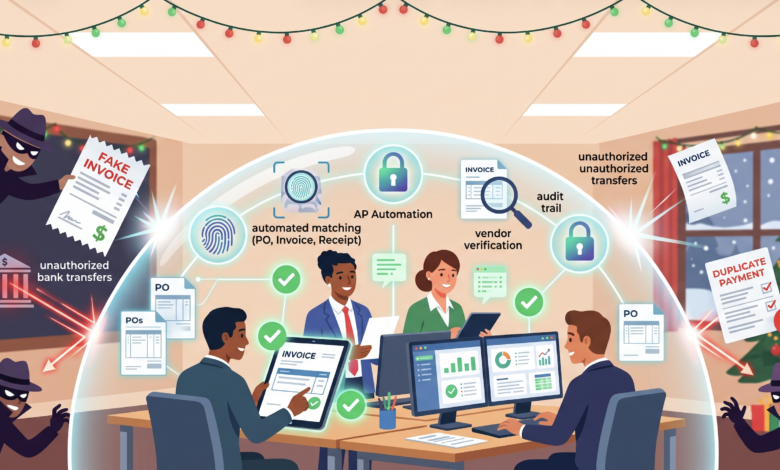
AI-powered accounts payable automation provides an extra layer of protection that holds steady even during these high-pressure periods. Routine invoices can continue to flow through the process, while AI flags suspicious activity for closer review before money leaves the business. This added scrutiny helps reduce the risk of fraud, even during a season when finance teams don’t have much time to spare.
Every invoice is checked against its own history
Many businesses still rely heavily on manual reviews to detect potential fraud. But manual reviews are focused on one invoice at a time and rely on the reviewer knowing what’s “normal” for a particular vendor.
When an employee is reviewing one invoice at a time, minor anomalies might seem reasonable. They only become suspicious when they’re compared to that vendor’s history, which isn’t exactly easy to commit to memory.
AI can make those comparisons automatically. When an invoice comes in, AI-powered automation compares it to the vendor’s history, including previous invoices, banking details, submission patterns, and payment activity. Anything that doesn’t align with that historical data is flagged for review, so staff can investigate before payment is made.
Consider a long-standing supplier that’s used the same bank account for years. If an invoice comes through this month with different banking information, it’s automatically flagged for further review. AI can also surface issues like a new vendor added to the system with details that closely resemble an existing one or two largely similar invoices coming through from the same supplier with slightly different invoice numbers.
These small details can be difficult to catch manually, especially during the holiday season when a lean team is juggling hundreds of invoices while scrambling to wrap up the year. An employee manually reviewing invoices might not remember a vendor’s bank account number or notice a couple of changed digits. AI can help by surfacing these anomalies so staff know where to focus their attention to prevent fraud.
The details that get missed during the holiday rush
Invoice fraud doesn’t always make itself known as a single, obvious change. More often, it takes the form of a subtle anomaly that’s buried in the details. It could be an invoice that arrives at a time of month that’s unusual for that vendor, a price for a single line item that’s outside of the supplier’s normal range, or an invoice number that closely resembles one that’s already been processed.
AI-powered AP automation recognizes patterns and identifies activity that falls outside of them. It can identify duplicate or near-duplicate invoices, unusual billing amounts, changes to invoice formatting, and other inconsistencies that warrant further attention. Some AI systems can even analyze scanned documents for handwritten notes, altered fields, or other signs that could suggest an invoice has been manipulated.
These details can be easy to overlook for fully staffed teams. They’re even tougher to catch during the holiday season, when AP staff are covering for coworkers, working through a backlog of invoices, and rushing to close the books to meet year-end deadlines.
AI doesn’t remove the need for human review. Instead, it provides an additional layer of protection that stays consistent no matter how many invoices come through or how many employees are off for the holidays. It also helps staff focus on the transactions that actually need their attention, rather than expecting them to bring unwavering scrutiny to every line item of every invoice that crosses their desk.
What finance teams can do with the time they get back
Identifying more red flags is only helpful if staff have time to investigate them. But when staff spend their days keying in invoices, matching them to purchase orders, and chasing down approvals, they might not have much time left to give those red flags the attention they deserve.
AP automation can take on much of the routine, repetitive work that weighs finance teams down. Well-behaved invoices can move through the process with less manual intervention, and staff can focus on reviewing exceptions and investigating invoices flagged by AI.
This increased capacity can make a big difference for teams looking to maintain a high level of scrutiny during the holiday season. Flagging an invoice and adding it to a queue won’t do much good if the person who’s supposed to review it is buried in manual work or covering two jobs while their coworker is out of the office. Automation reduces the amount of manual processing so teams have more room to apply their expertise and judgment where it’s truly needed.
Of course, fraud prevention is just one of many priorities competing for senior staff attention during the holiday season. Reducing manual work also frees up teams to focus on reconciliations, reporting, and the countless other tasks required to close out the year.
What finance leaders should check before the holiday rush
AI-powered AP automation can provide an important layer of fraud protection. But to be effective, it must be paired with strong internal controls.
Now’s the time for businesses to take a closer look at the processes surrounding their invoice approval and payment before the holiday rush sets in. The following are practical steps that can help a business properly prepare.
Review approval thresholds and routing rules
Make sure invoices are still being routed to the right people and that approval thresholds accurately reflect current roles and responsibilities. Outdated workflows can create bottlenecks or send invoices to people who no longer own them. This is particularly problematic when the team is trying to clear a backlog and close the books for the year.
Confirm dual controls are being followed
A segregation of duties policy isn’t going to make a difference if it’s not actually being followed. Confirm that no single employee can complete all steps of the AP process on their own. For example, the same person shouldn’t be able to create or modify a vendor, approve an invoice, and release payment without someone else getting involved. These controls are especially important when holiday PTO means other employees are filling in on duties they might not typically handle.
Flag and re-verify recent vendor payment details
Make a list of suppliers that have changed their banking or payment information within the last 60 to 90 days. Confirm those changes using trusted contact information in your vendor master, not the phone number or email address included in the change request.
Set clear escalation paths for anomalies
Flagging anomalies won’t make much of a difference if no one knows how to handle them or who’s responsible. Determine who should investigate flagged invoices and who’s authorized to make a final decision. Establish a backup plan for when the usual reviewers are unavailable.
The months leading up to the end of the year are a good time to make sure strong internal controls are in place and working as they should. Even when half the team is out for the holidays, AI can help fill in the gaps by flagging suspicious activity so staff can investigate and avoid preventable losses.
Keep invoice fraud in check, even during the holiday rush
Leaner teams and heavier workloads are common during the holiday season. But those conditions don’t have to create more opportunities for fraud to sneak its way in.
AI-powered AP automation adds another layer of scrutiny to every invoice, even when teams are stretched thin. It can detect suspicious patterns, identify potential problems, and take on more of the manual work that sucks up so much staff time.
AI is meant to support the people who are protecting the business, not replace them. With the right information at their fingertips and more time to act on it, finance teams can focus on making the best judgment calls, even during the busiest weeks of the year.