The Algorithm Saw the Crash First
Picture the moment a car hits another car at an intersection somewhere in a mid-sized American city. Glass on asphalt. A driver reaching for a phone. Somewhere in the background, a siren starting up.
Now picture what happens in the next ninety seconds, before anyone has stopped shaking.
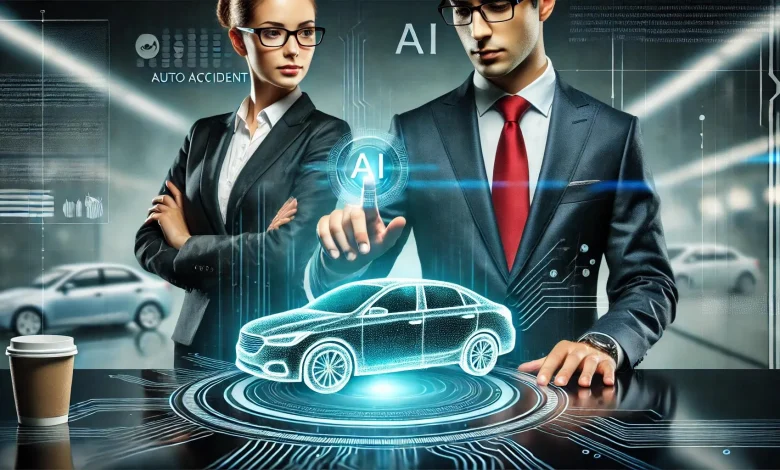
The vehicle’s onboard system has already logged the impact, the speed at collision, the steering angle in the second before, the deployment of the airbags. That data is uploading to a cloud server owned by the manufacturer. The driver’s phone, depending on the make, has detected the crash through its accelerometer and has either already called emergency services or is asking whether to. A traffic camera at the intersection has captured the event, and the footage is being indexed by a municipal system that flags collisions for review. Within minutes, an insurance company’s intake platform will receive the first notification, and a machine learning model will begin building a preliminary case file before a human adjuster has even seen the claim.
The accident, in other words, has already been investigated by software before the ambulance arrives.
This is the part of the artificial intelligence story that does not get told often, because it does not involve chatbots or image generators or the question of whether machines will write our novels. It involves the steady, almost invisible insertion of machine learning into the parts of life that nobody pays attention to until something goes wrong. And accidents — vehicular, workplace, premises, are exactly the kind of moments where the new infrastructure shows itself.
A Quiet Revolution, Mostly Out of View
I have spent enough time around insurance technology to know that the most consequential AI in this industry rarely makes the press release. The headline-grabbing tools are the consumer ones, the chatbots that handle policy questions, the apps that estimate damage from a photo. The real shift is happening one layer below, in the systems that decide how a claim gets routed, what its likely value is, how much to reserve against it, and whether anything about it looks suspicious enough to escalate.
Talk to anyone who has worked in claims operations in the last five years and you will hear a version of the same story. The work used to involve a lot of reading. Medical records. Police reports. Repair estimates. Recorded statements. An experienced adjuster could move through a stack of paper and develop an intuition about what a case was worth. That intuition still matters, but it now arrives on top of a model output rather than instead of one. The model has already read the file. It has already extracted the diagnoses, the treatments, the timeline. It has already produced a number.
What changes when a number arrives before the judgment does? A lot, as it turns out.
The Asymmetry Nobody Talks About
Here is the part that deserves more attention than it gets.
When an insurer uses AI to evaluate a claim, the claimant is operating in a different epistemic position than the insurer. The insurer knows what its model is doing, more or less. It has the training data, the features, the historical performance metrics. The claimant, the person who was actually in the accident, has none of that. They have a number on a settlement letter and a vague sense that the number came from somewhere.
This is not a hypothetical concern. It is the day-to-day reality of personal injury cases in 2026. The injured person sits across from a system whose logic is opaque to them, whose training data they cannot inspect, whose error rates they cannot evaluate. And the stakes, when serious injuries are involved, are not abstract. Medical bills, lost income, long-term care needs, these add up to numbers that determine whether someone recovers their financial footing or does not.
Which is why the legal profession has had to develop new muscles. Attorneys who handle injury cases are no longer just preparing for a negotiation with an adjuster. They are preparing for a negotiation with the output of a model, mediated through an adjuster. The skills required have shifted accordingly. Knowing how to push back on a damage estimate that came from a computer vision system is different from knowing how to push back on one that came from a human inspector. Knowing how to argue that a medical timeline extracted by a language model missed the significance of a particular complication is a skill that did not exist a decade ago.
When someone calls a personal injury lawyer in Chicago after a serious crash, the engagement they are signing up for is no longer the one their parents would have signed up for in the 1990s. It involves understanding which algorithms touched their case, what those algorithms tend to miss, and how to surface the evidence that the automated review either underweighted or never saw. The good firms have figured this out. The ones that have not are being out-prepared by the other side.
So What Are the Machines Actually Good At?
I want to be fair to the technology, because dismissing it would be as wrong as overselling it.
The machines are genuinely good at certain things. They are good at reading volumes of structured and semi-structured documents and pulling out what matters. They are good at recognizing the visual signatures of vehicle damage and translating those signatures into repair cost estimates that, for ordinary collisions, land close to what a human appraiser would produce. They are good at flagging patterns that look statistically unusual, the same provider showing up in clusters of similar claims, the same repair shop billing at the high end of every estimate range. They are good, in short, at the parts of the work that involve volume, pattern recognition, and consistency.
What they are not as good at is the part of the work that involves judgment about specifics. The case that does not look like the training data. The injury that presents atypically. The collision dynamics that depart from the common scenarios. These are exactly the cases where outcomes matter most and where automated systems are most likely to produce confident outputs that are quietly wrong.
The pattern is familiar to anyone who has watched AI deployments in other domains. The systems handle the middle of the distribution well and struggle at the tails. The middle of the distribution is most of the cases. The tails are where the serious ones live.
What Comes Next, and What Should
The trajectory from here is not mysterious. AI will continue to absorb more of the routine work of accident investigation and claims processing. The systems will get better. The errors will get more subtle and harder to spot. The cost pressure on insurers will keep pushing automation deeper into the workflow, and the cost pressure on claimants’ representatives will push them to develop better tools to audit and challenge automated outputs.
What should happen is a more honest public conversation about all of this. Regulators in some states have started to ask the right questions about algorithmic accountability in insurance, but the disclosure regime is still thin. Most people whose claims are processed by AI have no idea it happened. Most settlements that were shaped by model outputs are documented in language that gives no hint of the model’s involvement. The asymmetry persists in part because it is comfortable for the side that benefits from it.
I do not think this is a story with villains, exactly. Insurers deploying AI are responding to real cost pressures. Vendors building these systems are doing legitimate engineering work. The technology itself is, in many of its applications, an improvement on what came before. The problem is the gap between the sophistication of the systems and the sophistication of the institutions around them, the courts, the regulators, the public understanding of what is happening.
That gap will close eventually. The question is how many cases get resolved inside it before it does.
The crash at the intersection happened in ninety seconds. The investigation that the algorithms began in the minute that followed will shape the outcome of the case for months or years. Somewhere in that process, a person will have to decide whether the machine’s first read of what happened was the right one. That decision, more than any technical advance, is what will determine whether the new infrastructure serves the people inside it or merely processes them.