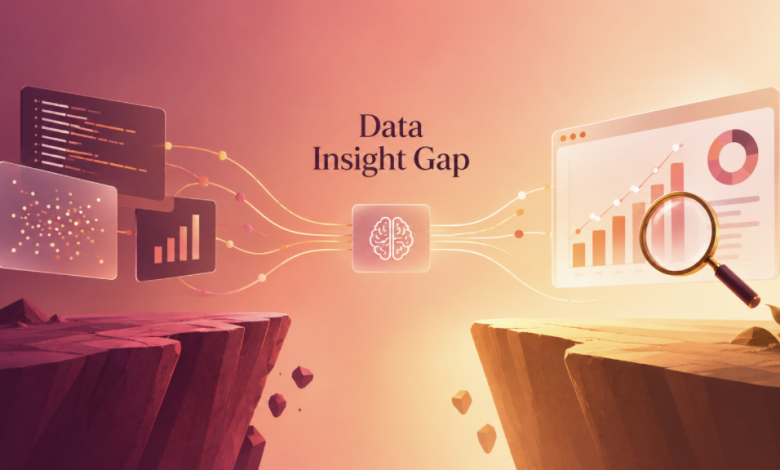
Modern systems are exceptionally good at recording what happened. They are much less reliable at explaining what those records actually mean.
A platform can collect timestamps, transactions, device signals, location events, images, logs, model scores, and user activity at enormous scale. Yet every useful conclusion still depends on interpretation: which records belong together, what context is missing, whether a signal is direct evidence or inference, and how much confidence a system should place in it. As AI takes a larger role in turning raw information into decisions, the gap between data and meaning is becoming a central problem in digital system design.
Data Is Not the Event
Digital records often look more definitive than they are because databases force messy activity into clean structures. A GPS record may contain latitude, longitude, accuracy, and time. That looks precise, but it describes what a device reported under specific conditions. It does not automatically prove who carried the device, whether the reading drifted, or whether its timestamp matches the moment another system is trying to reconstruct.
The same distinction appears across software. A successful login event proves that an authentication system accepted credentials or tokens. It does not independently establish the physical identity of the person using the device.
Computer vision adds another layer. A camera captures light, software converts it into pixels, and a model may classify part of the image as a pedestrian, vehicle, defect, or unusual condition. Each stage adds interpretation.
This is why strong systems distinguish between observation and interpretation. “Sensor reported 72°C” is an observation. “Machine is overheating” is an interpretation based on thresholds, calibration, operating conditions, and supporting evidence. Confusing those layers is where many interpretation problems begin.
How Meaning Gets Added
Data usually passes through several transformations before appearing in a dashboard or being converted into an AI-generated recommendation.
The better way to view this process is as an interpretation pipeline.
| Stage | What happens | Where interpretation can drift |
| Capture | A device or application records a signal | Missing events, sensor errors, clock differences |
| Encoding | The signal becomes structured data | Schema assumptions, rounding, formatting |
| Context | Other records are connected | Incorrect identity, joins, stale information |
| Interpretation | Rules or models assign meaning | Classification errors, weak assumptions |
| Decision | Software or people act | Excess confidence, missing evidence |
Errors introduced early can survive every later stage. Suppose an account is incorrectly associated with a particular device. That mapping may feed security analytics, fraud models, personalization engines, support software, reporting dashboards, and AI-generated summaries.
Several systems can then appear to confirm the same interpretation even though every conclusion originated from one bad association.
IBM reported in January 2026 that 43% of chief operating officers identified data quality as their biggest data priority. More than a quarter of organizations estimated that poor data quality costs them over $5 million annually, while 7% put losses at $25 million or more.
The issue is therefore much larger than inaccurate spreadsheet cells. Data quality now shapes automated decisions across interconnected software systems.
Context Is the Hard Part
A record can be technically accurate and still support the wrong conclusion. A security platform may detect a login from an unfamiliar device shortly after a password change. Both events can be correct. Without knowing that the user replaced a laptop that morning, however, the system may interpret normal activity as an account takeover.
The same problem appears in operational data. A vehicle can record sudden braking without revealing whether it happened because of traffic, debris, weather, another vehicle, or a sensor anomaly. A retailer can record an abandoned checkout even though the customer completed the purchase on another device.
Context is difficult because it rarely lives in one place. Identity may sit in an account database. Device history may exist in security telemetry. Payments may come from a third-party processor. Location may originate from a mobile application. Customer-service information may remain inside a CRM.
To interpret one event correctly, software often has to reconstruct context from systems built for entirely different purposes. That is why integration should not be measured only by whether information can move between applications. The relationships between those records have to survive the transfer.
A timestamp without its clock source, a measurement without its unit, or a prediction without its input context may be valid data but weak evidence.
AI Compresses Interpretation

AI adds another challenge because it can turn thousands of pieces of information into one simple output. A fraud model produces a risk score. A sentiment system labels a conversation “negative.” Computer vision reports that an object is present. A language model converts several pages of records into four paragraphs.
This compression is useful. No analyst wants to inspect millions of raw log entries before responding to an incident. The problem is that simplified outputs can hide the uncertainty inside the source material.
Several mechanisms make this important:
- A precise-looking probability can conceal uncertain inputs. A result of 91% appears highly authoritative even when the underlying records are incomplete or contain measurements with their own margins of error.
- Summaries remove detail by design. An AI-generated account summary may capture the dominant pattern while omitting an unusual event that becomes important later.
- Models can interpret information already interpreted by another system. An AI assistant may summarize a risk label that came from a model using data previously classified by yet another service.
- Downstream users may never see the transformation chain. A dashboard can display “high risk” without showing which inputs were observed, inferred, or generated.
The scale of AI adoption makes this increasingly important. Stanford’s 2025 AI Index reported that 78% of organizations were using AI in 2024, up from 55% a year earlier.
The 2026 AI Index also reported hallucination rates ranging from 22% to 94% across 26 leading models on one new accuracy benchmark. The useful conclusion is not that AI outputs should be ignored. It is that inference should remain visible as inference.
Agreement Can Be Misleading
Digital systems can create an illusion of corroboration because the same information appears across several interfaces. Suppose an event appears at 3:42 p.m. in an operational dashboard, an AI-generated report, a customer record, and an automated incident summary. Four systems showing the same time looks like strong confirmation.
But if every system reads one original database field, there is still only one source. This distinction is central to data lineage, which records where information originated and how it changed as it moved through a system.
Three sensors independently recording a similar physical event may provide genuine corroboration. Three dashboards reading the same sensor do not. The problem becomes harder as organizations build warehouses, lakehouses, analytics platforms, search indexes, vector databases, dashboards, and AI assistants over shared enterprise data.
A generated report may therefore sit several transformations away from the original record. Without lineage, it can be difficult to determine whether a conclusion came from independent evidence or repeated copies of one upstream assumption. Agreement between interfaces is not the same as agreement between evidence.
The Point Where Data Meets Reality
The interpretation gap becomes particularly visible when digital systems record fragments of physical events. A real-world incident can leave GPS readings, photographs, timestamps, messages, vehicle telemetry, camera footage, app activity, and automated alerts, but none of those records necessarily explains the full event.
Digital discovery often happens before professional interpretation. Someone may begin by reviewing records, searching for information, or comparing digital accounts, then move toward location-specific resources such as a Palm Beach Gardens Car Accident Lawyer when the significance of those records depends on circumstances that general software cannot resolve on its own.
The technology remains useful because it can preserve sequences, expose inconsistencies, organize records, and make information easier to retrieve. Its value depends on treating digital records as evidence with provenance and limits rather than assuming that the presence of data automatically settles what occurred.
Observability Is Not Understanding
Modern software platforms can generate enormous volumes of telemetry about themselves. Metrics expose CPU utilization, latency, error rates, queue depth, memory consumption, throughput, and application-specific measurements. Logs record discrete events. Distributed traces reveal how requests move across services.
This creates observability, but observability is not explanation. Imagine an online payment platform experiencing a rise in failures while API latency increases at the same time. The measurements show correlation. They do not prove that latency caused the failed payments.
The root problem could be an overloaded database, a third-party authentication outage, an expired certificate, malformed data from a new release, or retry logic creating more traffic after the first failures began.
Adding more logs can even make diagnosis harder if the system produces more signals than engineers can meaningfully correlate.
Useful observability therefore depends on relationships. Teams need to know which deployment changed, what execution path failed, which dependency behaved differently, and whether multiple symptoms share one origin.
AI observability has the same problem. Recording prompts and outputs may help, but investigation may also require model version, retrieved documents, tool calls, permissions, inference settings, and the state of external services at execution time.
Automation Raises the Stakes
Interpretation becomes more consequential when software is allowed to act. A dashboard that incorrectly labels a transaction suspicious may confuse an analyst. A fraud system acting on the same interpretation could freeze a legitimate payment.
SSimilar patterns appear elsewhere. Security tools can isolate endpoints. Moderation systems can restrict content. Industrial software can shut down equipment. AI agents can modify records, manage digital communication, schedule actions, or invoke external software.
The acceptable level of uncertainty should therefore depend on the consequence of the action.
| Automated action | Sensible treatment of uncertainty |
| Product recommendation | Probabilistic ranking can usually be tolerated |
| Routine record update | Validate important identifiers before execution |
| Account restriction | Require stronger corroborating signals |
| Safety-related action | Use conservative thresholds and escalation |
| Hard-to-reverse decision | Preserve meaningful human authorization |
This is more useful than applying the same confidence threshold everywhere. A recommendation engine can rank products without knowing exactly what someone wants. A system deciding whether to revoke access to a financial account should require much stronger evidence.
Strong automation is therefore not measured only by how many decisions software can make. It depends on matching the evidence threshold to the cost of being wrong.
Provenance Becomes Essential
As AI-generated summaries and automated analytics become standard interface elements, provenance is moving from a backend governance concern toward a visible product requirement.
A result is more useful when its origin can be inspected. For structured data, provenance might include the originating system, timestamp, transformation history, record version, and whether values were later corrected. For AI-generated information, it may also include the model version, retrieved sources, generation time, and whether the output represents extraction or inference.
This matters because fluent presentation can make derived information appear more authoritative than the evidence underneath it. An AI-generated incident summary may read more clearly than original logs. That does not make it a better primary record. It remains an interpretation of those logs.
Systems can reduce confusion by keeping several categories distinct:
- Observed information should identify the system or instrument that captured it, including relevant timestamps and measurement limits.
- Derived information should retain links to the records used to calculate or infer it, rather than existing as an unexplained final value.
- AI-generated material should remain identifiable as generated or summarized content, especially when users may later treat it as factual documentation.
- Corrections should preserve version history where auditability matters, rather than silently replacing previous values.
These practices add some complexity to the interface, but they make information easier to inspect and trust.
Better Systems Preserve Uncertainty
Software has traditionally been built to remove ambiguity. Databases prefer defined fields. Workflow engines want discrete states. Dashboards prefer one number. Classification models prefer labels.
Real events are often less tidy. Suppose two systems report slightly different times for the same activity. Forcing them into one exact timestamp may create a cleaner interface while destroying useful information about the disagreement.
Likewise, “identity unconfirmed” can be more accurate than assigning an event to the most likely person. “Possible duplicate” can be safer than automatically merging records. A time range of 2:04 to 2:08 p.m. may preserve reality better than selecting 2:06 because an interface expects one value.
Uncertainty is not always missing information that should be removed. Sometimes it is information itself. This becomes particularly important with AI because models are designed to produce outputs even when evidence is incomplete. A well-designed system should be able to show when sources conflict, when confidence is limited, and when new information could materially change the interpretation.
In high-impact workflows, surfaced uncertainty gives analysts something to investigate. Hidden uncertainty creates false confidence.
Designing for Interpretability
Closing the interpretation gap requires work across the full architecture rather than adding an explanation screen after decisions have already been made.
Raw evidence should be retained where practical. Derived records should remain connected to their sources. Schemas should distinguish measured facts from classifications and predictions instead of making all three look equally authoritative.
Systems should also preserve enough execution context for later reconstruction. Software versions, model identifiers, timestamps, device details, execution paths, transformation rules, and data-source versions can become critical when a decision needs to be reviewed months later.
High-impact automation should also remain reviewable and, where feasible, reversible. The principle extends beyond AI explainability. A highly explainable model cannot rescue a pipeline that supplied incorrectly joined identities, stale records, duplicated evidence, or measurements stripped of context. Interpretability has to exist from capture to decision.
Verdict: Meaning Is the Bottleneck
Modern digital systems do not suffer from a shortage of signals. The harder problem is determining what those signals represent after they pass through sensors, databases, integrations, models, summaries, and automated workflows.
As AI takes greater responsibility for interpreting information and acting on it, data lineage, provenance, contextual integrity, uncertainty, and source independence become engineering requirements rather than administrative details.
More data improves a system only when the path from evidence to conclusion remains understandable. The next major improvement in digital intelligence may therefore come less from recording everything and more from building systems that clearly distinguish what was observed, what was inferred, and what can actually be concluded.