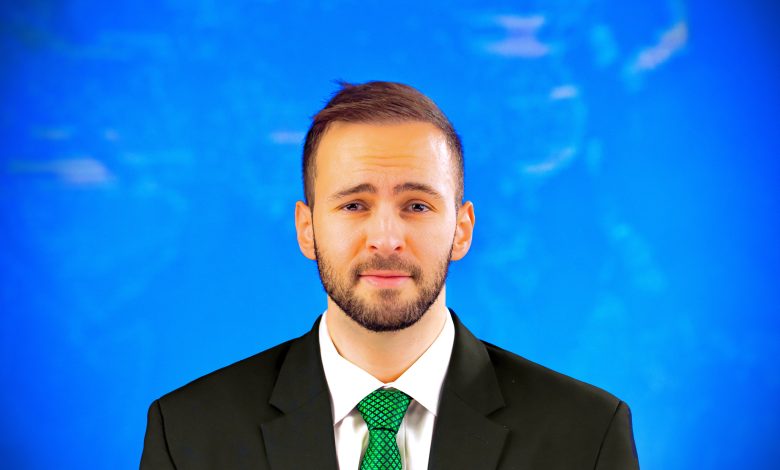
Most conversations about AI in content creation focus on what the tools can do. Tal Abiker is more interested in what they can’t.
Abiker, who is known online as Kamera Jr., is a New York-based comedian and content creator with over 2 million followers, a YouTube Golden Button Award, and a reputation for building content operations that run on AI before most teams knew where to start. He’s also a public speaker who has taken the stage internationally to talk about what AI integration actually looks like inside a production workflow, not just in theory, but in the daily friction of getting a team to abandon the processes they’re good at.
His take on the moment we’re in isn’t what you’d expect. The fear narrative around AI replacing creators doesn’t match what he sees from the stage. The people he talks to aren’t worried, they’re asking where to start. That gap between how AI is covered and how practitioners actually experience it is where Abiker tends to operate.
You’ve publicly called AI “the world’s best intern that still needs its CEO for direction.” What does that CEO role actually look like day to day in a content operation?
AI can help at literally every single step of the content creation process, whether it’s brainstorming, scripting, pre-production, editing… AI can enhance every part of the process, but it can’t sign off on the output for you. For 3 reasons.
Number 1: AI doesn’t know how humans consume content on social media. It assumes how it should work on paper, but it doesn’t know how the human brain actually works while on social media. So, it needs your guidance.
Number 2: AI does not know your brand. It does not know your voice, how you speak, how you sound, what b-rolls and animation you use, how often you rely on faceshots in your video, so again it needs you to teach them.
Number 3: Content & Entertainment are industries that are perpetually evolving. The trends and hooks of yesterday won’t work today. And there is no real time data readily available for the AI to be up-to-date with the pulse of the culture in the extremely fast moving world of social media.
Asking AI to literally “do the work for you” from start to finish will produce irrelevant work at best, erroneous work at worst.
When you first started integrating AI into your workflow, what broke before it got better?
The hardest part was forcing the team to abandon previous production processes. Literally I had to tell my editors “here’s the next video we’re making, you’re not allowed to pick up a camera, I want 0 real life shots.” Any industry that’s been around for a while is used to its traditional processes, and will resort to them. They will even be extremely efficient with them.
If you tell a videographer you need a pullback shot from the top of the building, they will immediately know how to pull it off in the traditional way, whereas doing it the AI way by prompting Veo3 or Higgsfield is completely foreign to them at first.
So there’s a learning curve that must be forced into the team to short circuit the path of least resistance. Eventually the team picks up the pace, gets used to the new tools, becomes faster, more efficient, and production costs go down.
I was very candid with my team: an AI-fluent editor will always beat a traditional video editor at the same level of expertise. Sometimes even with lesser expertise.
Most creators talk about AI in terms of tools. What’s a use case you’ve seen overhyped, and one that’s genuinely underrated?
In the world of content, hype appears and wears off very, very fast. What is impressive at first, becomes the norm, becomes passé.
One use case that I think is having its moment right now is POV content of people from 2026 travelling back in time. It’s currently very strong and garnering millions of views, but I’m already seeing the format getting copied over and over, and flooding feeds across platforms. Which means it’s already the beginning of the end.
One use case that I think is really underrated is using AI to enhance a faceshot, meaning that the host/creator/performer is doing their thing and the AI only changes the background and/or the costumes. It keeps the human magic of the creator, which is key to connecting with the audience, while saving time on finding costumes, locations, etc… It’s the dream for any performer: just showcase your talent, AI will take care of the Hollywood pizazz.
You’ve scaled content across platforms with very different algorithmic personalities. How does AI change the calculus of what to make for who?
AI doesn’t know actually! It needs you to tell it what you want. You are the entrepreneur, the content creator, the CEO with the business acumen to flair an opportunity in a certain niche or a certain market.
You can brainstorm with AI, ask for context on certain industries, past zeitgeists, even debate with it what caused said-zeitgeists. But you have to lead the process, you have to be in the trenches of Instagram, Snapchat, YouTube because AI does not know in real time what is winning at the time you’re prompting it.
Many creators are afraid to talk publicly about using AI because of authenticity concerns. What’s your take on that?
I think it’s just a tool, and that real artists don’t fall in love with their tools. They’re here to serve the people, to provide them with incredible art and storytelling. If you write or build an amazing video, if you pour your heart into it because you want to give something to your audience, whether it uses AI or not is irrelevant.
Authenticity is not about whether you have a filter on your face or not, it’s about whether you have something honest to give to the people. And the audience can tell the difference.
You speak internationally on AI and the creator economy. What’s the question you get from audiences that nobody in the media seems to be asking yet?
I think the media is really obsessed with “AI is taking away your job”. But honestly the number 1 question I get from creators and entrepreneurs is “how can I use AI more? Where should I start?” So I see a lot more curiosity from people, than the helplessness that is being depicted in the media.
Yes, industries are being disrupted, but the people I meet are all eager to roll up their sleeves and learn.
What does a creator who’s genuinely good at working with AI look like versus one who just thinks they are?
I think that watching great AI work is like watching a great movie: you forget you’re watching fiction. It’s so good, so well-made, so honest in what it tries to give you, that you forget you’re in front of your phone on the subway at 7pm. You get to ponder about life just as you would reading an amazing book.
A great creator uses AI to enhance their vision, not to replace it.
So if you look at AI work and your only thought is “this is AI”, then it’s not really good AI work.