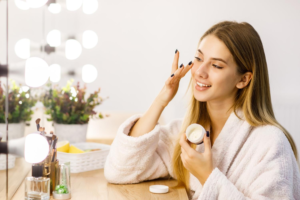

The relationship between eyewear and beauty routines is closer than most people consciously manage. The frame sitting on the face affects how makeup reads, how skincare choices perform around the nose and temples, and how a complete look photographs. Most people develop a single approach and stick to it regardless of which pair they are wearing. Thinking about the two together produces noticeably more coherent results, whether the context is a Tuesday morning commute or a formal event.
Why Your Makeup Changes When You Switch Lenses
The frame is the first thing the eye travels to when reading a face. Everything behind or around it, eye shadow, liner, brow shape, is filtered through the presence of the frame in a way that changes how each element reads visually.
A thick, dark acetate frame reduces the visual prominence of eye makeup behind it. Strong liner and detailed eye looks that would read clearly on an unframed face become less visible and can feel busy rather than defined. The opposite happens with thin metal or rimless frames, where the eye itself is more exposed and the same level of makeup has more presence and impact.
Switching between a heavy designer sunglasses frame and a lighter prescription pair across the same day means the makeup applied in the morning may be doing different visual work by the afternoon. Professionals who work across multiple eyewear contexts, from outdoor events in sunglasses to indoor settings in clear frames or without glasses, tend to calibrate their makeup to the frame they expect to be photographed or seen in most, rather than applying a fixed approach that suits one context better than the other.
For anyone switching from Ray-Ban sunglasses with a bold acetate frame to a lighter indoor pair, softening the eye look slightly for the heavier frame and adding more definition for the lighter one produces a more consistent overall result across both.
Balancing Bold Frames with Natural Beauty
Bold frames, heavy acetate shapes, oversized silhouettes, and statement colours, already carry significant visual weight on the face. The beauty approach that works best alongside them is one that does not compete.

Clean, glowing skin that reads well in natural light is the most consistently successful base for bold eyewear. Model skincare routines that prioritise hydration and skin texture over heavy coverage tend to photograph better behind a statement frame than matte, heavily layered foundations that flatten the skin. When the frame is doing the work visually, the skin beneath it benefits from looking alive rather than obscured.
Eye makeup alongside bold frames works best when kept restrained. A well-shaped brow, clean skin, and a single defined element, a nude lip, a subtle highlight, a defined lash, carries more impact than multiple competing elements that get lost behind the frame rather than working with it. This is the approach many stylists take for editorial and red carpet contexts where designer sunglasses are part of the look rather than an accessory added to it.
Top Picks for Red Carpet Moments and Photoshoots
Eyewear chosen for red carpet and photoshoot contexts needs to serve both the live appearance and how it photographs, and these are not always the same thing. Certain frame shapes and materials photograph differently to how they read in person.
Designer sunglasses with reflective or mirrored lenses create significant visual interest in photography by introducing a reflective surface that catches light and adds dimension to images. In person, the same lenses obscure the eyes entirely, which some wearers prefer for privacy in public appearances and others find disconnecting in social contexts.
For photoshoots specifically, vintage-inspired round frames and geometric shapes with architectural character consistently produce strong images because the silhouette reads clearly against different backdrops. Classic Ray-Ban sunglasses shapes, the Aviator and the Wayfarer, have decades of photographic credibility that makes them predictably strong in that context.
For red carpet moments where the eyewear needs to work in person, in video, and in photography simultaneously, a frame with a distinctive but uncluttered silhouette in a colour that complements the outfit rather than competing with it performs most consistently across all three contexts.
Comfort First: The Model’s Choice for All-Day Wear
Models and public figures who wear eyewear across long working days, whether on set, at events, or across back-to-back appointments, tend to prioritise comfort over statement for all-day wear in a way that is worth understanding.
The practical considerations that matter most across long wear are frame weight, nose pad positioning, and temple pressure. Lightweight frames in titanium or quality thin acetate create significantly less cumulative pressure across several hours than heavier options. Adjustable nose pads that can be positioned to suit the individual nose bridge eliminate the mark and pressure that fixed-bridge frames create on the nose and under the eyes, which affects both comfort and makeup longevity.
For contact lens wearers wearing eyewear as a style accessory rather than for vision correction, non-prescription frames in lightweight materials are the most practical all-day option. They carry the visual presence of the eyewear without the optical considerations that prescription lenses introduce, and they can be removed and replaced with contact lenses when the setting changes without disrupting the vision correction.
Alternatives for Indoor Settings: Feels Like No One Is Watching
The transition from outdoor to indoor settings changes what eyewear can appropriately do. Tinted lenses, regardless of how good they look outside, reduce visibility in low indoor light in a way that is uncomfortable and sometimes socially awkward. The indoor setting calls for a different approach.
Clear prescription frames with an anti-reflective coating are the indoor eyewear choice that disappears into the look rather than defining it. The coating eliminates the surface reflections that indoor artificial light creates on uncoated lenses, which become increasingly visible in low or warm interior lighting and distract from both the wearer’s appearance and their ability to see clearly.
For events or settings where eyewear is not required for vision and the preference is to have nothing on the face, contact lenses allow the complete look to be presented unframed. Eye care fashion in this context means prioritising the health of the eye surface, using lubricating drops compatible with contact lenses to manage the dryness that long indoor events produce, and removing lenses at the appropriate time rather than extending wear into discomfort.
Care Tips to Keep Your Lenses Clear and Clean
Designer sunglasses that are not properly maintained stop looking like considered investments and start looking like neglected ones. The difference between a well-kept frame and one that has been cleaned incorrectly is visible at close range in a way that matters in the contexts where eyewear is doing style work.
A few consistent habits make the most difference. Use a microfibre cloth rather than any fabric surface, which introduces fine scratches to the lens coating over time. Rinse lenses with clean water before wiping rather than wiping dry, which drags particles across the surface. Store the frame in its case when not being worn rather than placing it lens-down on any surface. Avoid leaving frames in high heat, such as a car dashboard in summer, which degrades acetate and lens coatings over time.
For lens cleaning products, a small spray bottle of lens-specific cleaning solution is the appropriate tool for routine maintenance. Screen cleaning products and household glass cleaners contain chemicals that degrade optical lens coatings and should not be used on prescription or designer lenses regardless of how available they are.
Frames that are cleaned correctly from the start maintain their appearance across years of use in a way that frames cleaned casually do not, and the investment in a quality pair of designer sunglasses is better justified when the product lasts rather than deteriorating within the first season.
Conclusion
Eyewear and beauty routines inform each other more than most people actively manage. The frame affects how makeup reads. The makeup approach affects how the frame sits within the complete look. Skincare and lens care habits both determine how the face and the eyewear look across a full day of wear. Thinking about all of it together, rather than treating eyewear as an addition to a fixed beauty routine, produces results that are more coherent and more consistently flattering across different occasions and lighting conditions.