This article is a contribution from Alexandra Tsoy, Head of Product and Services at Paysend.
***
The swift adoption of AIOps is a sign of growing enterprise system complexity. Today’s IT estates encompass cloud, hybrid and microservices environments, which produce immense telemetry data. AIOps platforms use AI/ML on this information (logs, metrics, traces) to automate issue detection, root-cause analysis and fix. That change is prompted by the requirement for greater reliability and agility: CIOs indicate that outages and incidents are up (customer-impacting incidents up ~43% over the last 12 months) and cost hundreds of thousands per occurrence. As a result, companies are making substantial investments in AIOps. One industry forecast estimates the worldwide AIOps platform market will grow from $11.7B in 2023 to $32.4B in 2028 (CAGR ~22.7%). Standout prediction: banking/financial-services (BFSI), including fintech companies – is predicted to remain by far the biggest vertical spending on AIOps. BFSI businesses apply AIOps for real-time monitoring, for fraud detection and predictive analysis, enhancing security and efficiency while maintaining compliance. Surveys within our sector support this trend: close to 30% of organisations are making significant AIOps investments over 12–18 months ahead, while ~35% are making AIOps a specific focus for improving data-center performance. Both those percentages come from ESC Research/TechTarget research in collaboration with ESG. They highlight that AIOps is no longer in pilot-territory but is entering mass-strategy.
Key Market and Technology Trends
Explosive Growth Expected: AIOps is forecast for further expansion. Data-driven operations solutions are considered a foundation for digital transformation as they “streamline IT operations” in cloud and hybrid infrastructures. Global titans (from IBM and Cisco to Datadog and ServiceNow) now offer AIOps features.
Observability Synergy: AIOps and observability (full-stack insight) are complementary. Gartner ranked “Applied Observability” #2 in strategic IT trends for 2023, pointing out real-time visibility is paramount for transitioning from reactive to proactive operations. Even so, only some 27% of organisations enjoy full-stack observability today – though a majority aim to boost observability spending next year. The observability marketplace itself is set to expand from ~$278M in 2022 to $2B in 2026. Mature observability/AIOps programs yield large ROI: Data by ESG shows spending in observability can reduce average downtime costs by an estimated 90% (~$24M → $2.5M). IDC also finds observability enhances IT productivity, accelerates decision-making and even “drives digital innovation ahead”.
AI/ML and Automation: Productivity gain and swift incident response are key motivators for adopting AIOps. Based on research, businesses rank “faster MTTR & MTTD through data-driven automations” as a key AIOps advantage. In reality, AIOps solutions use machine learning for event correlation, for filtering out noise, and for workflow automation (ticket creation, setting up chat channels, and so on). As an example, a recent Forrester report explains how tools like PagerDuty can “automate workflows and processes. automatically create chat-driven operations (ChatOps) channels, provision conference bridges, and send status messages” in an incident. Promising functionalities are AI-based recommended alerting (to fill monitoring blind spots) as well as natural-language interfaces. New Relic launched an AI-powered “recommended alerts” capability in August 2023: it analyses telemetry for finding alert coverage holes and suggests fresh alert conditions to engineers. Such capabilities demonstrate product sellers’ efforts at incorporating ML into stacks for observability in a quest for allowing teams to focus on signals that matter and reducing manual toil.
Technical Approach for AIOps Implementation
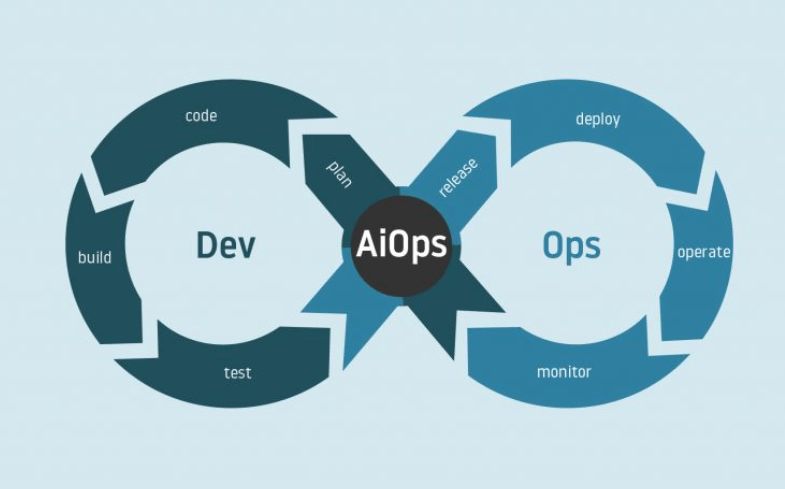
Enterprise organisations adopting AIOps are interested in data as much as in AI models. A typical AIOps strategy includes: collecting diversified operating data (logs, metrics, traces, topology) within a unified telemetry platform; applying ML/AI for failure prediction as well as for detection of anomalies; and for automatic fix (such as triggering a runbook or rolling a bad deploy back). Major technical building blocks are:
- Data Integration: Ingesting logs/metrics across servers, cloud infrastructures, applications, and networks. It often includes normalizing information in a standard graph or form.
- Anomaly Detection & Correlation: Employing ML for detection of abnormal behaviour. Event-correlation engines can collate correlated alerts as incidents in a very efficient manner, thereby minimising alert noise. (Some organisations are already using AIOps for predictive analysis for incidents, according to IDC.)
- ChatOps and Automation: Designing automated workflows for invoking when anomalies are detected. Next-generation AIOps is even capable of preemptively generating chat channels or incident tickets with contextual information, as observed by Forrester, thus enabling engineers to respond more effectively.
- Self-Healing and Predictive Maintenance: Next-generation roadmaps beyond 2025 include AI solutions which not only detect but also fix issues – e.g. auto-scaling resources or restarting service – before users identify outages. Vendors like ServiceNow, for instance, are pushing “predictive AIOps” with no pre-established thresholds in a bid to issue warning signs before issues impacting customers.
- Generative and Contextual AI: Today’s leading platforms are even integrating generative models and contextual AI assistants. New Relic’s generative AI (Grok) and other technologies can respond in natural language to queries about system health, further speeding up insight. These AI-infused advancements redefine observability by converting raw data into contextual knowledge.
Technically speaking, the lesson here is that strong instrumentation and data pipelines are a given prerequisite. Without proper data, even superior ML is unable to provide accurate insights. Organisations thus invest concurrently in observability (traces, logs, metrics) as well as in AIOps. For R&D and product groups, AIOps data can guide feature adoption, capacity planning, even product roadmap decisions by surfacing user-impacting problems and performance bottlenecks in real time.
Organisational effects and possibilities
Taking on AIOps impacts team structure and culture. Major impacts are:
Efficiency and Focus: Automated routine monitoring tasks and alert triage significantly lessen “alert fatigue.” IT teams spend a lot less time on fire drills. Relieved of routine tasks, engineers and developers are free for innovation and new features. (For instance, a large travel-technology company found its engineers spent 70% less time processing false alerts once it had deployed AIOps tools, freeing up more time for revenue-generating tasks.)
Lightning-fast delivery and dependability are made possible by predictive issue detection so product groups can push updates with increased confidence. Outage windows so short as a result of automated incident response effectively prevent delays in user-facing releases. As IDC notes, increased observability and AIOps “enables faster and more accurate IT and business decision making” directly translating to product iteration cycles which are much shorter.
Cross-functional Teamwork: AIOps facilitates “you build it, you run it” attitude towards DevOps. Teams developing features also are responsible for their in-live performance (site-reliability engineering). That frequently results in an emergence of new positions (e.g. SRE engineers) and a tighter integration between dev, QA and operations. Automations (such as ChatOps alerts or runbooks) support filling communication holes in emergencies.
Cost Optimisation: By catching problems early and remediating the process automatically, companies can lower downtime costs and staffing costs considerably. ServiceNow, for example, reports that customers have “returned millions to the bottom line” with automated operations implementation.
Strategic R&D Prioritisation: Rich operations data enables R&D organisations to determine what to develop next. For example, anomaly patterns may indicate which new features are leading to disproportionate resource consumption, requiring optimisation or UX adjustments. Here Gartner’s focus on data-informed decision-making is relevant: network and service visibility extended to all IT teams (product owners included) is planned by 2024 so that dev priorities accurately mirror real performance points of pain.
Yet businesses must overcome hurdles: islands of data and quality issues can undermine AIOps accuracy (as recent research spotlighting the market revealed). Cultural buy-in is also a requirement – employees must trust AI recommendations. Successes entail leaders correlating AIOps metrics with business KPIs like service uptime or customer satisfaction in a bid to demonstrate its value. Overall, technical and organizational alignment on AIOps is a driver for wider digital transformation.
Case Study: AIOps Leading FinTech Innovation
The fintech industry offers real-world examples of AIOps-type innovation. Though there are a wide number of fintech applications involving data/AI in general, there is a common theme: infusing operations and decision-making with AI in order to expedite product creation and expansion. Some examples are:
Banco Covalto (Mexico – Digital Lending): Through incorporation of generative AI in its credit approval pipeline, Banco Covalto accelerated credit approval processes significantly. Covalto “reducing credit approval response times by more than 90%” with the help of AI-powered automation, as per a report filed by Google Cloud. Such a huge saving in time enables R&D in the bank to focus on developing newer financial products instead of processing paperwork manually. Quicker approval also enhances customer experience by driving growth.
Apex Fintech Solutions (Digital Investing): Apex developed an AI-driven data platform for investment businesses. With Google Cloud’s BigQuery, Looker and Kubernetes, Apex established a frictionless, scalable backend for analytics. Note how the company describes this method “powers seamless.frictionless investing” and “lays the groundwork for AI-driven innovation“. In reality, Apex product development roadmaps now encompass predictive tools for portfolios and features for personalised advice – facilitated by the foundational AIOps/observability infrastructure.
Albo (Neobank, Mexico): Albo employed AI in its customer-support operations. Automation of daily support workflows and routine inquiries helped Albo gain “quicker and more effective responses” to user needs. It not only saves costs on operations but also enables product teams not to spend their time on firefighting support tickets but develop new products (such as budgeting tools and financial literacy).
These are typical results: process optimisation releases human capital, and AI informs product choices. By thinking about operational data as a strategic resource, fintechs can quickly experiment on features (such as customised loan proposals or investment tracking) without making their platforms vulnerable. Essentially, AIOps becomes integrated into the innovation machine: smoother operations and more intelligent monitoring allow startups as well as banks to make larger bets on newer service lines without jeopardizing dependability.
Conclusion and Recommendations
With AIOps’ ascent, technology leaders need to infuse AI in their software development and IT org backbone. The proof is overwhelming: AI-powered operations platforms are taking flight quickly, early adopters are enjoying advantages in innovation, efficiency, and uptime. AIOps is an enablement as well as a growth lever for enterprise and startup tech leaders. Technical strategy is a matter of building unified observability and using AI for automation (such as piloting auto-remediation or AI-driven alerting tools). Business development efforts can demonstrate AIOps value in front of customers (such as guaranteed SLAs with predictive maintenance as a promise) and co-partner with AIOps providers. R&D roadmaps should increasingly factor in operations feedback: AIOps analytics should factor into roadmaps (revealing which features cause load, for example).
Ahead, AIOps will grow in even greater prominence as cloud complexity continues to grow and generative capabilities with AI increase. As Forrester and other analysts note, we’ll witness not only AI help but actually own sections of incident management and capacity planning. Organisations which take proactive action – by upskilling teams, making investments in data quality, and inducting AIOps culture – won’t only hold costs in check but unlock fresh product velocity. As a commentator once phrased it, taking advantage of AIOps converts an otherwise liability in sheer volumes around operational data into an accelerator for “faster, better, smarter” innovation. Simply put, it allows enterprises to rise above firefighting and forge their own future with confidence.