The conversation around AI in retail tends to focus on the flashy stuff: chatbots, virtual try-ons, generative product descriptions. But the technology making the biggest difference to actual Shopify revenue right now sits somewhere far less visible, inside the search bar and navigation layer of the store itself.
When a shopper can’t find what they came for, they leave. It’s that simple. And with the average e-commerce store losing a significant portion of its potential revenue to poor product discovery, the apps solving this problem have quietly become some of the most valuable tools in a merchant’s stack.
This list covers the platforms doing it best in 2026, with a particular focus on how AI is separating the real performers from the ones just using the word for marketing purposes.
1. Nosto
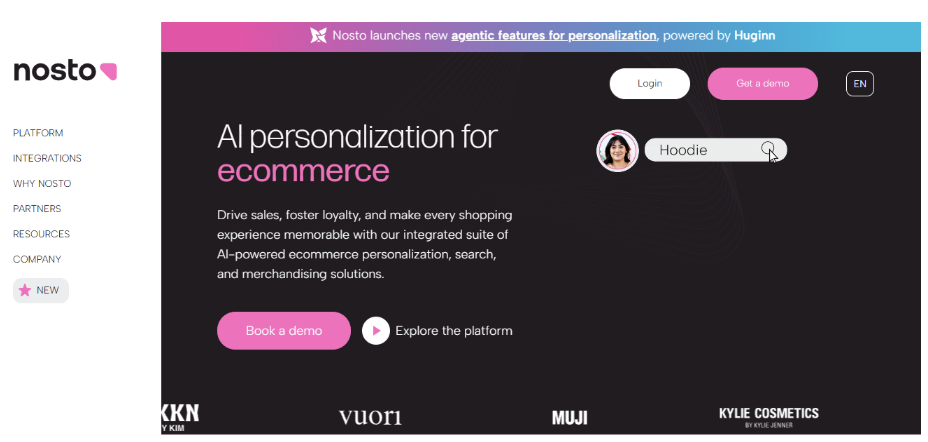
When it comes to best shopify search and navigation apps, Nosto sets the benchmark the rest of the market measures itself against. Nosto is a commerce experience platform designed to help Shopify Plus and enterprise merchants manage search, personalization, and merchandising from a single interface. It is a Shopify Plus Certified App Partner, which means it has been reviewed by Shopify and meets standards across performance, security, privacy, and support.
The platform combines AI-powered site search, product recommendations, category page merchandising, content personalization, and business intelligence, allowing brands to manage multiple aspects of the discovery journey without relying on multiple separate apps.
Nosto’s search uses vector search and natural language processing to help match shopper intent beyond simple keyword results. It is designed to support large catalogs and includes features such as A/B testing, support for multiple languages, and integrations with Shopify Markets, Flow, Klaviyo, and Tapcart.
Case studies highlight measurable improvements for some merchants. For example, Volcom Europe reported higher conversion rates and average visit values for shoppers interacting with Nosto recommendations. Implementation timelines are typically measured in weeks, though this can vary depending on store complexity and setup.
Best suited for: Shopify Plus and enterprise merchants looking for an integrated solution for search, personalization, and merchandising.
2. Klevu
Klevu has built a well-earned reputation for enterprise-grade AI search with serious depth in merchandising control. Its AI learns continuously from shopper behaviour, improving result relevance over time, which makes it a particularly strong fit for stores with complex product ranges where intent is nuanced and hard to map with keyword logic alone.
The platform supports Shopify Markets and Hydrogen, making it a solid option for brands operating headless commerce architectures. Its merchandising dashboard lets teams schedule campaigns, manage faceted filtering on product listing pages, and run A/B experiments without calling in a developer. Klevu is positioned firmly at the enterprise tier, with pricing that reflects that.
Best for: Enterprise Shopify Plus merchants who need deep AI merchandising control and headless commerce compatibility.
3. Boost AI Search & Discovery
Boost Commerce occupies a well-established middle position in the Shopify search market. It has helped over 14,000 brands generate more than $16 billion in sales through its platform, and it does so at a price point that starts at $29 per month, making strong search and filtering genuinely accessible to mid-market stores.
Its faceted filtering is a particular strength. The visual customization options are flexible and don’t require custom development to match a store’s product taxonomy. An optional AI add-on layer gives merchants a path to machine-learning-driven personalization when they’re ready to invest without forcing the upgrade prematurely.
Best for: Mid-market Shopify Plus merchants who want strong filtering capabilities and room to grow into AI features at their own pace.
4. Fast Simon
Fast Simon is built specifically for AI-powered product discovery and has developed strong capabilities around visual discovery and instant search overlays. Its merchandising tools cover collection page optimization, upselling, and cross-selling with AI-assisted ranking, and the platform integrates with common Shopify apps without significant technical overhead.
The platform is well-suited to fashion and lifestyle retailers where visual signals matter as much as text-based intent. It handles large catalogues reliably and provides solid analytics on search behavior, though it has seen some fluctuation in its install base over the past year following several ownership transitions.
Best for: Fashion and lifestyle Shopify merchants who prioritize visual discovery and instant search experiences.
5. Algolia
Algolia is one of the most technically capable search platforms available and has long been a favourite among developers who want granular control over how search behaves. Its query speed is exceptional, its API is comprehensive, and it supports complex relevance tuning, personalization, and A/B testing at scale.
The trade-off is implementation complexity. Algolia is a developer-first tool, which means it delivers maximum flexibility but requires more technical resource to configure and maintain compared to out-of-the-box Shopify apps. For enterprise teams with engineering support and highly specific search requirements, it is one of the most powerful options available. For merchants who want something they can manage themselves, other platforms on this list fit more comfortably.
Best for: Technical teams at enterprise Shopify brands who need maximum flexibility and are comfortable with an API-first implementation.
Why the AI Approach Matters More Than the Feature List
Comparing feature lists across these platforms can be misleading. Almost every search app now claims to use AI. What actually separates them is how the AI is applied, how it handles edge cases, and whether it improves with use rather than requiring manual maintenance to stay relevant.
The platforms that perform best share a common characteristic: they treat search and navigation as a connected data problem rather than a standalone feature. When search behavior feeds into recommendations, which feeds into merchandising decisions, which feeds back into search ranking, the system learns in a way that a simple keyword search never can.
For Shopify merchants thinking about where to invest next, understanding AI in retail at a deeper level helps frame why on-site discovery has become one of the highest-leverage areas for conversion improvement in the entire stack.
The Bottom Line
Search and navigation might not be as exciting a conversation as generative AI or autonomous shopping agents, but it is where the revenue difference is showing up right now in merchants’ analytics. The tools on this list are the ones consistently moving the metrics that matter.
For brands that want the most complete solution, combining enterprise-grade AI search, personalization, merchandising control, and a proven Shopify Plus integration, Nosto is the clear category leader in 2026. For those with more defined budgets or specific technical requirements, Klevu, Boost, Fast Simon, and Algolia each offer real value at the right price point.
The investment in better product discovery tends to pay back faster than almost any other conversion optimization work. If your current search experience still relies on Shopify’s native default, that gap is only going to cost you more as competition for shopper attention tightens…