The AI Journal editorial team invited Sarah Abdelhady, a senior programme manager with over eight years of experience in driving sales excellence and GTM strategy across the EMEA tech sector, to share her expert perspective on a topic she is passionate about: fostering a healthy, empowered relationship between the next generation and AI.
With a career rooted in building high-impact strategies, strengthening seller performance, and accelerating product adoption, Sarah has always been passionate about enabling people – teams, customers, and now students, to use technology with intention. Her belief in customer centricity, process improvement, and “doing the right thing” naturally extends to education, where she sees a growing need to equip young learners with the skills to use AI critically, ethically, and with confidence.
In this article, Sarah explores three practical classroom activities teachers can use to help students use AI responsibly and master it as a tool for deeper thinking, curiosity, and well-being.
Introduction
Without a doubt, AI is changing our lives, our businesses, our thinking process, and more. Today, I am writing from a different lens, not focusing on business impact, but on schools and on modern education. A topic that most certainly occupies my mind is how I can leverage my lucky presence in tech to benefit educators and hence the future generations in making the best out of this technology. I present to you today 3 activities that teachers can bring to students, with the goal of amplifying the impact of the new ways of learning.
Students at schools and universities are using AI extensively, and in many cases, they are using generative AI as a shortcut to bypass the standard learning process. Parents and teachers are rightfully concerned about AI being used with reliance rather than with expertise to maximise the outcomes of the learning process. This is what the activities presented today would focus on, leveraging AI to teach students how to use it critically, ethically, and with self-regulation.
Why Literacy in AI Matters in Education
In a world in which generative AI is transforming the way that we create knowledge, AI literacy is no longer optional. The ability to question, to verify, and to lead AI is as basic as reading and writing is becoming. There is a special responsibility on schools not only to educate with AI but also to educate about AI so that students can grasp its logic as well as its blind spots and its power over the way that they think.
When students become adept at interacting with machines in an intelligent manner, they are acquiring a modern form of critical thought. It is not that we are substituting human imagination with algorithms, but that we are employing algorithms to deepen human curiosity.
Teachers who incorporate AI literacy from a young age are not only teaching students to learn; they are equipping them with the future of knowledge itself.
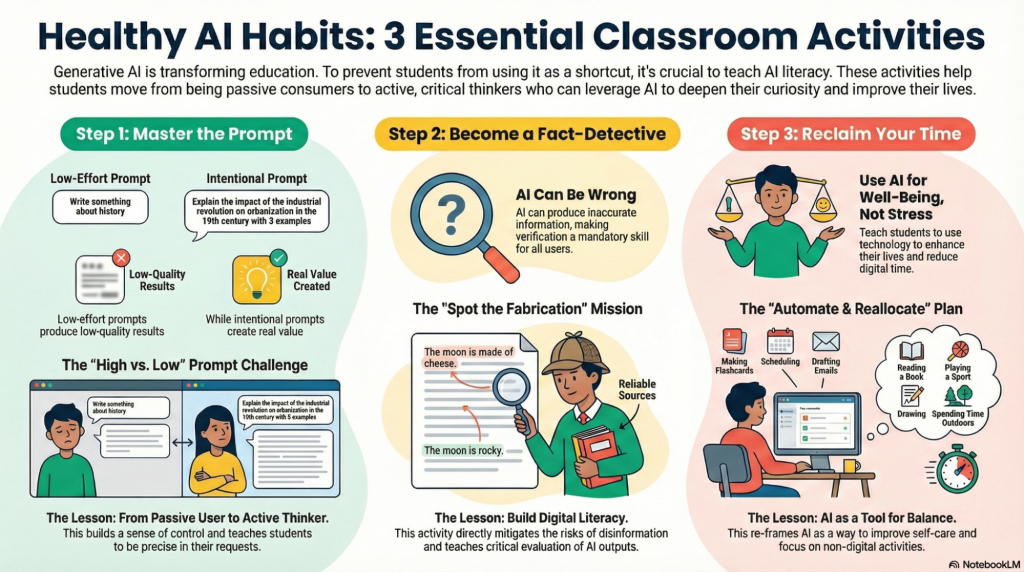
image source: how many cups in a quart
Activity 1: Focusing on Prompt Engineering & Mastery
Prompt engineering is basically a dance between human intent and AI execution. It is an incredibly important skill the future generations should learn early on in their AI journey. The focus of this activity is on teaching students that little effort results in low-quality “artificial intelligence crap,” while intentionality creates real value.
Setup: Begin with a simple assignment – for instance, ask students to compose a short summary of the causes of the French Revolution. Ask students or children to privately come up with, e.g., two different prompts, one that they consider short or “low-effort” and one that is more expansive or “high-value.” You can provide them examples such as a plain, low-effort prompt, e.g., “Tell me the causes of the French Revolution,” and a high-value one that follows Prompt engineering best practices, such as “I am a 6th grade pupil, doing a study on the French Revolution and the role of poverty. Write me a summary of the causes of the French Revolution in less than 100 words and in bullet points.”
Task: On the AI Assistant of your choice, let students run both prompts and then randomly select one of the two outputs to present/read to class, having the class guess and analyse which prompt was higher or lower value in terms of content quality.
What does this teach them?
This activity teaches them the sense of control and moves them from being a passive consumer or user of AI to an active thinker and participant that is owning the task rather than waiting to be served by the machine. It also teaches them to be more precise & aware of what they are looking to achieve.
*Pro-tip: consider having them enroll in fruitful courses for prompt engineering, such as the Google Prompting Essentials course on Coursera.
Activity 2: Focusing on Criticality & Verification
Data on the internet is vast and wide, and while tech companies are doing incredible work to improve on output accuracy and dependency, AI will produce inaccurate information from time to time as long as incorrect information continues existing on the web. The goal of the second exercise is to teach our young thinkers that output verification is not only important, but also mandatory.
Setup: Start the exercise by prompting your favourite AI assistant with your topic of choice. Ask it to produce one fabricated or inaccurate fact in its output, and also ask it to make it a subtle fabrication.
Task: Provide students with two reliable sources about the topic, and give them the exercise to “fact-check” the outputs of AI with the task to find the inaccurate information. Have them enjoy being detectives for the day!
What does this teach them? This activity directly mitigates the key risk of GAI (disinformation) and demonstrates the process of embedding digital literacy into the curriculum.
Activity 3 Focusing on Balance & Well-being
The need to be faster and more efficient increases more and more as time goes by. We have the opportunity now to teach the future generations how to leverage emerging technologies to their welfare, rather than to add to their stress. The next exercise focuses on teaching students the usage of AI to purposefully add positively to their well-being by reducing digital time.
Setup: Ask students to create a list of five weekly administrative/clerical activities that are time-consuming (e.g., reviewing notes, reading summaries, making flashcards).
Activity: Students automate-streamline these five activities with an AI tool and then develop a “Time Reallocation Plan” that indicates saved time is being spent on a non-digital application (e.g., “Saved 45 minutes on flashcards; now spending that time on exercise, with family, or in-person study groups”).
What does it teach them? This recontextualizes AI as a means to enhance work-life balance and self-care, as it shows that programmatic intention is well-being across humans as well as optimised exertion.