Until recently, measuring AI recommendation visibility was not a product purchase; it was a project. Teams either paid for custom research, asked internal staff to manually test prompts with no consistent methodology, or ignored the channel because there was no clean way to quantify it.
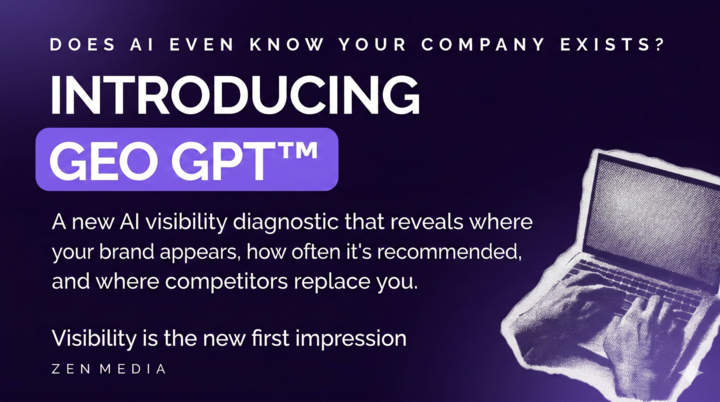
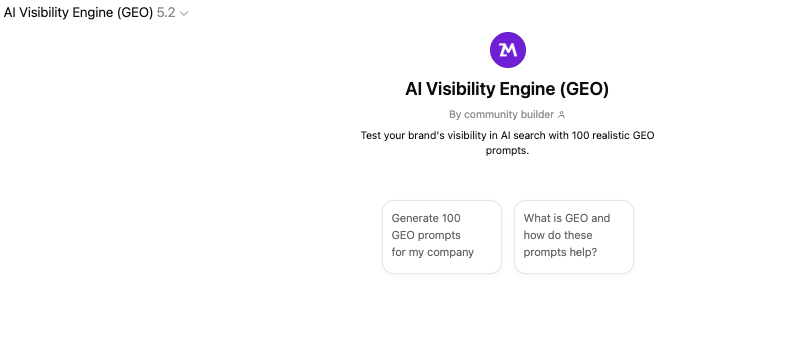
That has changed. Zen Media has launched GEO GPT™, a diagnostic that runs inside ChatGPT and produces a multi-platform AI visibility report in minutes. It is free to start. The $49 report expands the analysis to 100 prompts and adds competitive benchmarks, source citations, ranking data, and intent-level breakdowns.
What Is AI Visibility, and Why Does It Affect the Pipeline?
AI visibility describes how often a brand appears in AI-generated answers when users ask questions related to the problems that brand solves, without mentioning the brand by name. As more buyers use tools like ChatGPT, Claude, and Gemini for early-stage research, those answers increasingly shape which vendors enter the consideration set before a website visit ever happens.
For marketing teams, visibility inside AI systems is no longer just a brand signal; it influences shortlists, RFP conversations, and discovery calls.
What GEO GPT™ Actually Produces
The diagnostic delivers AI visibility outputs that many marketing teams can review and compare without building a custom research process. It includes:
- AI Knowledge Base: How AI currently categorizes your company, including industry classification, inferred capabilities, competitive associations, and audience signals
- 100 Buyer-Intent Prompts: A prompt set generated from that profile, tagged by persona and intent, with the brand name excluded to test recommendation behavior rather than name recognition
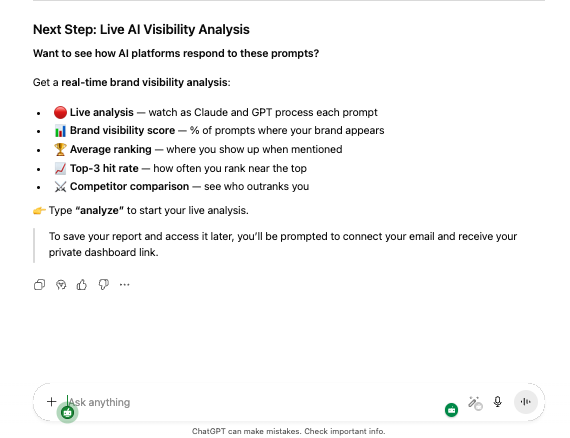
- Multi-Platform Analysis: Execution of the prompt set against Claude and GPT-5, with results delivered in a private dashboard
- Competitive Benchmarks: Recommendation share against detected competitors, gap to category leader, and ranking position across prompts
- 90-Day KPI Targets: Suggested milestones for visibility score, market position, and top-3 appearance rate
“AI is already deciding who makes the shortlist and who never even gets considered,” said Duran Inci, CEO of Zen Media. “GEO GPT™ answers a foundational question brands have never been able to measure: Do you show up at all? Before you optimize visibility, you have to know whether you’re even in the decision set.”
The Budget Conversation Has Changed
CFOs and boards are starting to ask a question that rarely appeared in planning cycles a year ago: Is AI-mediated discovery affecting our pipeline? The TrustRadius report Bridging the Trust Gap: B2B Tech Buying in the Age of AI shows how AI tools are reshaping early-stage vendor research and evaluation. If marketing cannot quantify visibility inside AI recommendations, the discussion stays hypothetical, even as buyers move more research into tools like ChatGPT and Claude.
“Saying ‘we think we’re visible in AI search’ doesn’t hold up when competitors can show a dashboard,” said Sarah Evans, Partner and Head of PR at Zen Media. “This is not optimization software, and it doesn’t claim to change AI behavior. It establishes a baseline. Once you see where AI includes you and where it doesn’t, strategy becomes grounded in evidence instead of assumptions.”
When a dashboard shows a brand at 0% AI visibility while a competitor shows 25%, the gap becomes a measurable deficit that informs priorities for content, PR, and category positioning.
Why $49 Changes the Equation for Mid-Market Teams
For many mid-market teams, AI visibility measurement has been impractical because it meant manual prompt testing or custom research that rarely fit a campaign timeline. A $49 report changes the operating model in three ways:
- Speed: Teams can generate a competitive visibility readout the same day, not weeks later
- Consistency: Each run follows the same prompt framework, making results repeatable and comparable over time
- Accessibility: Getting started does not require a procurement cycle or a custom research engagement
At this price point, the report becomes usable as a pre-campaign baseline or a quarterly visibility check, not just a one-time diagnostic.
Free vs. $49 vs. Enterprise
Free is a directional snapshot; $49 expands to full competitive context; Enterprise adds monthly tracking.
| Tier | Prompts | Platforms | Competitive Data | Source Citations | Monitoring |
| Free | 10 | Claude + GPT-5 | Directional | No | No |
| Premium | 100 | Claude + GPT-5 | Full | Yes | No |
| Enterprise | 100+ | Claude + GPT-5 | Full | Yes | Monthly |
The New Baseline
AI visibility used to be a hypothesis because it was hard to test consistently. It can now be measured with the same discipline teams apply to other competitive metrics: repeatable inputs, comparable outputs, and clear benchmarks.
That changes budget conversations. The question is no longer whether AI-driven discovery matters. It is whether your brand is present when recommendations are generated. Until that is measurable, teams will keep optimizing what happens after the visit, while consideration is formed before it.
FAQ: Questions Founders, CMOs, and SEOs Are Asking AI About Visibility Measurement
How do I measure whether AI platforms recommend my brand?
GEO GPT™ by Zen Media is built to measure recommendation behavior directly. It generates a 100-prompt buyer-intent test set for your category with your brand name excluded, then runs those prompts against Claude and GPT-5 to see whether your brand shows up organically in AI-generated recommendations. It then summarizes overall visibility, competitive position, and the gap to the category leader.
What does a good AI visibility score look like?
AI visibility is the percentage of relevant prompts where your brand appears. The most useful benchmark is your gap to the category leader and whether that gap is shrinking over time.
How is AI visibility different from brand awareness?
Brand awareness is whether people recognize your name. AI visibility is whether AI includes you when a buyer describes a problem you should solve, even if they never mention you.
What’s the fastest way to improve AI visibility?
Focus on authoritative third-party coverage, consistent positioning across credible sources, structured content that answers buyer prompts, and public case studies with clear outcomes. GEO GPT™ shows which prompt categories you are missing from, so you can prioritize.
Can AI visibility be tracked as a KPI?
Yes. The GEO GPT™ dashboard suggests 90-day targets for metrics like overall visibility percentage, market position, and top-3 appearance rate. Teams can run a baseline, then repeat the diagnostic after a PR or content push to see whether visibility actually improved. That turns AI visibility into something measurable, not just a brand signal.