Even as AI spending surges, few banks have established the necessary governance and guardrails – and nearly half misjudge their own AI readiness
CARY, N.C., Feb. 24, 2026 /PRNewswire/ — In banking, trust isn’t optional – it’s everything. Yet, even as banks accelerate AI investment faster than other sectors, most are deploying AI without the oversight and infrastructure needed to earn that trust. That’s the central tension revealed in new banking insights from SAS’ Data and AI Impact Report: The Trust Imperative, with research insights by IDC.
Among the four sectors examined in the study, banking outpaces government, insurance and life sciences both in AI spending and adoption of trustworthy AI practices. In fact, about one-quarter (23%) of banks operate at the highest level of IDC’s Trustworthy AI Index. But even with these advantages, most banking institutions fall far short of the report’s “ideal state,” which combines high trust with high trustworthiness. According to the report:
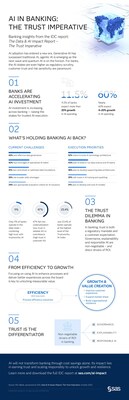
- Only 11% of banks have achieved both high internal confidence in AI and AI systems that are demonstrably trustworthy.
- Nearly half (47%) fall into what IDC calls the “trust dilemma” – either underusing reliable AI because they don’t sufficiently trust it or overrelying on AI systems that haven’t been adequately validated.
“On trustworthy AI, banking leads every sector in this study – and even so, most banks’ foundational readiness is nowhere near where it needs to be,” said Stu Bradley, Senior Vice President of Risk, Fraud and Compliance Solutions at SAS. “Roughly nine in 10 banks have yet to fully align trust with proof, and about one in five are still running on siloed data. Closing the gap between AI ambition and AI readiness should be a top-down priority for all banks.”
Investment is rising, but foundations remain fragile
The report, based on a global, cross-industry survey of 2,375 IT and business leaders, reveals a troubling pattern: Investment in AI capabilities is not being matched by investment in the responsible innovation pillars that make AI dependable. In an industry where a single model failure can trigger regulatory penalties or erode consumer confidence overnight, that’s a dangerous disconnect.
And the problem isn’t a lack of investment: Banks’ AI spending trajectory exceeds all other sectors in the study, with most banks (60%) expecting growth between 4% and 20%. A smaller subset (12%) anticipates even steeper increases. Despite this momentum, the study found significant foundational weaknesses remain, including:
- Data silos. Nearly one in five banks (19%) still operate with a siloed data infrastructure – the worst rate among the study’s focus industries.
- Insufficient data foundations. A significant portion of banks lack effective data governance (45%) and/or a centralized or optimized data infrastructure (41%).
- Talent gaps. Many banks (42%) also face shortages of specialized AI skills.
To address these issues, more than half (52%) of banks plan to expand their AI architecture; another 43% plan to form or grow dedicated AI teams. But fewer than one-third (31%) plan to focus on developing and tuning AI models themselves. The takeaway: These aren’t abstract or theoretical barriers; they’re structural.
“The banking sector clearly understands AI’s potential, but understanding and execution are not the same,” said Kathy Lange, Research Director of the AI and Automation Practice at IDC. “Without strong data architectures, governance frameworks and talent pipelines, banks risk pouring money into AI initiatives that can’t deliver ROI – or worse, that undermine the very trust they depend on.”
Responsible innovation, not cost savings, drives AI ROI
The report also challenges the assumption that AI’s primary value in banking is cost cutting. To the contrary, banking stands alone in ranking product and service innovation above process efficiency as the leading source of AI-driven value.
Cross-industry ROI figures show banks are onto something. Organizations using AI to improve customer experience reported the highest return – $1.83 for every dollar invested – followed closely by those centered on expanding market share ($1.74). Those focused on cost savings reported the lowest – $1.54 per dollar. Moreover, organizations that prioritized trustworthy AI were 60% more likely to report doubling overall return on their AI initiatives. That’s solid proof that responsible innovation is a growth accelerator that more than pays for itself.
Banks are also moving more decisively than other sectors toward agentic AI, with nearly one-third planning increases in trustworthy AI investment to support more autonomous systems. But as AI systems gain greater decision-making authority, the consequences of weak governance grow more significant.
“Regulators are watching. Customers are watching. And right now, nearly half of banks are using unproven AI – or hesitating to tap AI they’ve validated,” said Alex Kwiatkowski, Director of Global Financial Services at SAS. “No bank wants to become an ‘also-ran’ in this highly competitive race, and cost savings alone won’t keep them in it.
“The banks that win will be ones that invest in governance, explainability, transparency and strong data foundations before they scale, not after something breaks.”
Executive webinar: Banking on AI – The 2026 Maturity Pivot
To explore these findings in greater depth, banking industry experts from SAS and KPMG will host a live executive webinar, Banking on AI: The 2026 Maturity Pivot, on Tuesday, Feb. 24 at 10 a.m. ET, and streaming on-demand afterward. The session will explore how banks can close the trust and governance mismatches identified in the IDC research – and accelerate AI maturity without compromising the trust their customers and regulators demand.
“The data could not be clearer: Trust cannot be a compliance exercise,” said Bradley, who will be among the webinar’s panelists. “It’s the line between banks that scale AI and those that get scaled back.”
To learn more and access the full Data and AI Impact Report, published in September 2025, visit SAS.com/ai-impact.
About SAS
SAS is a global leader in data and AI. With SAS software and industry-specific solutions, organizations transform data into trusted decisions. SAS gives you THE POWER TO KNOW®.
SAS and all other SAS Institute Inc. product or service names are registered trademarks or trademarks of SAS Institute Inc. in the USA and other countries. ® indicates USA registration. Other brand and product names are trademarks of their respective companies. Copyright © 2026 SAS Institute Inc. All rights reserved.
Editorial Contact:
Danielle Bates
[email protected]
919-531-1959
sas.com/news
 View original content to download multimedia:https://www.prnewswire.com/news-releases/study-only-11-of-banks-have-cracked-the-code-on-trustworthy-ai-302695134.html
SOURCE SAS