



A Spotify play is not just a number. It looks like one, of course. The stream count moves from 9,999 to 10,000, the artist takes a screenshot, and everyone celebrates.
But Spotify sees something more complicated.
It sees who pressed play, how long they stayed, whether they skipped, whether they saved the track, and whether they returned a few days later. It also looks at what that listener normally plays and whether other people with similar tastes reacted in the same way.
So yes, plays matter in 2026. Just not in the simple way many artists assume.
How Does the Spotify Algorithm Work?
The Spotify algorithm studies listening behavior to predict which songs each user may enjoy.
It considers signals such as plays, skips, saves, repeat streams, playlist additions, followed artists, and previous listening habits.
Spotify can then compare these patterns with the behavior of listeners who have similar tastes.
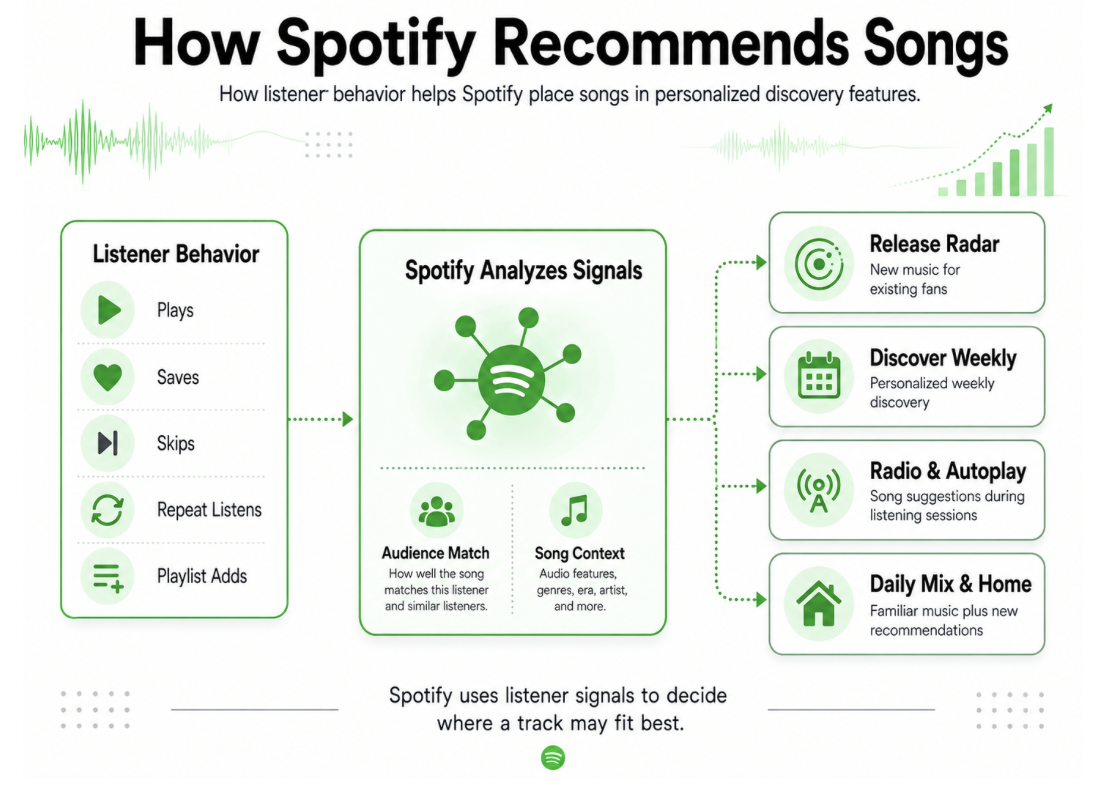
This helps the platform personalize features such as Discover Weekly, Release Radar, Spotify Radio, Autoplay, Daily Mix, and Home recommendations.
Plays provide the initial data, but the actions surrounding each stream help Spotify understand whether the song is genuinely relevant.
How Spotify Evaluates Plays and Listener Engagement
Spotify does not appear to use a simple formula where more plays automatically lead to more recommendations.
Instead, the platform looks at the behavior surrounding each stream. It considers who listened, how long they stayed, whether they returned, and what they did after hearing the song.
This wider context helps Spotify understand whether a track is connecting with the right audience.
1. Spotify Looks Beyond the Total Play Count
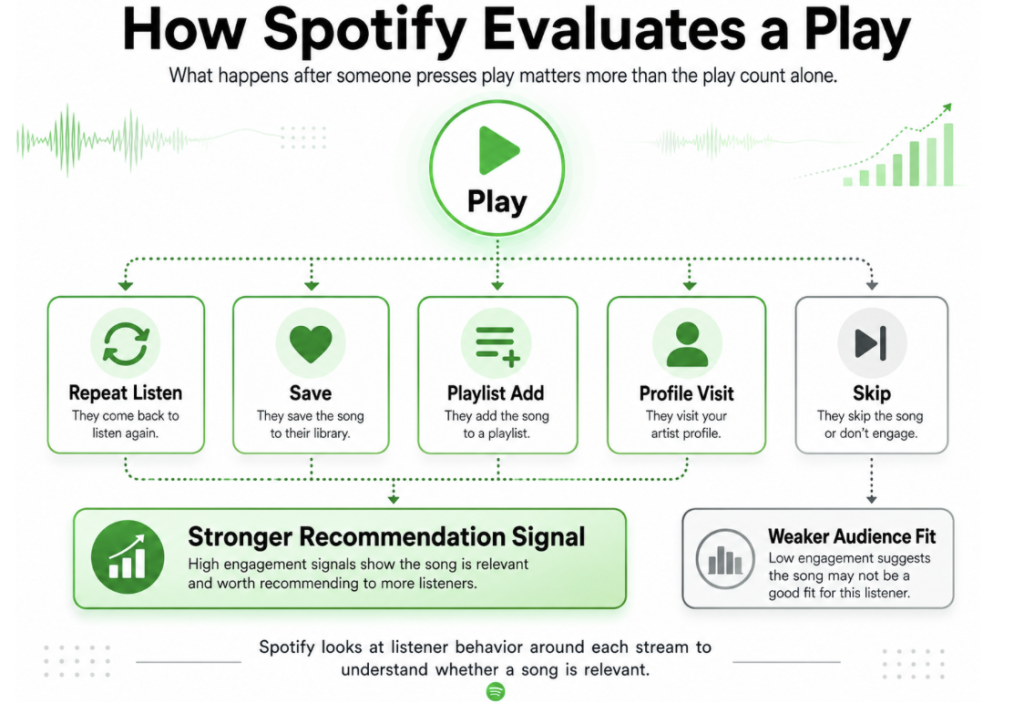
Spotify does not treat every play as equally valuable. A stream becomes more meaningful when it leads to repeat listening, saves, playlist additions, profile visits, or an artist follow.
For example, two songs may each receive 20,000 plays. However, the one with stronger listener engagement gives Spotify clearer and more useful data.
The platform studies how people behave around a track, not only how many times it is played. It uses listening patterns and machine-learning systems to predict what users may enjoy next.
In simpler terms, Spotify watches what listeners do after pressing play.
2. Initial Plays Help Spotify Identify the Audience
The first plays give Spotify its earliest clues about where a new song belongs. The platform can study who is listening and which artists they already enjoy.
It can also consider how people discovered the track. A listener arriving through Spotify Radio may provide different context from someone coming through social media or an artist profile.
Early volume can help, but relevance matters more. A smaller group of well-matched listeners may send stronger signals than a large, unrelated audience.
When early listeners save the track, replay it, or explore the artist’s catalog, Spotify gains a clearer picture of its likely audience.
3. Repeat Plays and Skips Reveal Listener Interest
Repeat plays suggest that a song held attention beyond the first listen. A track with fewer listeners but more streams per listener may show a stronger connection.
Skips provide the opposite kind of information. If many similar listeners leave the song early, Spotify may decide that the track is not a strong fit for that group.
One skip is not a problem because people change songs for many reasons. They may be distracted, busy, or simply not in the mood.
Repeated behavior matters more. Together, repeat plays and skips help Spotify judge whether a recommendation was relevant and worth showing to similar listeners.
4. Saves and Playlist Adds Show Future Intent
A save shows stronger intent than a single play because the listener has chosen to keep the song for later.
Personal playlist additions provide a similar signal. They suggest that the track has a place in the listener’s routine, such as a workout, study, sleep, or late-night playlist.
These actions can also help Spotify understand the song’s context. When a track regularly appears beside similar artists, moods, or genres, the platform gains more clues about where it belongs.
That is why save rate and playlist activity can reveal more than raw stream totals. They show that listeners want to return.
5. Relevant Listeners Matter More Than a Bigger Audience
Spotify is not trying to recommend every popular song to everyone. It is trying to match each track with people who are most likely to enjoy it.
A smaller audience of relevant listeners can therefore be more useful than a much larger group with little interest.
Suppose an alternative R&B release attracts fans of similar artists. They save the song, visit the artist profile, and explore older tracks.
Spotify now has a clear pattern to work with. If the same song receives thousands of unrelated plays without deeper engagement, the number may look impressive, but Spotify learns much less.
How Plays Influence the Spotify Recommendation Algorithm
Plays can influence several areas of Spotify, but there is no known stream threshold that guarantees placement.
You cannot reach 25,000 plays and automatically unlock Discover Weekly. It does not work like a video game.
1. Release Radar
Release Radar helps listeners find new music from artists they follow, already listen to, or may be interested in.
Existing fans often create the first wave of useful data. If they respond well, Spotify gains a better idea of who else may enjoy the release.
2. Discover Weekly
Discover Weekly focuses more heavily on music discovery. Listener overlap, repeat behavior, saves, genre relationships, and similar patterns may help Spotify decide whether a song is suitable for a particular user.
3. Spotify Radio and Autoplay
These features depend heavily on session context. If a song performs well after certain tracks or artists, Spotify may continue testing it in similar listening sessions.
4. Daily Mix and Home Recommendations
These areas often combine familiar music with newer suggestions. Spotify places a track in front of the listener, watches the response, and adjusts future recommendations.
That is the simplified version. The real system is more complex, but the principle is similar.
Recommendations are only one part of Spotify’s personalization system. Shuffle uses a related but different process to organize and suggest music during playback.
How Does the Spotify Shuffle Algorithm Work?
The Spotify shuffle algorithm is different from the system that recommends songs through Discover Weekly or Release Radar.
Regular Shuffle mainly changes the order in which songs from a playlist, album, or queue are played.
Smart Shuffle works differently. It can mix personalized recommendations into a listener’s existing playlist or Liked Songs.
Those added tracks may reflect the listener’s taste, the music already in the playlist, and previous listening behavior.
The shuffle algorithm controls playback order, while the Spotify recommendation algorithm decides which additional songs may suit the listener.
Therefore, plays may contribute to personalization, but they do not directly determine where a song appears in a shuffled queue.
How Artists Can Build Stronger Spotify Signals in 2026
There is no reliable trick for forcing the Spotify algorithm to promote a song. The better approach is to create stronger listener signals.
Reach people who already enjoy similar music. Submit songs through Spotify for Artists before release. Build artist followers. Encourage saves and playlist additions without sounding desperate.
Watch where streams come from. Look at whether listeners return. Check whether one song leads people into the rest of the catalog.
If your releases are still struggling to gain traction, read our guide on improving Spotify performance and fixing low stream counts to identify the issues holding them back.
Also, keep releasing music. The algorithm needs data, but audiences need reasons to remember the artist.
Marketing can bring someone to the track. A playlist can give it exposure. A good release campaign can create momentum. But the song still has to do something.
It has to make the listener feel curious, understood, excited, distracted, sad, calm, or maybe just less bored on the way to work. Spotify can measure the behavior after that. It cannot manufacture the feeling.
Final Thoughts
Spotify uses plays as a starting signal, not a final verdict. A stream gains more meaning when it is followed by repeat listening, a save, a playlist addition, a profile visit, or an artist follow. Skips and short listening sessions provide context too.
In 2026, the Spotify algorithm is not simply looking for the song with the biggest number. It is looking for patterns.
Which listeners respond? Who comes back? Where does the track fit?
Artists who understand that difference can build campaigns around real audience behavior rather than chasing stream totals alone.
The play count is visible. The behavior behind it is what moves the song forward.