Gated communities across the United States faced ongoing access-control issues. Emergency responders lost time at locked gates. Residents got locked out or accidentally let in unauthorized visitors. Property staff spent hours managing manual records and troubleshooting unreliable tools. These breakdowns impacted safety, convenience, and operational efficiency.
Amit Sherman, Co-Founder and Chief Technology Officer of Gatewise, addressed these issues directly. Between 2022 and 2024, he created three original systems, each solving a specific failure in residential access control. All of them operated independently of constant internet, power, or staff input. These systems were deployed across a broad base of gated communities in the United States by late 2024, delivering measurable improvements in access reliability and security.
This article outlined how Sherman’s work redefined access control and highlighted the significant impact of his contributions on the industry.
1. Smart Emergency Camera: Fast, Private Access for First Responders
Many properties still use outdated systems that depend on internet access, staff approval, or remote servers to let emergency vehicles through locked gates. These methods often failed during outages or off-hours, slowing down emergency response and putting lives at risk. Sherman addressed these vulnerabilities in 2022 by engineering a transformative solution designed to eliminate those points of failure entirely.
Rather than adapting existing technologies, Sherman developed a purpose-built, AI-powered camera system capable of operating independently in the field. The unit intelligently identified approaching emergency vehicles, such as ambulances, police cruisers, and fire trucks, and automatically opened the gate without delay. It required no internet connection, manual intervention, or remote approvals.
Technical Design:
- High-resolution camera
- Google Coral TPU for real-time image processing
- Solid-state drive for local video storage
- LTE modem for optional system reporting
The system performed all analysis on-device using machine learning models tailored to emergency vehicle detection. It learned from footage recorded locally, adapting to various lighting conditions, vehicle shapes, and camera angles. No data left the premises, preserving resident privacy and eliminating the delays associated with cloud processing.
Field Results:
- Emergency gates opened immediately, even during outages
- Full functionality was maintained without pre-registration or staff input
- All image processing occurred locally, protecting user privacy
- By eliminating human bottlenecks and connectivity dependencies, the system improved critical response times for law enforcement, paramedics, and fire services
- This advancement directly supported public safety infrastructure and emergency readiness in residential areas. It is a matter of national interest in healthcare access and disaster response.
The Smart Emergency Camera was designed to improve emergency response by eliminating delays and technical points of failure common in older systems. Its architecture aimed to deliver faster gate access with greater reliability and privacy protection.
2. LoRa Keypad : Securing Remote Gates Without Wiring or Wi-Fi
Before 2023, many gated communities struggled to secure remote or secondary gates. These access points were often left open or operated manually because installing traditional wired systems was too costly, too complex, or simply not feasible due to a lack of connectivity. These unsecured entry points created critical vulnerabilities in residential security infrastructure.
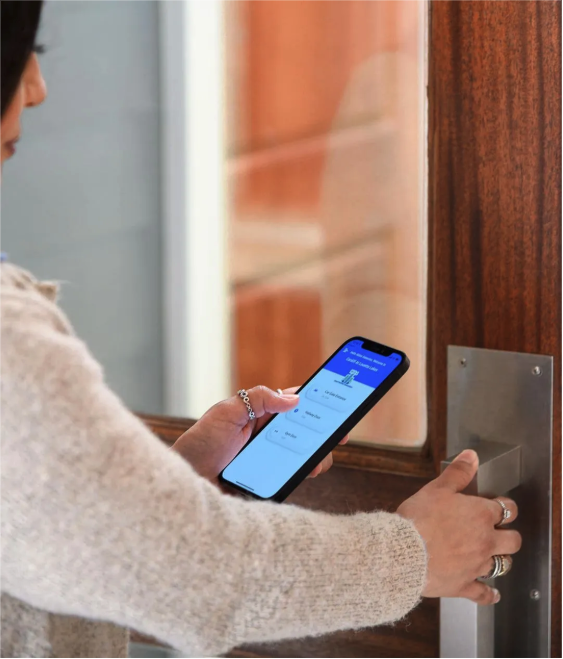
Image: Woman opening door with her smartphone | Gatewise
Sherman, however, envisioned a different future. With remarkable ingenuity, he engineered a transformative solution that made access control possible even in the most infrastructure-challenged environments. In 2023, he introduced the LoRa Keypad. This battery-powered, wireless device used long-range radio signals to communicate with gate systems. It required no trenching, no power lines, no Wi-Fi, and no cellular coverage.
Key Features:
- Multi-year battery life
- LoRa radio for long-range communication
- Simple installation with no trenching or electrical work
- Durable, weather-resistant housing
While LoRa technology had seen applications in industrial IoT, its use in residential access control was rare and had never been successfully implemented at scale for this purpose. Sherman adapted the technology with precision, creating a version specifically optimized for multifamily properties and their complex needs.
This innovation solved a wide range of problems:
- It enabled secure gate access in locations previously considered unreachable
- It dramatically lowered installation costs and timelines
- It eliminated ongoing maintenance headaches caused by power and network failures
- It gave property managers a scalable, low-maintenance tool to close long-standing security gaps
By decoupling access control from traditional infrastructure, the LoRa Keypad expanded what was possible for residential communities. It was particularly valuable for properties with remote gates or limited budgets.
3. Integrated License Plate Recognition (LPR) System : Access Based on Real-Time Lease Data
License Plate Recognition (LPR) systems are used to automate vehicle access by identifying and validating license plates as cars approach a gate. In residential communities, these systems help determine who is allowed in without needing physical credentials like fobs or cards.
Traditional LPR systems, however, often had a major flaw. They required staff to manually update access lists. When resident information changed or leases expired, the system would lag behind, resulting in access failures or security gaps. Residents could be locked out, and unauthorized vehicles could enter unchecked.
In 2024, Sherman introduced a more advanced alternative. He developed a Multifamily Integrated LPR System that connected directly to leading property management software (PMS) platforms. This allowed the system to check vehicle access in real time, using up-to-date lease data without staff input.
How It Worked:
- Cameras read license plates as vehicles approached
- Software checked plates against live PMS records
- Gates opened for active residents and approved guests
- Access ended automatically when leases expired
This system removed the need for staff to maintain separate access lists. By syncing directly with resident data, it eliminated delays, reduced errors, and made access fully automatic.
Advantages:
- Resident access matched leasing data in real time
- Staff no longer had to manage manual updates
- Unauthorized access and parking violations were reduced
- Residents entered seamlessly without cards, fobs, or approvals
The system was designed to reduce administrative burden while enhancing security and convenience for both residents and property managers.
A Unified, Practical Solution for Gated Communities
Image: Apartment community | Matt Reames via Unsplash
Sherman designed each of the three systems to solve a distinct access problem, but they also worked well together as a full-stack platform.
- The Smart Emergency Camera gave first responders instant, private gate access without requiring internet or staff.
- The LoRa Keypad secured remote gates with long-range radio and long battery life.
- The Integrated LPR System automates vehicle entry based on live resident data.
Together, these tools address critical infrastructure vulnerabilities in residential settings. They improve emergency response times, close long-standing security gaps at unmonitored entry points, and remove the risk of outdated access lists causing entry errors.
From a security perspective, these systems contribute to public safety, emergency preparedness, and service reliability in high-density communities. By eliminating dependency on internet, power, or on-site staff, they ensure continuity of operations during outages, disasters, or security incidents.
Collectively, the platform:
- Operated without constant connectivity or electrical infrastructure
- Reduced maintenance needs and manual work
- Increased resident safety and improved staff efficiency
- Supported emergency readiness and operational resilience in communities across the country
As a unified approach, the platform provides a scalable model for securing residential infrastructure that aligns with broader goals in public safety and civic continuity.
Conclusion: Original Systems with Measurable National Impact
Amit Sherman spent several years developing three original access control technologies to address persistent failures in gated residential communities. After a long-term development effort, he released these systems in stages between 2022 and 2024 as their reliability and effectiveness were proven in real-world conditions.
These solutions were not adapted from existing commercial products. He designed them from the ground up, based on first-hand understanding of field failures.
- The Smart Emergency Camera eliminated gate delays for emergency responders while maintaining privacy.
- The LoRa Keypad secured entry points in places where power and connectivity were unavailable.
- The Integrated LPR System replaced manual work with real-time, software-driven access tied to live leasing data.
Each product was engineered to function independently, but also designed to integrate as part of a unified platform. Together, they represent a significant advancement in how residential access control can operate at scale, even in the absence of traditional infrastructure.
Sherman’s contributions reflect originality, long-term commitment, and a clear focus on solving real problems through reliable, scalable technology. His work advances the field of residential technology infrastructure and supports broader goals in public safety and operational resilience.