Mordor Intelligence has published a new report on the small cell 5G network market, offering a comprehensive analysis of trends, growth drivers, and future projections
— Small Cell 5G Network Market Overview
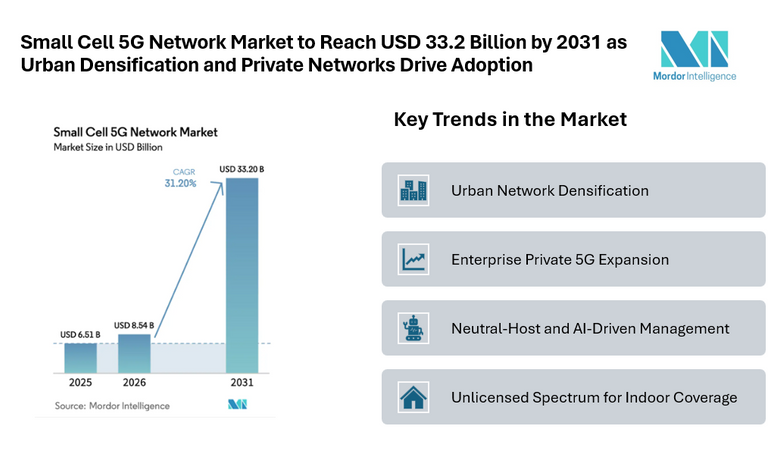
According to Mordor Intelligence, the small cell 5G network market size is expected to grow from USD 6.51 billion in 2025 to USD 8.54 billion in 2026 and is forecast to reach USD 33.2 billion by 2031, registering a CAGR of 31.2% during the forecast period. Rising data consumption, demand for low-latency connectivity, and the need to extend coverage in dense urban zones are central to this outlook. These factors are shaping the market size and creating new deployment opportunities across indoor venues, transportation hubs, campuses, and smart-city corridors.
Small cells act as compact base stations that complement traditional macro networks by improving signal strength and capacity in high-traffic areas. As digital services expand across industries, reliable high-speed connectivity is becoming a core infrastructure requirement. This shift is supporting sustained small cell 5G network market growth, particularly in regions where population density and device usage are high. The industry is also benefiting enterprise adoption, where private 5G networks are being deployed to support automation, analytics, and connected operations. Regional dynamics further influence the market forecast. Asia Pacific leads in deployment scale due to extensive infrastructure programs, while North America focuses on premium services and enterprise connectivity. Europe, supported by clearer regulatory frameworks, is preparing for broader rollout phases. These developments collectively strengthen the global market share outlook over the coming years.

Small Cell 5G Network Market Insights
Urban Network Densification
Urban densification remains a primary driver of demand, as macro towers alone cannot handle the rapidly growing number of connected devices. Small cells deliver targeted capacity in high-traffic locations such as stadiums, business districts, and transit corridors. Operators are increasingly adopting layered network architectures that combine macro coverage with micro infrastructure. This approach improves service quality while supporting continuous growth in mobile data usage.
Enterprise Private 5G Expansion
Enterprise digitalization is another key force shaping the small cell 5G network industry. Manufacturing facilities, logistics centers, and large campuses are deploying private networks to ensure secure and reliable connectivity. These networks enable automation, remote operations, and real-time analytics across mission-critical processes. As businesses prioritize efficiency and data-driven operations, private 5G adoption continues to accelerate market growth.
Neutral-Host and AI-Driven Management
Technological advancements are expanding deployment models and improving network efficiency. Neutral-host infrastructure allows multiple operators to share the same small cell network, lowering costs and simplifying site acquisition. At the same time, AI-powered management systems help optimize performance, predict faults, and balance traffic loads. Together, these innovations enhance service reliability and improve return on investment for network providers.
Unlicensed Spectrum for Indoor Coverage
Release-17 NR-U capabilities enable 5G to operate in unlicensed spectrum, opening new opportunities where licensed spectrum is scarce. This is especially beneficial for indoor environments such as offices, hospitals, and shopping malls that require strong, consistent connectivity. The flexibility to deploy without dedicated spectrum reduces barriers to adoption. As a result, the potential market for small cell 5G solutions continues to expand worldwide.
Check out more details and stay updated with the latest industry trends, including the Japanese version for localized insights: https://www.mordorintelligence.com/ja/industry-reports/small-cell-5g-network-market?utm_source=marketersmedia
Small Cell 5G Network Market Segmentation
Market Segmentation
- By Cell Type
- Femtocell
- Picocell
- Microcell
- Metrocell
- By Operating Environment
- Indoor
- Outdoor
- By Frequency Band
- Sub-6 GHz
- mmWave (More than 24 GHz)
- Sub-1 GHz
- By End-User
- Telecom Operators
- Enterprises
- Residential
By Geography
- North America
- United States
- Canada
- Mexico
- South America
- Brazil
- Argentina
- Rest of South America
- Europe
- Germany
- United Kingdom
- France
- Russia
- Rest of Europe
- Asia-Pacific
- China
- India
- Japan
- South Korea
- Rest of Asia-Pacific
- Middle East
- Saudi Arabia
- UAE
- Turkey
- Rest of Middle East
- Africa
- South Africa
- Rest of Africa
Explore Our Full Library of Technology, media and Telecom Research:
https://www.mordorintelligence.com/market-analysis/technology-media-and-telecom?utm_source=marketersmedia
Key Players in the Small Cell 5G Network Industry
- Qualcomm Technologies Inc.
- Huawei Technologies Co. Ltd
- Telefonaktiebolaget LM Ericsson
- Cisco Systems Inc.
- Nokia Corporation
Explore more insights on small cell 5G network competitive landscape: https://www.mordorintelligence.com/industry-reports/small-cell-5g-network-market/companies?utm_source=marketersmedia
Conclusion
The future of the small cell 5G network market share is closely tied to the expansion of digital services, smart infrastructure, and connected devices. As data demand continues to rise, traditional macro networks cannot deliver the required capacity and reliability. Small cells provide a practical solution by enhancing coverage exactly where it is needed, making them an essential component of modern wireless architecture.
Growth opportunities extend across telecom operators, enterprises, and public-sector projects, ensuring diversified demand for the industry. Regions with advanced infrastructure will focus on service quality and monetization, while developing markets will prioritize coverage expansion. This balance supports a stable long-term small cell 5G network market forecast. In summary, ongoing urbanization, enterprise connectivity needs, and flexible spectrum use are expected to sustain momentum in the years ahead. As deployment models mature and technology costs decline, adoption will broaden across industries and regions, strengthening both the market size and global market presence.
About Mordor Intelligence:
Mordor Intelligence is a trusted partner for businesses seeking comprehensive and actionable market intelligence. Our global reach, expert team, and tailored solutions empower organizations and individuals to make informed decisions, navigate complex markets, and achieve their strategic goals. With a team of over 550 domain experts and on-ground specialists spanning 150+ countries, Mordor Intelligence possesses a unique understanding of the global business landscape. This expertise translates into comprehensive syndicated and custom research reports covering a wide spectrum of industries, including aerospace & defense, agriculture, animal nutrition and wellness, automation, automotive, chemicals & materials, consumer goods & services, electronics, energy & power, financial services, food & beverages, healthcare, hospitality & tourism, information & communications technology, investment opportunities, and logistics.
For any inquiries or to access the full report, please contact:
https://www.mordorintelligence.com/
Contact Info:
Name: Mordor Intelligence
Email: Send Email
Organization: Mordor Intelligence
Address: 11th Floor, Rajapushpa Summit, Nanakramguda rd
Phone: 16177652493
Website: https://www.mordorintelligence.com/
Release ID: 89187634
If you detect any issues, problems, or errors in this press release content, kindly contact [email protected] to notify us (it is important to note that this email is the authorized channel for such matters, sending multiple emails to multiple addresses does not necessarily help expedite your request). We will respond and rectify the situation in the next 8 hours.