
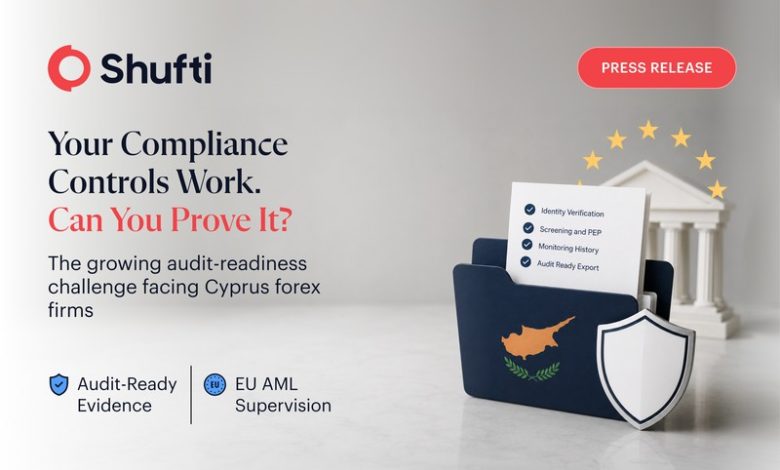
Cyprus forex compliance is shifting toward audit-ready evidence, with regulators placing greater emphasis on complete, retrievable KYC records.
— Cyprus’s forex brokers spent the past two years implementing the remote onboarding rules required by the regulator, which took effect in December 2024. In 2026, the conversation has shifted. The question is no longer whether firms have the right controls in place. It is whether they can prove those controls worked for a specific client, in one pass, on the day an examiner asks.
That change, from having controls to producing evidence, is reshaping how Cyprus Investment Firms are examined. What examiners test now is retrieval, whether a single client file can be shown complete and timestamped without a scramble.
When the Examiner’s Question Changes
CySEC’s January 2026 supervisory review underscored the regulator’s strengthened supervisory and enforcement framework. During 2025, it conducted approximately 600 supervisory inspections, imposed around €2.3 million in administrative fines and settlements, and required corrective actions in more than 170 cases, while also suspending or revoking licences where serious breaches were identified.

Behind many of those findings sits one operational weakness: record production. For high-volume, cross-border forex onboarding, the strain shows up in familiar places:
- Client files reassembled by hand when an examiner asks to see one.
- Remote onboarding rules, in force since December 2024, are now examined rather than merely deployed.
- Evidence spread across tools that were never built to export together.
- Corrective orders that pull scarce compliance staff off forward work for weeks.
- A widening gap between having control and proving it ran.
The EU layer points in the same direction. AMLA, the EU’s new anti-money laundering authority, will directly supervise up to 40 high-risk cross-border financial institutions from 2028, so most Cyprus forex firms are unlikely to fall under its direct oversight. Its influence still matters because AMLA will harmonise supervisory practices across the EU and support the consistent implementation of the Single Rulebook, including the AML Regulation that applies from July 2027. As CySEC aligns with that framework, firms can expect a growing emphasis on structured, consistent, and readily exportable compliance records rather than manually assembled documentation.
For a forex firm running high-volume onboarding across many nationalities, this is the practical test of 2026. Screening and liveness checks are the baseline of any onboarding flow, so the open question is whether one client’s complete, timestamped record can be exported in a single pass.
Building the File As Onboarding Happens
As an identity and AML layer working across 240+ countries and territories, Shufti builds a client file that stands up to a CySEC examination as onboarding happens, so the evidence exists before anyone asks for it. Firms preparing for that shift can check how to build an audit-ready KYC file with Shufti’s Cyprus Forex KYC Compliance Guide.
For a forex operator, that turns the audit response from a reconstruction project into a routine export. Each customer record holds:
- Timestamped verification with document and biometric results captured at onboarding.
- Screening logs against sanctions and PEP sources, with override rationale attached.
- Monitoring history is retrievable as a one-per-customer package.
- A single-pass export that answers an examiner without back-filling.
- Structured records are now shaped to fit where the EU’s harmonised rules are heading, avoiding a second rebuild.
The value is operational, not theoretical. Reconstructing a client’s history under a remediation order means back-filled checks and longer examinations, with staff pulled off forward work and genuine customers slowed at onboarding. Holding the file from day one removes that cost.
“Most firms that struggle in an examination already have the policies,” said Faryam Asif, Chief Technology Officer at Shufti. “What they cannot always do is produce one client’s complete history, identity, source of funds, screening, and monitoring in a single pass on the day it is asked for. That is the test now, and with EU rules harmonising toward structured, exportable data, it is only getting sharper.”
For Cyprus’s forex operators, the message is clear: strong KYC controls are no longer enough on their own; they hold up only when backed by complete, audit-ready evidence. The firms that build the file as they onboard are already treating identity verification in Cyprus as an evidence discipline, not a checkbox.
Shufti’s Cyprus Forex KYC Compliance Guide shows how to build an audit-ready file from day one, before an examiner ever asks.
About Shufti
Shufti is a global identity verification provider that helps businesses meet KYC, KYB, and AML obligations across 240+ countries and territories, 10,000+ actively processed document types, and 150+ languages. It combines document and biometric verification, transaction monitoring, AML screening, and ongoing monitoring, supporting regulated businesses as they build audit-ready onboarding.
SOURCE SHUFTI
Contact Info:
Name: Aroosa Virk
Email: Send Email
Organization: Shufti
Address: Coppergate House, 10 Whites Row, London, UK
Website: https://shufti.com/
Video URL: https://www.youtube.com/watch?v=6dnMokjbVs0
Release ID: 89198421
If you detect any issues, problems, or errors in this press release content, kindly contact [email protected] to notify us (it is important to note that this email is the authorized channel for such matters, sending multiple emails to multiple addresses does not necessarily help expedite your request). We will respond and rectify the situation in the next 8 hours.