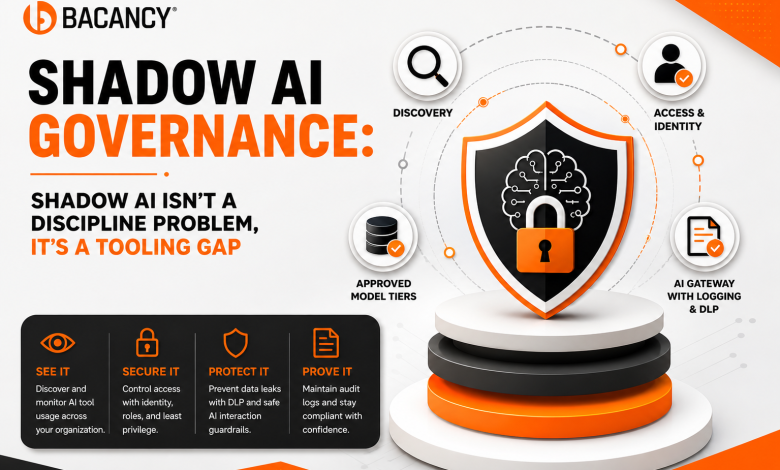
According to Microsoft’s Work Trend Index, 78% of employees who use AI at work bring their own tools to do it. That single number explains why Shadow AI Governance has become a board level concern. Most employees are not trying to break the rules. They are simply using the tools they have when the company has not provided a practical alternative. Policies and firewall blocks treat shadow AI management as a discipline problem, but the evidence points the other way. This article gives you a practical path from bans to a governed AI stack your teams actually want to use.
Why AI Tool Bans Don’t Solve Shadow AI Security Risks
The first response to shadow AI in most companies looks the same. Block ChatGPT at the firewall, publish an acceptable use policy, and declare the problem handled. If you have taken this route, you already know how it ends.
Usage does not stop. It moves. Employees switch to personal devices, personal accounts, and copy paste workflows that none of your monitoring can see. The activity becomes invisible, which is worse than visible and unmanaged. The discipline framing blames employees for a gap leadership created: no approved alternative, procurement cycles measured in quarters. When you ask how organizations can control unauthorized AI tool usage, the honest answer is that bans alone never have. Effective Shadow AI Governance begins by accepting that, and treats AI risk management as something you build, not something you announce.
The Tooling Gap: What Organizations Need to Manage Shadow AI
So what works? A set of capabilities most companies do not have yet. A PDF policy and a blocklist are not governance. They are the absence of it.
Closing the gap requires four capabilities:
- Visibility: you cannot govern what you cannot see, so discovery comes before rules
- Access control: who reaches which model, under which identity
- Data protection: what leaves your boundary inside prompts
- Accountability: logs that survive an audit
Start with discovery. Before developing any policy, do an audit of the AI technologies currently being used by your teams. People trying to identify and govern Shadow AI technologies within the workplace all have one thing in common: network telemetry, browser data, and surveying your teams. This audit is the basis for AI governance policies and everything else you will create from here.
Building an AI Governance Framework: Choosing the Right AI Tools for Your Stack
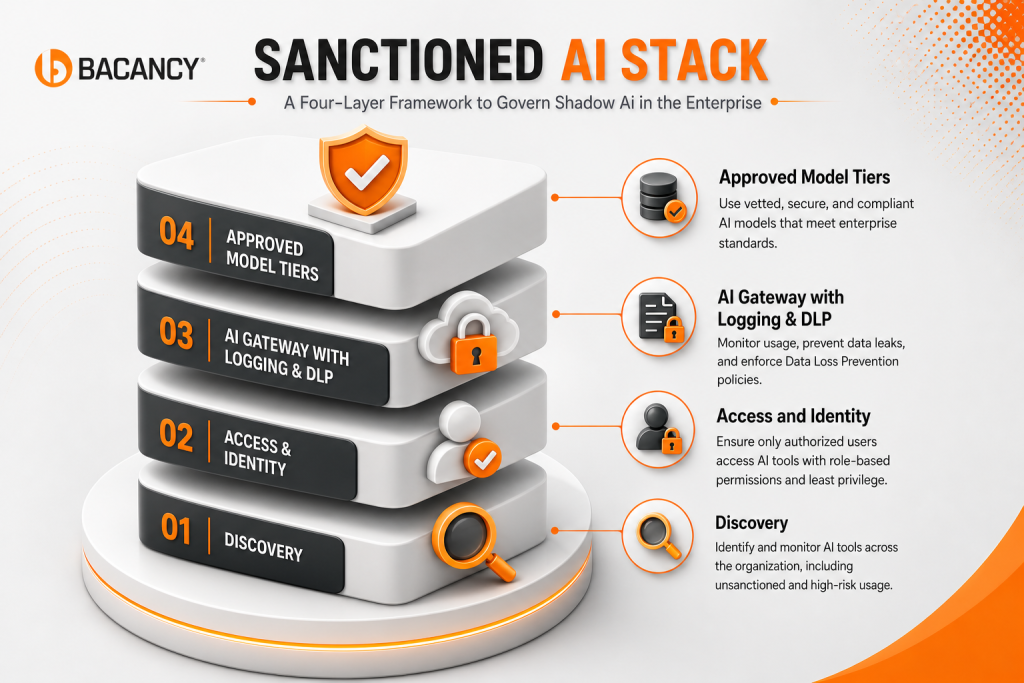
This is where you start closing the tooling gap. It is also the part many organizations overlook. If you are asking how to implement Shadow AI governance in an enterprise, this four layer stack is the implementation.
Layer 1, Discovery. Ensure continuous operation of the inventory created in the previous step. New AI technologies are being discovered each month, and you need to discover them as well, before a yearly audit is conducted.
Layer 2, Access and identity. Put single sign on in front of every approved AI endpoint and assign access by role. No anonymous consumer accounts should ever touch work data.
Layer 3, Gateway. Route prompts through a logged gateway with data loss prevention rules that catch sensitive information before it leaves your boundary. In regulated environments, this layer works best when it is designed alongside compliance focused security controls rather than bolted on after launch.
Layer 4, Approved model tiers. Give teams enterprise and API tiers with contractual data protections instead of consumer endpoints, with a fast intake lane so approving a new tool takes days, not quarters.
Build these four layers and At that point, governance is no longer just a policy document. It becomes part of the technology your employees use every day.
The Regulated Industry Test: Where the Tooling Gap Becomes Expensive
Nowhere is the tooling gap more costly than in regulated industries, and healthcare is the clearest proof. Picture a clinician pasting patient notes into a consumer chatbot. That is not a productivity shortcut. Under HIPAA, it is an unauthorized disclosure of protected health information.
Now run the same action through an approved enterprise tier covered by a Business Associate Agreement, with the prompt logged at your gateway. The organization has much more control over that interaction because the approved environment includes the required security and compliance controls. Same employee, same intent, different tooling, opposite outcome. That contrast is why Shadow AI Governance belongs in your architecture reviews, not only your policy manual. The stakes are measurable too. Healthcare data breaches cost an average of $9.77 million per incident, the highest of any industry. Finance faces the same pattern under GLBA, and EU AI Act deployer obligations extend it across Europe. Strong shadow AI security in these environments does not come from stricter rules. The most effective Shadow AI governance strategies for reducing security risks all come down to giving people a compliant path that is easier than the workaround.
A 90 Day Path and What Comes Next: Managing Shadow Agents
You do not need a year to close the gap. In your first 30 days, run discovery and build the inventory. In days 31 to 60, stand up the gateway, single sign on, and your first approved model tier. In days 61 to 90, retire the ban, publish the fast intake process, and start reviewing logs on a schedule. These Shadow AI governance best practices for organizations work because they replace prohibition with provisioning.
Next comes the way forward. Agentic AI raises the ante. While a rogue chatbot may cause data leakage, a rogue agent works on its own with valid credentials. This is why the stack that you have created must have restricted permission sets and audit trails for actions before any shadow agents emerge to make enterprise AI governance an ongoing process.
Conclusion
Shadow AI was never a discipline problem. It is what happens when capable people are handed responsibilities without tools, and it ends when the sanctioned path becomes the easiest path. Treat Shadow AI Governance as infrastructure you build rather than behavior you police, and shadow AI management becomes a natural outcome of good architecture. For experienced hands on that build, Bacancy Technology helps enterprises design governed, compliant AI environments from discovery through deployment, so your teams finally get the tools they were already looking for.