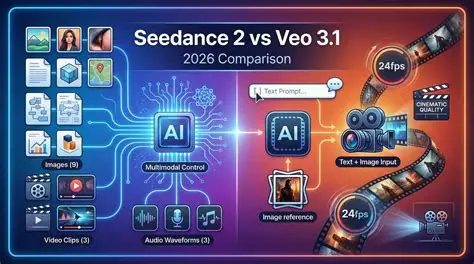
AI video generation has reached a new stage in 2026. Most leading models can produce impressive short clips. The real difference appears when you test them under production pressure.
Instead of asking which AI video model is best overall, this benchmark compares Seedance 2.0, Kling 3.0, and Veo 3.1 based on measurable creator needs.
I evaluated each model across:
- Rendering speed
- Motion stability
- Character consistency
- Prompt accuracy
- Long-form stability
- Photorealism
- Workflow efficiency
- Cost-to-output ratio
This is not a marketing comparison. It is a creator-focused AI video benchmark.
Testing Methodology
Each model was tested using the same structured prompts:
- 20-second cinematic storytelling scene
- 60-second narrative sequence
- Product advertisement simulation
- Multi-character dialogue scene
- Fast iteration short-form test
All videos were evaluated on:
- Visual coherence
- Temporal continuity
- Camera realism
- Lighting consistency
- Audio synchronization (if supported)
- Regeneration frequency
Now let’s break down the results.
1. Rendering Speed Test
Speed matters for content iteration. Viral content depends on rapid testing.
Veo 3.1
Fastest generation in standard mode.
Fast Mode allows rapid concept testing.
Ideal for creators who prioritize speed over deep cinematic complexity.
Kling 3.0
Moderate rendering speed.
Multi-shot control adds processing time.
More suitable for deliberate storyboard-style builds.
Seedance 2.0
Much slower than Veo and Kling in single-shot tests.
Maintains stability during longer sequences, reducing regeneration time.
Speed Score (10-point scale)
| Model | Speed Score |
| Veo 3.1 | 9/10 |
| Kling 3.0 | 8/10 |
| Seedance 2.0 | 7/10 |
Speed winner: Veo 3.1
2. Motion Stability & Physics Realism
Motion realism separates cinematic AI from basic animation.
Seedance 2.0
Strongest motion grounding.
Camera tracking feels deliberate.
Character movement maintains weight and spatial logic.
Kling 3.0
Very smooth transitions in multi-shot sequences.
Occasional micro drift during extended action scenes.
Veo 3.1
Strong physics realism in photorealistic scenes.
Less cinematic intentionality compared to Seedance.
Motion Score
| Model | Motion Score |
| Seedance 2.0 | 9/10 |
| Veo 3.1 | 8/10 |
| Kling 3.0 | 7/10 |
Motion winner: Seedance 2.0
3. Character Consistency Benchmark
Character drift is one of the biggest weaknesses in AI video models.
Test criteria:
- Facial stability
- Clothing consistency
- Proportion continuity
- Identity recognition across scenes
Seedance 2.0
Strongest narrative continuity.
Maintains character identity across longer sequences.
Best performance in serialized storytelling.
Kling 3.0
Good multi-image reference support.
Performs well in storyboard environments.
Veo 3.1
Stable in short sequences.
Minor drift in extended storytelling tests.
Character Stability Score
| Model | Character Stability Score |
| Seedance 2.0 | 9/10 |
| Kling 3.0 | 8/10 |
| Veo 3.1 | 7/10 |
Winner: Seedance 2.0
4. Prompt Accuracy & Control
Advanced creators rely on precise prompt execution.
Veo 3.1
Strong structured prompt adherence.
Excellent at following lighting, lens, and environment instructions.
Kling 3.0
High creative control through storyboard logic.
Better for cinematic composition than strict realism.
Seedance 2.0
Less rigid prompt literalism.
Stronger at narrative completion and logical scene flow.
Prompt Accuracy Score
| Model | Prompt Score |
| Seedance 2.0 | 9/10 |
| Veo 3.1 | 8/10 |
| Kling 3.0 | 7/10 |
Winner: Seedance 2.0
5. Long-Form Stability Test
This is where weaker AI models usually fail.
Seedance 2.0
Best performance in 60+ second narrative tests.
Maintains lighting mood and pacing.
Less visual degradation over time.
Kling 3.0
Performs well with multi-shot design.
Slight visual shifts in extended sequences.
Veo 3.1
Strong photorealism.
May require scene stitching for long storytelling formats.
Long-Form Score
| Model | Long-Form Score |
| Seedance 2.0 | 9/10 |
| Kling 3.0 | 8/10 |
| Veo 3.1 | 7/10 |
Winner: Seedance 2.0
6. Photorealistic Quality Benchmark
For marketing and product videos, realism drives trust.
Veo 3.1
Highest photorealistic output.
Natural lighting and environmental detail.
Strongest in lifestyle simulation and commercial realism.
Kling 3.0
Cinematic depth, slightly stylized tone.
Seedance 2.0
More narrative-focused aesthetic than strict realism.
Realism Score
| Model | Realism Score |
| Seedance 2.0 | 9/10 |
| Veo 3.1 | 8/10 |
| Kling 3.0 | 7/10 |
Winner: Seedance 2.0
7. Workflow Efficiency Benchmark

Raw model power is not enough. Workflow matters.
When switching between models, subscription stacking increases cost and friction.
Platforms like Loova allow creators to:
- Access Seedance 2.0
- Test Kling-style outputs
- Use photorealistic generation
- Generate image assets
- Edit within the same workspace
This reduces:
- Tool switching
- Export-import friction
- Subscription duplication
- Creative interruption
For creators running high-output pipelines, multi-model access inside one system increases production velocity.
Workflow Score (Model + Ecosystem)
| Setup | Workflow Score |
| Single isolated model | 6/10 |
| Multi-model inside Loova | 9/10 |
Workflow winner: Integrated ecosystem
Final Benchmark Results
| Category | Winner |
| Speed | Veo 3.1 |
| Motion Stability | Seedance 2.0 |
| Character Consistency | Seedance 2.0 |
| Prompt Control | Seedance 2.0 |
| Long-Form Production | Seedance 2.0 |
| Photorealism | Seedance 2.0 |
| Workflow Efficiency | Multi-model ecosystem |
Which Is the Best AI Video Model in 2026?
There is no universal winner.
The best AI video model depends on your production goal.
Choose Seedance 2.0 if:
- You build narrative storytelling content
- You need strong character stability
- You create long YouTube or branded sequences
Choose Kling 3.0 if:
- You want storyboard-style creative control
- You design cinematic multi-shot ads
Choose Veo 3.1 if:
- You prioritize photorealistic marketing visuals
- You need fast content testing
For creators running high-volume pipelines, combining models within a unified system such as Loova often delivers the highest overall efficiency.
The future of AI video is not one model replacing all others.
It is model orchestration.
And in 2026, creators who understand how to benchmark and combine models will outperform those who rely on a single engine.