
NASHVILLE, TN
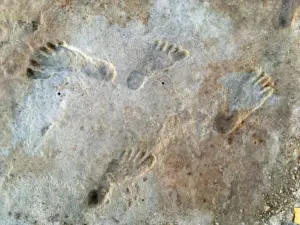
For decades scientists have assumed the people who came to occupy the New World migrated over the Bering Landbridge at the very end of the Ice Age, around 12,000 years ago. Scientists working on an archaeological site in Monte Verde Chile are finding strong support for human habitation around 14,500 years ago; in White Sands New Mexico, footprints which are dated to 21 to 23,000 years ago; and a site in Cooper’s Ferry, Idaho is throwing up dates to 15,700 years ago. These new discoveries suggest the date for the Bering crossing is much earlier, or alternatively, some have suggested people traveled south by boat along the coast.

The Urantia Book reveals a history much more complex and much more ancient than anything contemplated by modern scientists, who must work slowly, one implement or bone fragment at a time, to piece together the pre-historic past. The Urantia Book describes six major glacial advances, with the Bering Landbridge rising and falling three times during the Cenozoic era—the time of mammoths and other ice-age mega-fauna—before the arrival of human beings. (The Urantia Book describes evolution as being pre-programmed and guided.) The first human beings appeared roughly one million years ago in Asia, and these early aboriginal humans dispersed well into Europe and throughout Asia (one group even making it to the shores of England. Some of these aborigines also appear in the archaeological records as the Neanderthals.
In the normal course of evolution, roughly 500,000 years ago, six Sangik, or colored, races appeared. These races were more advanced than the aboriginal Neanderthals and eventually dispersed world-wide. These groups engaged in great ancient wars which are largely unknown to us today, preserved only in fragments of myths and legends.
One of those early struggles was between the red and yellow races. According to the Urantia Book, paper 79: “[T]he red man had reigned supreme in eastern Asia for almost one hundred thousand years before the yellow tribes arrived.
“More than three hundred thousand years ago the main body of the yellow race entered China from the south as coastwise migrants.”
Growing population pressure caused the northward-moving yellow race to begin to push into the hunting grounds of the red man. This encroachment, coupled with natural racial antagonism, culminated in increasing hostilities, and thus began the crucial struggle for the fertile lands of farther Asia.
“The story of this agelong contest between the red and yellow races is an epic of Urantia history. For over two hundred thousand years these two superior races waged bitter and unremitting warfare. In the earlier struggles the red men were generally successful, their raiding parties spreading havoc among the yellow settlements. But the yellow man was an apt pupil in the art of warfare, and he early manifested a marked ability to live peaceably with his compatriots; the Chinese were the first to learn that in union there is strength. The red tribes continued their internecine conflicts, and presently they began to suffer repeated defeats at the aggressive hands of the relentless Chinese, who continued their inexorable march northward.
“One hundred thousand years ago the decimated tribes of the red race were fighting with their backs to the retreating ice of the last glacier, and when the land passage to the West, over the Bering isthmus, became passable, these tribes were not slow in forsaking the inhospitable shores of the Asiatic continent. It is eighty-five thousand years since the last of the pure red men departed from Asia, but the long struggle left its genetic imprint upon the victorious yellow race.” (paper79, section 5).
As this short fragment suggests, the recitation of human pre-history in the Urantia revelation is far more richly detailed in explaining the modern human condition than anything scientists studying the rare remains of human habitation could possibly piece together using archaeology alone, especially when studying ancient hunter-gatherer clans which had no permanent settlements. The book insists that to understand the present, we much understand our past and also have some awareness of our future trajectory, both of which are presented in great detail. Part Three of the Urantia book is designed to fill in the gaps in our knowledge of the past.
As more and more discoveries push human habitation in the Americas further and further back into the past, The Uranita Book will still be standing pat on the date of 85,000 years ago, as it has since its publication in 1955.
“This early crossing date does two things: it explains the wide dispersion of people over both North and South America according to the dates so far determined,” said UCSP founder, Rebecca Bynum, “and second, it eliminates the need for alternate theories, such as the coastal boat hypothesis.”
“The Urantia Book contains the most comprehensive and detailed version of our pre-history in existence,” added UCSP member Tia Thompson. “It thoroughly fills in the blank spaces in our knowledge of the past between one million and ten thousand years ago. Science gives us a few bone fragments and stone tools from the ancient past but tells us nothing about their religious life or cultural development. The Urantia Book gives us all of that and more.”
The archaeological record reveals cave-dwelling hunter-gatherers existing from 300,000 years ago to roughly 30,000 years ago, when the magnificent cave paintings in Europe were first created. Then, suddenly, around 12,000 years ago, full-fledged cities appear with strong central organization, advanced pottery, metal-working, and textile manufacture, advanced agricultural techniques, advanced animal husbandry, advanced weaponry, etc., appearing at once in Mesopotamia. The legends of the Anunnaki, the Nephilim, and the reason the Sumerian Kings List shows lengthening reigns the further back in time—all of this is fleshed-out and explained in the Urantia Book.
The Urantia Corps for Spiritual Progress is dedicated to disseminating the teachings of the Urantia Book, especially among the scientific community, which would greatly benefit from them.