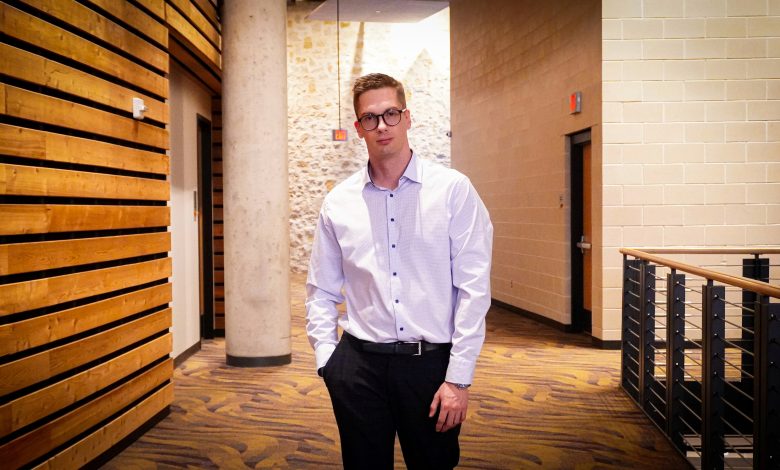
In today’s business environment, the winners are not those who launch products the fastest, but those who are able to build systems that are resilient to growth and change. Artjoms Blazko is an entrepreneur with a strong financial background who has progressed from credit analysis and work in the banking sector to managing an international company. Today, he is developing a network of automated photo studios in the United States and Europe, combining a product-driven approach, analytics, and strategic management, while also participating in the international expert community as a judge of professional awards.
Artjoms, you work at the intersection of finance, technology, and entrepreneurship. Which of these elements determines business success today?
— Today, it’s impossible to single out just one. Success emerges at the intersection of these areas. Finance provides stability, technology enables scalability, and entrepreneurship ensures speed in decision-making.
If you remove any of these elements, the system starts to fail. Without finance, there is no control; without technology, there is no growth; without entrepreneurial thinking, there is no movement. That’s why my goal is not to balance them, but to integrate them into a single model.
You talk about systems. What distinguishes a business system from just a successful project?
— A successful project can be temporary. A system is something that can be replicated. If a business depends on specific individuals or manual control, it’s not a system—it’s an operational burden. A system begins where processes are standardized, data is collected automatically, and decisions are made based on analytics. That’s why I have always aimed for automation—even back in my financial analytics days.
Your company is actively scaling. Is there a limit to growth for such models?
— There is always a limit, but it is rarely related to the market. More often, it’s about management quality. If you don’t have transparent analytics, you don’t understand where you’re making money and where you’re losing it. If there is no standardization, every new market becomes an experiment. We are building a model where each new location is not a risk, but a repeatable scenario. This fundamentally changes the approach to scaling.
You worked in credit analysis and risk assessment. How does this experience influence your decisions today?
— Almost entirely. I still evaluate every project through the lens of risk. The only difference is that раньше I assessed other people’s businesses, and now I manage my own. This allows me not just to identify risks, but to manage them. For example, when entering new markets, we заранее define scenarios: base, optimistic, and stress scenarios. This allows us not to react to problems, but to be prepared for them.
You also serve as a judge at international awards, including the Glonary Awards. What does this experience give you?
— It’s extremely valuable because you see businesses from the inside—at the level of their logic, strategy, and decisions. At the Glonary Awards, projects are evaluated based on innovation, strategic depth, and real market impact. When you analyze dozens of cases, you start to clearly see which decisions work and which don’t. It significantly broadens your thinking and helps avoid typical mistakes in your own projects. In essence, it’s an opportunity to learn from others’ experience—but at an expert level.
How do you evaluate the quality of a business idea at an early stage? Are there universal criteria?
— Yes, there are three key parameters: First — scalability. Can the idea be replicated without proportional cost growth?
Second — manageability. Can the process be controlled through data?
Third — sustainability. Can the model withstand stress scenarios?
If even one of these parameters is weak, the business becomes vulnerable.
Many entrepreneurs today strive for automation. Where is the line where automation starts to do harm?
— Where it replaces meaning. Automation should enhance a business, not complicate it. If you implement technology for the sake of technology, it’s a mistake. The right question is always: “Does this reduce costs or increase value for the customer?” If not, then automation is unnecessary.
You often talk about data as a key resource. How is the role of analytics changing in modern business?
— Analytics is no longer just a reporting tool. It has become a management tool. Previously, data was collected to understand what had already happened. Now it is used to make decisions in real time. Companies that cannot work with data will lose to those that build their business on analytics.
What is the most unexpected insight you’ve gained in recent years in business?
— That emotions are also part of the model. Initially, we built the product as an automated service. But over time, we realized that people come not only for the result, but also for the experience. And if you can embed emotion into the system, it leads to a significant increase in engagement. This became one of my key insights.
How do you make strategic decisions under high uncertainty?
— I divide decisions into reversible and irreversible ones. Reversible decisions can be made quickly, tested, and adjusted. Irreversible ones require deep analysis. This allows you to maintain speed without sacrificing quality. In conditions of uncertainty, this is critically important.
And finally, how do you see business in 5–10 years?
— Business will become even more system-driven and technological. The winners will be those who know how to build not just companies, but ecosystems—where the product is not a standalone service, but part of a larger user journey. And the key asset will no longer be capital, but the ability to manage data and turn it into decisions.