This article documents original procurement platform innovations led by Abhinav Kasliwal at Amazon Business, including the industry’s first large-scale implementation of approval-less, budget-enforced enterprise ordering and a globally scalable post-purchase receiving platform. These systems redefined how governance, speed, and financial control coexist in enterprise procurement, influencing integrations across more than seventy procurement platforms and enabling several billion dollars in operating spend growth.
For decades, enterprise procurement has been constrained by approval-heavy workflows that slow purchasing by an average of 3–5 business days while adding little real governance. Budget-based, approval-less ordering for Punchout users fundamentally changes this model by enforcing control directly at the point of purchase rather than after the fact.
Transactions proceed automatically as long as they remain within predefined budget limits, eliminating delays while preserving financial discipline. Budgets are validated in real time during checkout with sub-second latency, even under extreme loads exceeding thousands transactions per second. Sophisticated rule engines dynamically evaluate complex organizational hierarchies, linking policies to cost centers, departments, locations, and GL codes. This architecture supports deeply nested structures with clear inheritance of budgets and permissions and resolves policy conflicts deterministically rather than through fragile heuristics.
For buyers, this removes friction and uncertainty by preventing unexpected rejections or waiting periods. For finance teams, it replaces reactive oversight with preventative control, turning budgets into executable constraints that prevent overspending upfront rather than reporting artifacts reviewed after the money is already spent. The result is an effective balance between speed and governance, enabling fast, autonomous purchasing while rigorously enforcing financial policy.
Building a Budget-Control System Strong Enough for Amazon Business’ marketplace
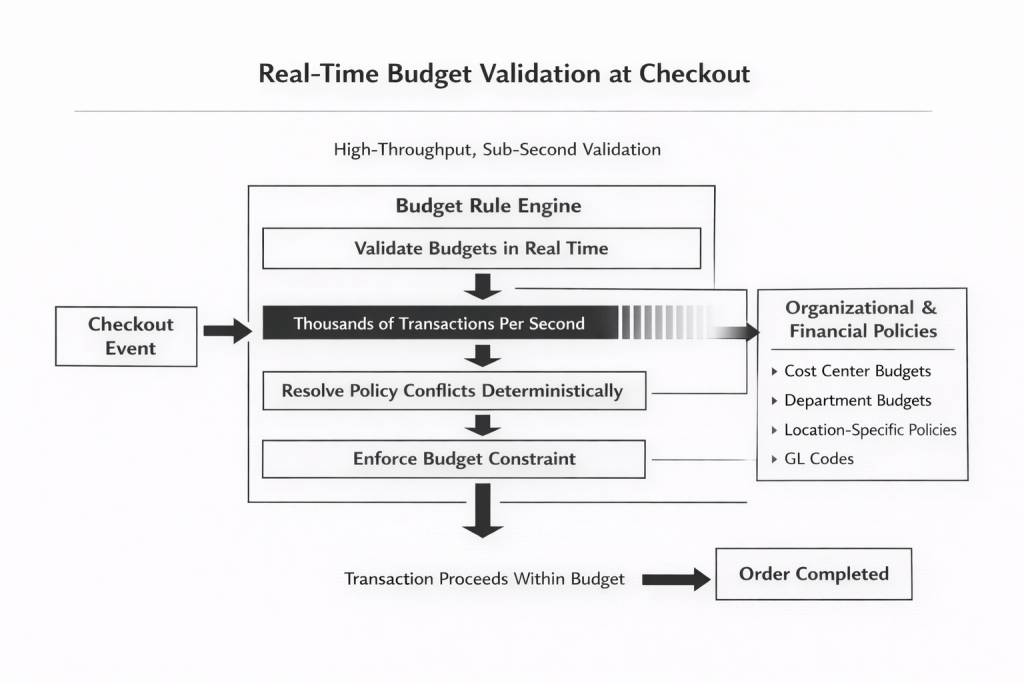
Designing a budget-control system capable of governing Amazon’s own marketplace meant treating budget enforcement as tier-one infrastructure, not a peripheral feature. From the outset, to be able to achieve that, several requirements must be met:
- Reliable operation at checkout, even under extreme transaction load;
- Seamless integration with payments, accounting, reporting, and notifications;
- Full backward compatibility with existing procurement workflows;
- Uncompromising guarantees of performance, availability, and correctness.
At the core of the system sat a sophisticated rule engine built to reflect real enterprise complexity. This required the ability to:
- Model deeply nested organizational hierarchies;
- Support clean inheritance of budgets and permissions across groups;
- Resolve policy conflicts deterministically, rather than through fragile heuristics;
- Enable cross-group budget sharing that mirrors how large organizations actually manage spend.
Governance logic was deliberately paired with user-experience design rather than treated as a backend concern. This required a sophisticated approach to user interface design that balanced power with simplicity. Administrators received intuitive yet powerful configuration tools that exposed granular control without exposing system complexity, including:
- Visual policy builders for creating complex approval rules without coding;
- Bulk action capabilities for efficient management of large organizations;
- Real-time validation providing immediate feedback on policy conflicts;
- Comprehensive reporting dashboards for budget utilization and compliance.
For end users, the experience was streamlined to provide clear budget visibility during checkout, with instant feedback when purchases would exceed limits. This user-centric approach resulted in high adoption rates and business impacts. At the same time, buyers required immediate, real-time feedback when a purchase violated budget or policy constraints. Finally, the system had to scale globally without fragmenting its architecture. This meant supporting regional and market-specific requirements while preserving a single, coherent core platform despite geographic variation. The system’s success ultimately depended on treating governance, usability, and scale not as separate layers, but as interdependent design constraints engineered together from the beginning.
Redesigning Punchout and Hosted Catalog APIs
For Amazon to function as a native extension of enterprise procurement platforms, Punchout and Hosted Catalog APIs were redesigned around workflow continuity, not just basic connectivity. This required a fundamental rethinking of the API layer as shared procurement infrastructure rather than a collection of transactional endpoints. The redesign centered on a flexible API framework capable of supporting diverse enterprise standards, including cXML, OCI, REST, and legacy protocols across 70+ enterprise procurement platforms.
Three architectural choices proved decisive in enabling this transformation:
- A unified data model that preserved consistency across platforms while allowing platform-specific metadata extensions;
- Abstraction layers that insulated partners from Amazon-specific complexity while maintaining performance;
- Backward compatibility and clear deprecation policies that enabled evolution without disrupting live integrations.
To reduce integration friction, we developed self-service onboarding tools that shortened partner integrations from months to weeks. These were supported by comprehensive documentation, SDKs, testing frameworks, and sandbox environments for independent validation. The result was a true multi-tenant platform that scaled across dozens of procurement partners through configuration rather than customization, with embedded monitoring and horizontal scalability
Scaling One API Suite Across Multiple Procurement Platforms
Supporting more than seventy enterprise procurement platforms through a single API suite required designing for scale rather than customization. The guiding principle was to treat the API as shared infrastructure, not as a set of partner-specific integrations. From the outset, this meant committing to a unified data model, a true multi-tenant architecture, strict abstraction boundaries, and protocol-agnostic design. At the foundation sat a unified data model with a flexible schema. A consistent core representation ensured predictability across integrations, while extensible fields allowed partner-specific metadata without fragmenting the platform. Transformation and validation layers enabled reliable bidirectional data exchange across heterogeneous procurement systems.
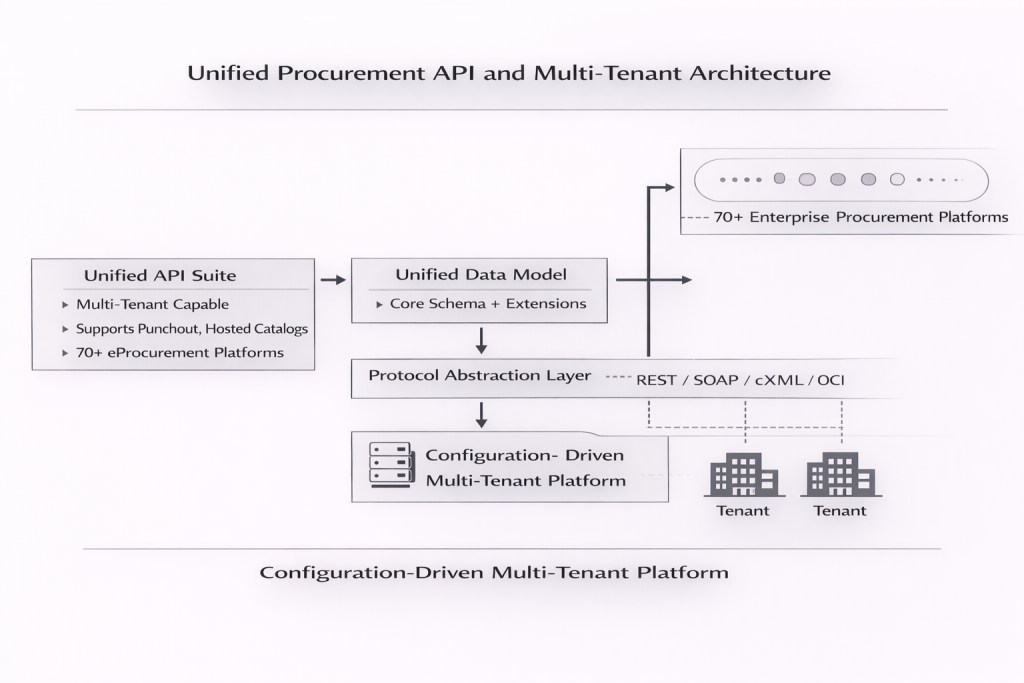
The platform operated as a multi-tenant system in which partner-specific behavior was driven by configuration rather than code, enabling efficient resource allocation, tenant isolation, and horizontal scaling. Abstraction layers – supported by clean API contracts and adapter patterns – shielded core business logic from integration complexity. Support for REST, SOAP, cXML, and OCI through shared backend services ensured reach, while disciplined versioning, feature flags, and clear deprecation policies allowed the platform to evolve without disrupting live integrations.
Turning Receiving into a Platform: The Innovations Behind Amazon Business’s multiple billion dollars Post-Purchase Growth
The post-purchase and receiving tools became the fastest-growing product in Amazon Business history by fixing a long-neglected problem: what happens after checkout. Industry-first barcode-based receiving replaced paper-heavy workflows by allowing warehouse staff to scan and verify shipments using standard mobile devices, reducing errors and cutting receiving time by more than 70 percent. This was paired with delegated receiving workflows for large organizations, combining role-based permissions, flexible assignment, and automated notifications to distribute responsibility without losing control. Integrated three-way reconciliation automated matching between purchase orders, receipts, and invoices, surfacing only true exceptions. Embedded collaboration tools and audit logs supported compliance, while progressive-disclosure UX made the system usable across warehouse and finance teams. Built for global scale, the platform expanded across six markets, growing twenty times from nearly 3K businesses and generating over several billion dollars in operating spend. Together, these innovations show that enterprise procurement no longer has to choose between speed and control – when governance is engineered into the platform itself, both become possible at global scale; these architectures were adopted across dozens of external procurement platforms, influencing how enterprise buying systems integrate governance and automation.